Loading...
Done
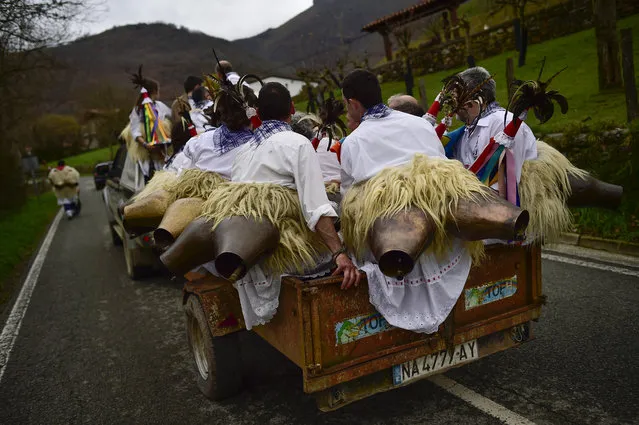
Joaldunaks return in a trailer to their town at the end of Carnival between of the Pyrenees villages of Ituren and Zubieta, northern Spain, Monday, February 1, 2016. In one of the most ancient carnivals in Europe, dating from before the Roman empire, companies of Joaldunak (cowbells) made up of residents of two towns, Ituren and Zubieta, parade the streets costumed in sandals, lace petticoats, sheepskins around the waist and shoulders, coloured neckerchiefs, conical caps with ribbons and a hyssop of horsehair in their right hands and cowbells hung across their lower back. (Photo by Alvaro Barrientos/AP Photo)

Joaldunaks return in a trailer to their town at the end of Carnival between of the Pyrenees villages of Ituren and Zubieta, northern Spain, Monday, February 1, 2016. In one of the most ancient carnivals in Europe, dating from before the Roman empire, companies of Joaldunak (cowbells) made up of residents of two towns, Ituren and Zubieta, parade the streets costumed in sandals, lace petticoats, sheepskins around the waist and shoulders, coloured neckerchiefs, conical caps with ribbons and a hyssop of horsehair in their right hands and cowbells hung across their lower back. (Photo by Alvaro Barrientos/AP Photo)
Details
02 Feb 2016 13:07:00
An Indian Hindu widow smeared with colors sits and watches others playing during Holi celebrations at the Gopinath temple, 180 kilometres (112 miles) south-east of New Delhi, India Monday, March 21, 2016. (Photo by Manish Swarup/AP Photo)

An Indian Hindu widow smeared with colors sits and watches others playing during Holi celebrations at the Gopinath temple, 180 kilometres (112 miles) south-east of New Delhi, India Monday, March 21, 2016. A few years ago this joyful celebration was forbidden for Hindu widows. Like hundreds of thousands of observant Hindu women they would have been expected to live out their days in quiet worship, dressed only in white, their very presence being considered inauspicious for all religious festivities. (Photo by Manish Swarup/AP Photo)
Details
22 Mar 2016 11:24:00
Members of the Pussyfooters dance at the Krewe of Cleopatra Mardi Gras parade in New Orleans, Friday, February 2, 2018. Mardi Gras season is kicking into high gear with a slew of major parades throughout New Orleans. Although Carnival season officially began Jan. 6, the festivities really kick into high gear the two weekends ahead of Fat Tuesday. This year Fat Tuesday is Feb. 13. (Photo by Gerald Herbert/AP Photo)

Members of the Pussyfooters dance at the Krewe of Cleopatra Mardi Gras parade in New Orleans, Friday, February 2, 2018. Mardi Gras season is kicking into high gear with a slew of major parades throughout New Orleans. Although Carnival season officially began Jan. 6, the festivities really kick into high gear the two weekends ahead of Fat Tuesday. This year Fat Tuesday is Feb. 13. (Photo by Gerald Herbert/AP Photo)
Details
17 Feb 2018 00:01:00
This November 11, 2014 aerial photo, shows a deforested area dotted with blue tarps, marking the area where miners reside, and craters filled with water, caused by illegal gold mining activities, in La Pampa, in Peru's Madre de Dios region. (Photo by Rodrigo Abd/AP Photo)

This November 11, 2014 aerial photo, shows a deforested area dotted with blue tarps, marking the area where miners reside, and craters filled with water, caused by illegal gold mining activities, in La Pampa, in Peru's Madre de Dios region. Less than a month before Peru plays host to global climate talks, the government sent a battalion of police into southeastern jungles to dismantle illegal gold-mining mining camps. Peru's anti-illegal mining czar, retired army Gen. Augusto Soto, marched the men to the wasteland known as La Pampa, where 50,000 hectares of rainforest have been obliterated in the past six years. (Photo by Rodrigo Abd/AP Photo)
Details
21 Nov 2014 12:35:00
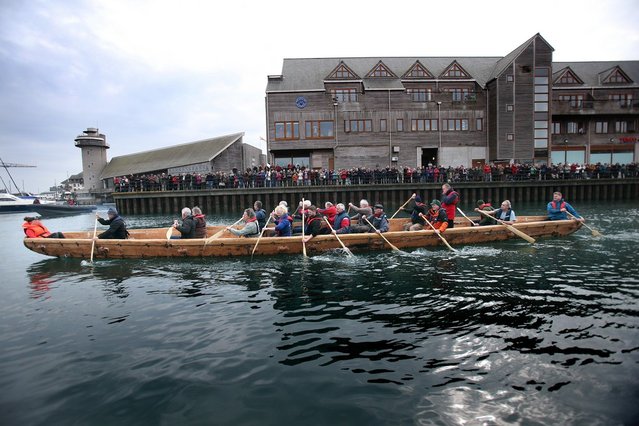
Crew in Britain's first ever full-size reconstructed sea-going Bronze Age boat, paddle out to sea near to the National Maritime Museum as it makes its maiden voyage on March 6, 2013 in Falmouth, England. With a crew of of 18, equipped with Bronze-Age-style wooden paddles, the 15 metre long experimental vessel – a replica of the sort of craft used for long-distance trade between Britain and the continent 4000 years ago – will be used to test prehistoric seafaring methods in a project in collaboration with the University of Exeter and the Falmouth-based National Maritime Museum Cornwall. (Photo by Matt Cardy)

Crew in Britain's first ever full-size reconstructed sea-going Bronze Age boat, paddle out to sea near to the National Maritime Museum as it makes its maiden voyage on March 6, 2013 in Falmouth, England. (Photo by Matt Cardy)
Details
07 Mar 2013 08:48:00
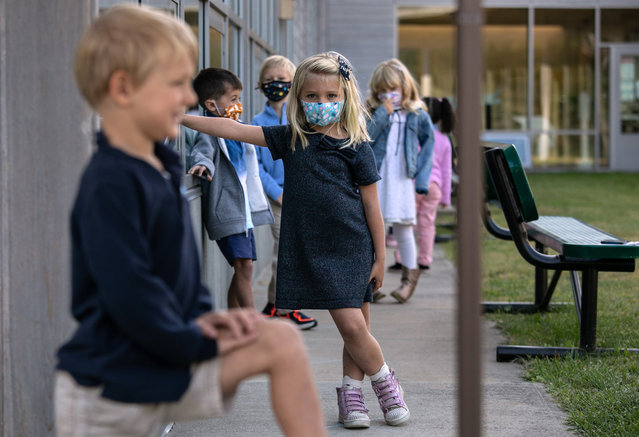
Kindergartner Cameron McManus, 5, watches as a fellow student has his portrait made during “picture day” at Rogers International School on September 23, 2020 in Stamford, Connecticut. Students lined up outside to be photographed while socially distanced due to COVID-19 precautions. Most students at Stamford Public Schools are taking part in a hybrid education model, attending in-school classes every other day and distance learning the rest. (Photo by John Moore/Getty Images)

Kindergartner Cameron McManus, 5, watches as a fellow student has his portrait made during “picture day” at Rogers International School on September 23, 2020 in Stamford, Connecticut. Students lined up outside to be photographed while socially distanced due to COVID-19 precautions. Most students at Stamford Public Schools are taking part in a hybrid education model, attending in-school classes every other day and distance learning the rest. (Photo by John Moore/Getty Images)
Details
03 Oct 2020 00:03:00
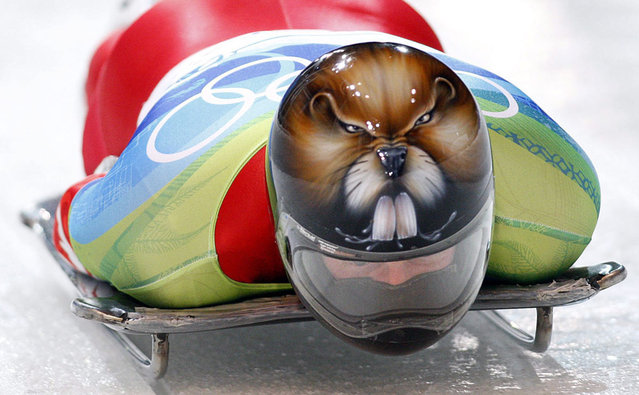
Awesome Helmet  On Sochi Olympics 2014

Skeleton involves a person riding a small sled down a frozen track while lying face down. The sport is a more intense form of luge because skeleton competitors leap onto the sled and slide downhill head first. Skeleton athletes can reach up to 80 mph on straightaways, causing forces up to 5g, so the helmet is a critical component for attitude as well as safety.
Details
12 Feb 2014 13:46:00
Steampunk World By Vadim Voitekhovitch

Vadim Voitekhovitch was born in a small town of Mozyr, Belarus. He spent most of his life Belarus and he graduated from Bobruisk Art College. From 2004 he lives and works in Germany. His style is quite diverse, but he dedicates most of his time to watercolor and oil. Voitekhovitch likes to draw pictures on history subjects and especially subjects coming from XVIII-XIX centuries.
Details
15 Jul 2013 11:45:00