Loading...
Done
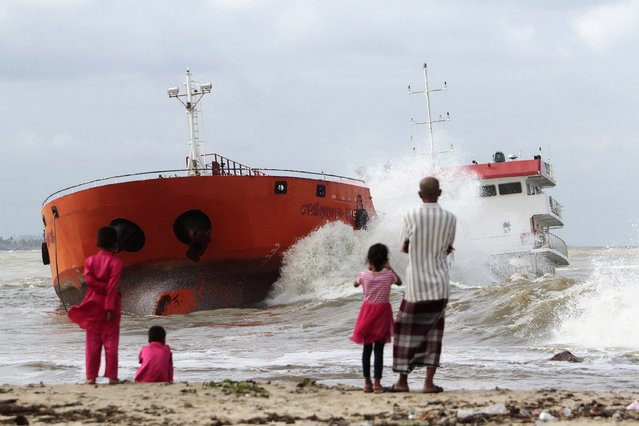
Locals watch from the beach as waves hit an Indonesian tanker that ran aground near Narathiwat in southern Thailand December 19, 2014. The tanker loaded with palm oil, previously hijacked by its crew members and then seized by Thai authorities, was anchored some 400 meters from the beach but strong wind and waves broke it free, according to local media. (Photo by Surapan Boonthanom/Reuters)

Locals watch from the beach as waves hit an Indonesian tanker that ran aground near Narathiwat in southern Thailand December 19, 2014. The tanker loaded with palm oil, previously hijacked by its crew members and then seized by Thai authorities, was anchored some 400 meters from the beach but strong wind and waves broke it free, according to local media. (Photo by Surapan Boonthanom/Reuters)
Details
20 Dec 2014 11:58:00
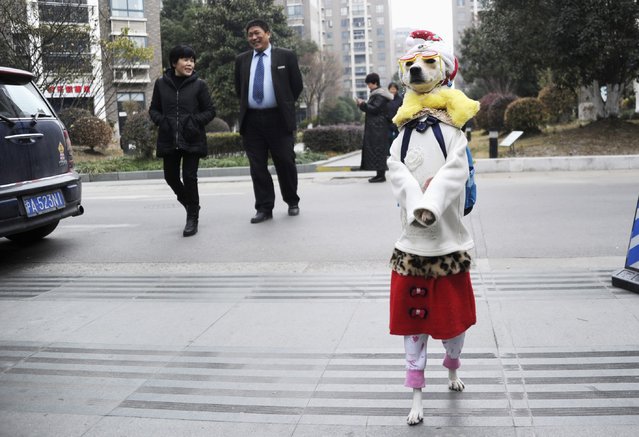
Dog Xiaoniu dressed in clothes walks across a street with its owner (not pictured) in Shanghai, December 19, 2014. According to local media, Xiaoniu accompanies its owner to the food market everyday and is able to walk with its hind legs for up to about an hour. (Photo by Reuters/Stringer)

Dog Xiaoniu dressed in clothes walks across a street with its owner (not pictured) in Shanghai, December 19, 2014. According to local media, Xiaoniu accompanies its owner to the food market everyday and is able to walk with its hind legs for up to about an hour. (Photo by Reuters/Stringer)
Details
27 Dec 2014 12:03:00
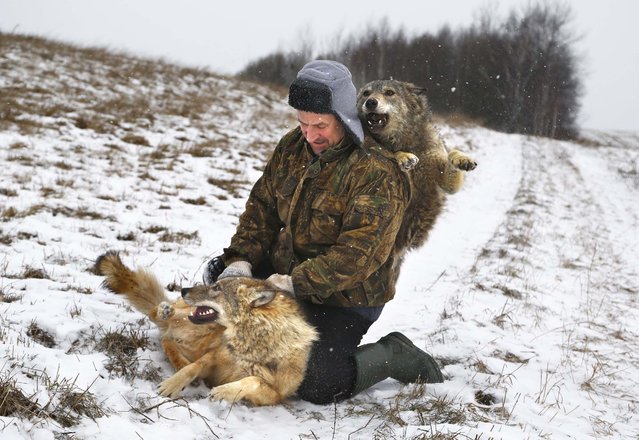
Belarusian Sergei Selekh plays with his 6-month-old tamed wolves on the outskirts of the village of Gaina, 45 kilometers (28 miles) north of Belarus capital Minsk, Wednesday, December 31, 2014. Selekh owns a farmstead, where sheep, wolves and an ethnographic museum serve as entertainment for guests. (Photo by Sergei Grits/AP Photo)

Belarusian Sergei Selekh plays with his 6-month-old tamed wolves on the outskirts of the village of Gaina, 45 kilometers (28 miles) north of Belarus capital Minsk, Wednesday, December 31, 2014. Selekh owns a farmstead, where sheep, wolves and an ethnographic museum serve as entertainment for guests. (Photo by Sergei Grits/AP Photo)
Details
03 Jan 2015 12:51:00
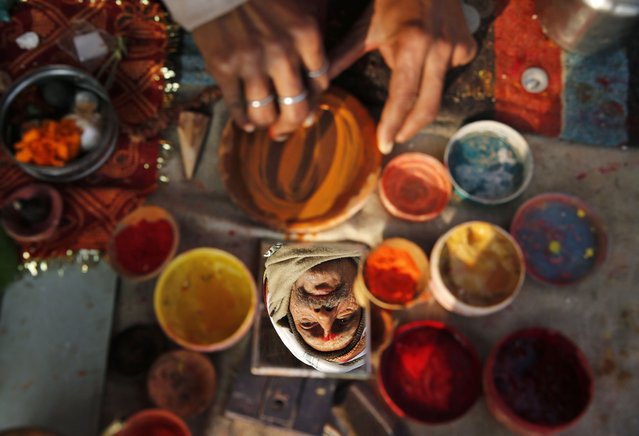
A Hindu holy man is reflected on a mirror as he prepares a bowl of vermillion powder for devotees near “Sangam”, the confluence of holy rivers of Ganges, Yamuna and the mythical Saraswati, during the annual traditional fair of Magh Mela in Allahabad, in the northern Indian state of Uttar Pradesh, India, Tuesday, January 6, 2015. (Photo by Rajesh Kumar Singh/AP Photo)

A Hindu holy man is reflected on a mirror as he prepares a bowl of vermillion powder for devotees near “Sangam”, the confluence of holy rivers of Ganges, Yamuna and the mythical Saraswati, during the annual traditional fair of Magh Mela in Allahabad, in the northern Indian state of Uttar Pradesh, India, Tuesday, January 6, 2015. Hundreds of thousands of devout Hindus are expected to take holy dips at the confluence during the astronomically auspicious period of over 45 days celebrated as Magh Mela. (Photo by Rajesh Kumar Singh/AP Photo)
Details
07 Jan 2015 13:41:00
Bikers push their motorbikes during a traffic block as they take part in the “Enduropale” motorcycle endurance race on the beach of Le Touquet, northern France, February 1, 2015. (Photo by Pascal Rossignol/Reuters)

Bikers push their motorbikes during a traffic block as they take part in the “Enduropale” motorcycle endurance race on the beach of Le Touquet, northern France, February 1, 2015. About 1100 motorbike and 600 quad bike riders descend on Le Touquet every year for the racing endurance event. (Photo by Pascal Rossignol/Reuters)
Details
07 Feb 2015 13:54:00
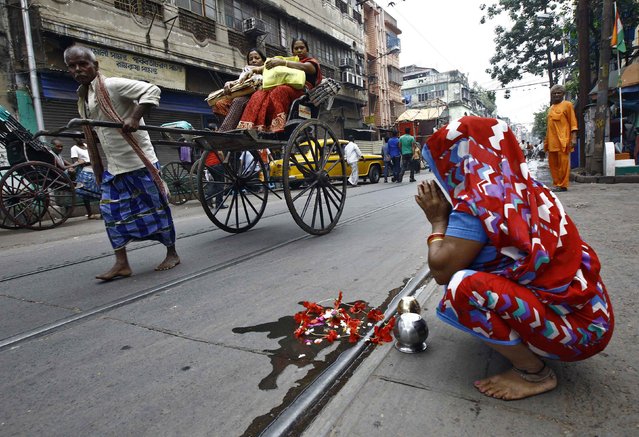
A woman offers prayers by a road as a rickshaw puller transports passengers in Kolkata October 28, 2014. (Photo by Rupak De Chowdhuri/Reuters)

A woman offers prayers by a road as a rickshaw puller transports passengers in Kolkata October 28, 2014. (Photo by Rupak De Chowdhuri/Reuters)
Details
01 Nov 2014 14:25:00
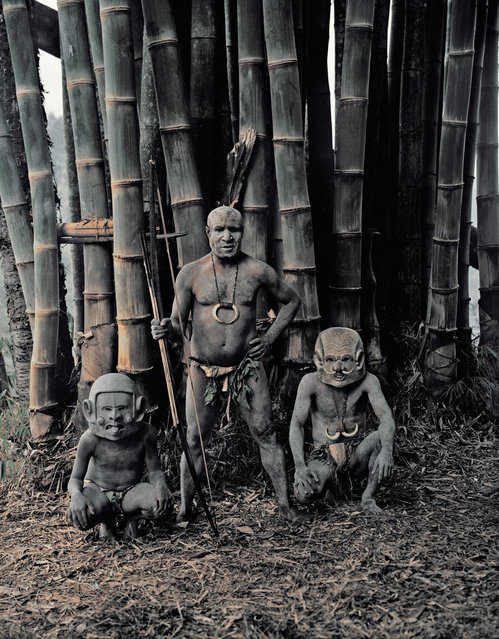
“Asaro from the Eastern Highlands”. The mudmen could not cover their faces with mud because the people of Papua New Guinea thought that the mud from the Asaro river was poisonous. So instead of covering their faces with this alleged poison, they made masks from pebbles that they heated and water from the waterfall, with unusual designs such as long or very short ears either going down to the chin or sticking up at the top, long joined eyebrows attached to the top of the ears, horns and sideways mouths. (Jimmy Nelson)

“Asaro from the Eastern Highlands”. The mudmen could not cover their faces with mud because the people of Papua New Guinea thought that the mud from the Asaro river was poisonous. So instead of covering their faces with this alleged poison, they made masks from pebbles that they heated and water from the waterfall, with unusual designs such as long or very short ears either going down to the chin or sticking up at the top, long joined eyebrows attached to the top of the ears, horns and sideways mouths. (Photo and caption by Jimmy Nelson)
Details
20 Oct 2013 08:54:00
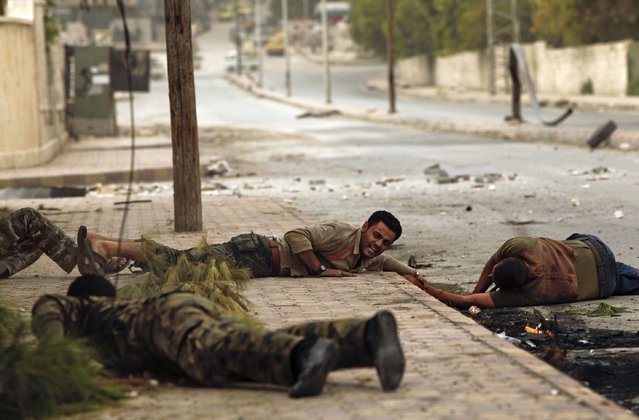
Members of the Al-Baraa bin Malek batallion, part of the Free Syria Army's Al-Fatah brigade, duck to the ground as they pull a man (R) who was shot by a sniper twice in the Bustan al-Basha district of the northern city of Aleppo on October 20, 2012. (Photo by Javier Manzano/AFP Photo)

Members of the Al-Baraa bin Malek batallion, part of the Free Syria Army's Al-Fatah brigade, duck to the ground as they pull a man (R) who was shot by a sniper twice in the Bustan al-Basha district of the northern city of Aleppo on October 20, 2012. (Photo by Javier Manzano/AFP Photo)
Details
23 Jan 2014 11:55:00