Loading...
Done
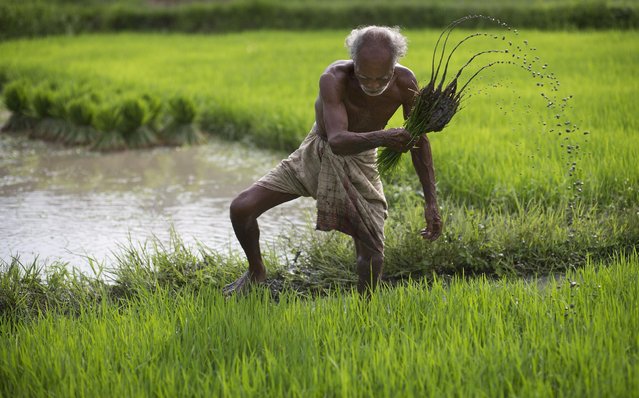
A farmer works in a paddy field at Reba Maheswar village, 56 kilometers (35 miles) east of Gauhati, India, Friday, July 3, 2015. (Photo by Anupam Nath/AP Photo)

A farmer works in a paddy field at Reba Maheswar village, 56 kilometers (35 miles) east of Gauhati, India, Friday, July 3, 2015. Rice is one of the most important food crops of India and about 4,000 different varieties are grown in different parts of the country. (Photo by Anupam Nath/AP Photo)
Details
04 Jul 2015 11:24:00
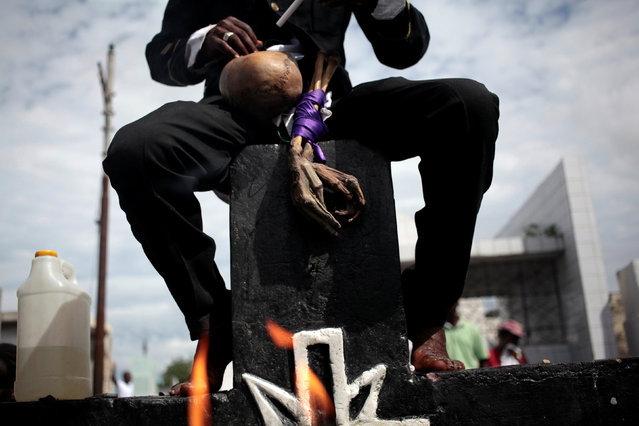
A voodoo believer, dressed as "Gede", a spirit of voodoo, sits on the cross of Baron Samdi during celebrations at the cemetery of Port-au-Prince, Haiti, November 1, 2016. (Photo by Andres Martinez Casares/Reuters)

A voodoo believer, dressed as "Gede", a spirit of voodoo, sits on the cross of Baron Samdi during celebrations at the cemetery of Port-au-Prince, Haiti, November 1, 2016. Voodoo believers and devotees offer candles, alcohol and food. The Day of the Dead is celebrated on the first two days of November during All Saints and All Souls Day. (Photo by Andres Martinez Casares/Reuters)
Details
02 Nov 2016 12:23:00
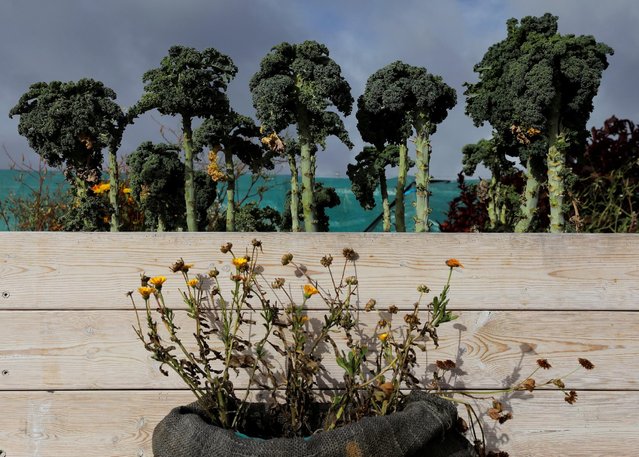
Kale grows at Kajodlingen farm in Gothenburg, Sweden, September 28, 2016. (Photo by Maxim Shemetov/Reuters)

Kale grows at Kajodlingen farm in Gothenburg, Sweden, September 28, 2016. They are doing it on the rooftops, on tower block balconies and even on a disused railway: Swedes have discovered a passion for urban gardening as a way of growing fresh food and getting back in touch with nature. Part of a global movement, an increasing number of Swedish city-dwellers are growing their own in window boxes and allotments or are visiting public gardens built in or on industrial or office spaces. (Photo by Maxim Shemetov/Reuters)
Details
11 Nov 2016 07:58:00
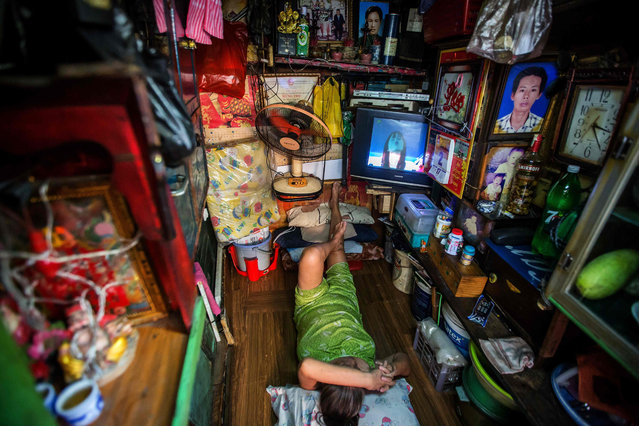
Kha Tu Ngoc rests in her two- square- meter house in Ho Chi Minh City on May 2, 2018. (Photo by Thanh Nguyen/AFP Photo)

Kha Tu Ngoc rests in her two- square- meter house in Ho Chi Minh City on May 2, 2018. The “micro- house” dwellings are dotted throughout Vietnam' s bustling southern hub, occupied by families clinging to postage stamp- sized plots a city developing at breakneck pace. Tucked away in winding alleys, nestled under new condo developments or sandwiched between street food stalls and shops, the tiny houses are easily missed by the unattentive passerby. (Photo by Thanh Nguyen/AFP Photo)
Details
04 Jun 2018 00:01:00
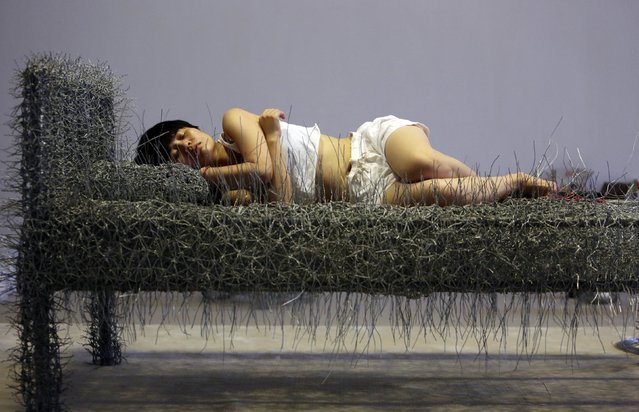
Chinese artist Zhou Jie takes a nap on an unfinished iron wire bed, one of her sculpture works, after lunch at Beijing Now Art Gallery, in Beijing August 11, 2014. Zhou started her art project titled “36 Days” on August 9, in which she would live inside an exhibition hall with an unfinished iron wire bed, some iron wire sculptures in the shape of stuffed animal dolls, a certain amount of food and her mobile phone, for 36 days. (Photo by Jason Lee/Reuters)

Chinese artist Zhou Jie takes a nap on an unfinished iron wire bed, one of her sculpture works, after lunch at Beijing Now Art Gallery, in Beijing August 11, 2014. Zhou started her art project titled “36 Days” on August 9, in which she would live inside an exhibition hall with an unfinished iron wire bed, some iron wire sculptures in the shape of stuffed animal dolls, a certain amount of food and her mobile phone, for 36 days. The entire process is open to visitors and she may also interact with them, according to Zhou. (Photo by Jason Lee/Reuters)
Details
22 Aug 2014 12:04:00
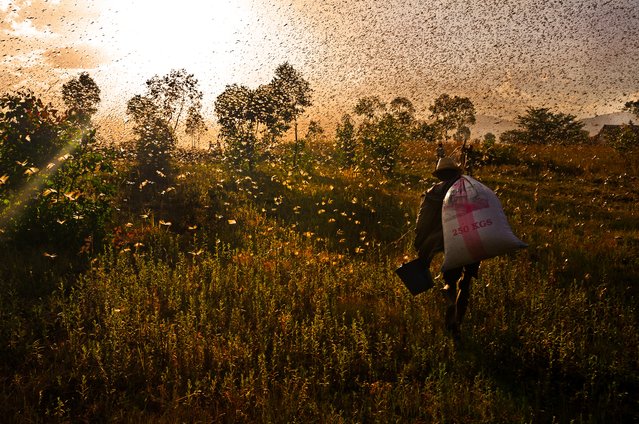
“Locusts & Men”. Oppression, interaction, collaboration. In the life cycle of nature nothing is lost, but the coexistence of different species is sometimes difficult. In Madagascar periodically returns the archaic antagonism between man and the migratory locust, in a circle of life where the two species are looking for space and food for their survival. Photo location: Madagascar, 2013. (Photo and caption by Michele Martinelli/National Geographic Photo Contest)

“Locusts & Men”. Oppression, interaction, collaboration. In the life cycle of nature nothing is lost, but the coexistence of different species is sometimes difficult. In Madagascar periodically returns the archaic antagonism between man and the migratory locust, in a circle of life where the two species are looking for space and food for their survival. At the end of the day a man walks home carrying on his shoulders the heavy bag which contains the locusts captured during the day. The insects provide nutritious meals for the man and his family. Photo location: Madagascar, 2013. (Photo and caption by Michele Martinelli/National Geographic Photo Contest)

ATTENTION! All pictures are presented in high resolution. To see Hi-Res images – just TWICE click on any picture. In other words, click small picture – opens the BIG picture. Click BIG picture – opens VERY BIG picture.
Details
03 Dec 2013 10:59:00
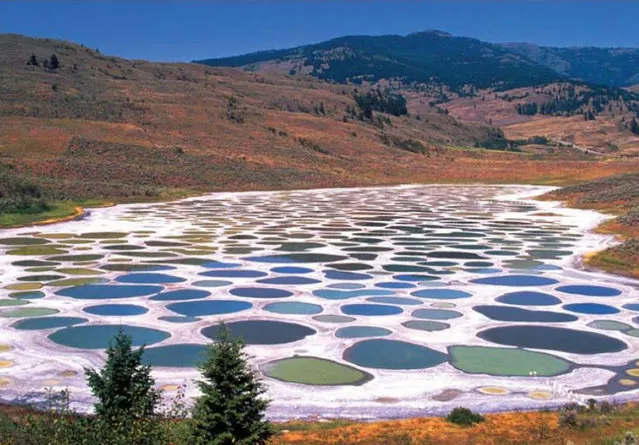
Kliluk, the Spotted Lake, Canada

Originally known to the First Nations of the Okanagan Valley as Khiluk, which was- and remains today revered as a sacred site producing therapeutic waters. During World War I the minerals of Spotted Lake were used in manufacturing ammunition. Later the area came under the control of the Ernest Smith Family, for a term of about 40 years. In 1979 Smith attempted to create interest in a spa at the lake. The First Nations responded with an effort to buy the lake; in October 2001 they finally struck a deal. First Nations arranged the purchase of 22 hectares of land for a total of $720,000, and contributed about 20% of the cost. The Indian Affairs Department paid the remainder.
Details
06 Mar 2015 12:59:00
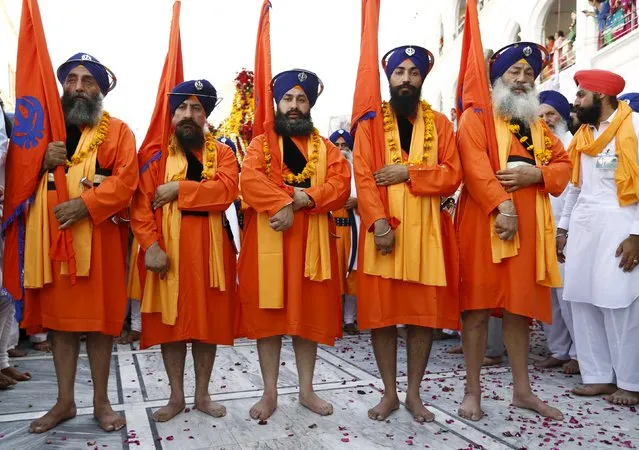
Sikh devotees participate in the Baisakhi festival at Panja Sahib shrine in Hassan Abdel April 13, 2015. (Photo by Caren Firouz/Reuters)

Sikh devotees participate in the Baisakhi festival at Panja Sahib shrine in Hassan Abdel April 13, 2015. Hundreds of Indian Sikh pilgrims arrived into Pakistan to celebrate the Baisakhi festival with Pakistani Sikhs at the shrines of Panja Sahib and Nankana Sahib, the birth place of Sikh faith founder Guru Nanak Dev. (Photo by Caren Firouz/Reuters)
Details
14 Apr 2015 10:42:00