Loading...
Done
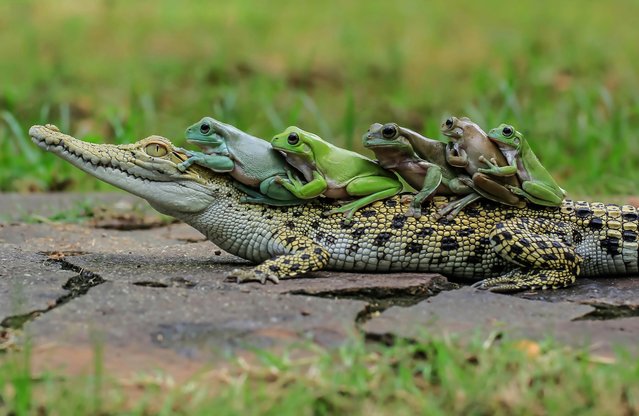
Clearly comfortable in the croc’s company the amphibians wait patiently for their chauffeur to move. But the bemused crocodile doesn’t appear to be going anywhere in a hurry. The hilarious images were captured by Tanto Yensen, 36, from Jakarta, Indonesia. (Photo by Tanto Yensen/Media Drum World Photo Agency)

A group of frogs hitched a lift on a passing crocodile. Clearly comfortable in the croc’s company the amphibians wait patiently for their chauffeur to move. But the bemused crocodile doesn’t appear to be going anywhere in a hurry. The hilarious images were captured by Tanto Yensen, 36, from Jakarta, Indonesia. (Photo by Tanto Yensen/Media Drum World Photo Agency)
Details
06 Nov 2016 11:12:00
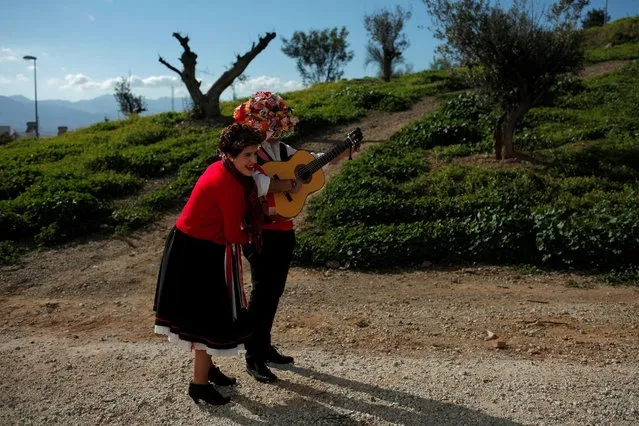
People in traditional costumes prepare before competing in the 55th Verdiales music contest in Malaga, southern Spain December 28, 2016. (Photo by Jon Nazca/Reuters)

People in traditional costumes prepare before competing in the 55th Verdiales music contest in Malaga, southern Spain December 28, 2016. Verdiales is a form of traditional Flamenco music, which is common in the province of Malaga. Members of singing groups, known as “pandas”, wear traditional costumes decked with flowers and other accessories as they perform in the contest, which is held annually on December 28. (Photo by Jon Nazca/Reuters)
Details
29 Dec 2016 07:33:00
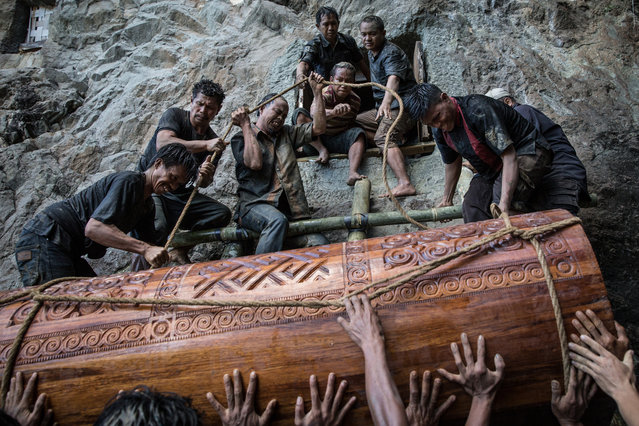
It is said that Torajans are people who “live to die”. For this Indonesian ethnic group, funerals are such extravagant events that they sometimes attract tourists. Families can postpone burials years (and the deceased are considered sick and hosted at home until the funeral) until the family can raise enough money and gather as many relatives as possible. And then it’s a jubilant multiday social event with a parade, dances and animal sacrifices. Agung Parameswara photographed these funerary practices when he traveled to South Sulawesi province, where the Torajans live. But often, their funeral isn’t the last time the dead are seen. In August, crypts are opened, coffins are slid back out and bodies delicately unsheathed. This tender ritual is known as Ma’Nene, which is customarily performed every few years. (Photo by Agung Parameswara/The Washington Post)

It is said that Torajans are people who “live to die”. For this Indonesian ethnic group, funerals are such extravagant events that they sometimes attract tourists. Families can postpone burials years (and the deceased are considered sick and hosted at home until the funeral) until the family can raise enough money and gather as many relatives as possible. And then it’s a jubilant multiday social event with a parade, dances and animal sacrifices. Agung Parameswara photographed these funerary practices when he traveled to South Sulawesi province, where the Torajans live. (Photo by Agung Parameswara/The Washington Post)
Details
06 Oct 2016 09:15:00
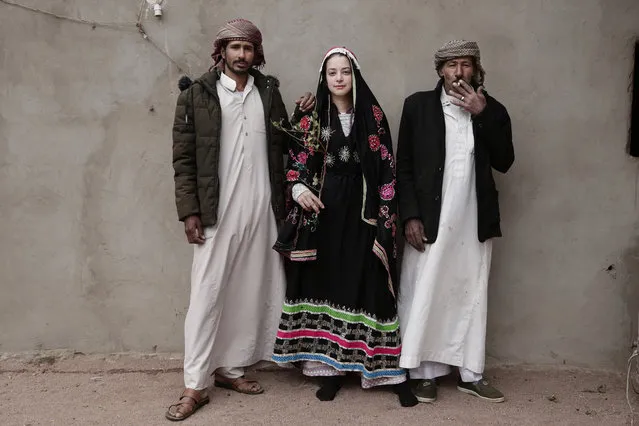
In this March 31, 2019 photo, an Egyptian student borrows a Bedouin wedding dress to pose for a photograph with Bedouin men from the Hamada tribe, in Wadi Sahw, Abu Zenima, in South Sinai, Egypt. Four Bedouin women are for the first time leading tours in Egypt’s Sinai Peninsula, breaking new ground in their deeply conservative community, where women almost never work outside the home or interact with outsiders.  The tourists can only be women, and the tours can’t go overnight. Each day before the sun sets, the group returns to the Hamada’s home village in Wadi Sahu, a narrow desert valley. (Photo by Nariman El-Mofty/AP Photo)

In this March 31, 2019 photo, an Egyptian student borrows a Bedouin wedding dress to pose for a photograph with Bedouin men from the Hamada tribe, in Wadi Sahw, Abu Zenima, in South Sinai, Egypt. Four Bedouin women are for the first time leading tours in Egypt’s Sinai Peninsula, breaking new ground in their deeply conservative community, where women almost never work outside the home or interact with outsiders. The tourists can only be women, and the tours can’t go overnight. Each day before the sun sets, the group returns to the Hamada’s home village in Wadi Sahu, a narrow desert valley. (Photo by Nariman El-Mofty/AP Photo)
Details
11 Apr 2019 00:01:00
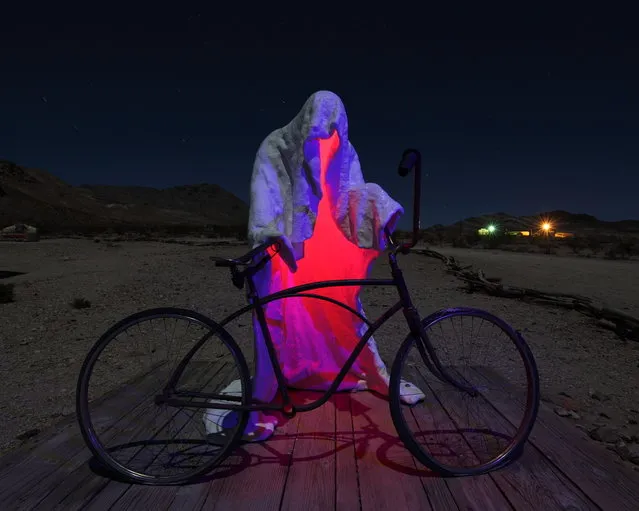
Goldwell Open Air Museum: Last Supper

Just outside of a Nevada ghost town, Rhyolite, is the Goldwell Open Air Museum. The museum was created by a group of Belgian artists and consists of seven outdoor sculptures dramatically using the Mojae Desert as a backdrop. The Last Supper, created by the late artist Charles Szukalski, is a piece that was due to last only a couple of years but withstood time and nature since 1984. Men from the local community were covered in linen and plaster to create the eerie forms, reminiscent of Da Vinci's last supper. It is a truly unique environment and piece of art in the great American desert.
Details
03 Feb 2013 13:13:00
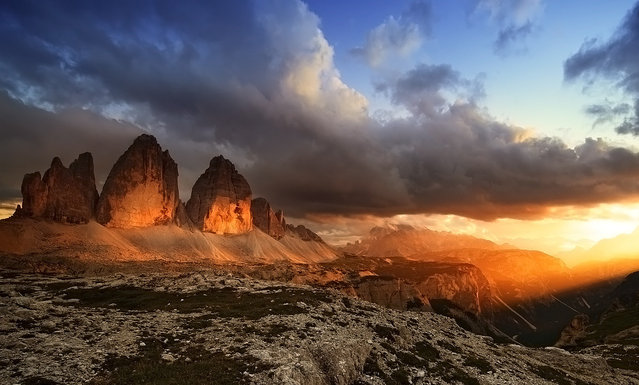
The Three Peaks Of Lavaredo

The three peaks of Lavaredo, or the “Tre Cime di Lavaredo” in Italian, are three distinctive battlement-like peaks, in the Sexten Dolomites of northeastern Italy. They are probably one of the best-known mountain groups in the Alps, and one of the most photographed in Italy. The three peaks are named, from east to west, "little peak" (Cima Piccola), "big peak" (Cima Grande) and "western peak" (Cima Ovest). The Cima Grande has an elevation of 2,999 metres (9,839 ft). It stands between the Cima Piccola, at 2,857 metres (9,373 ft), and the Cima Ovest, at 2,973 metres (9,754 ft).
Details
21 Oct 2013 10:27:00
Realistic Celebrity Caricatures By Rodney Pike

Hi, my name is Rodney Pike and I am a Humorous Illustrator. I have a lifetime of experience in Fine Art and Graphic Design and Digital Illustration. I offer Photo-Manipulated Illustrations of all sorts but I specialize in Photo-Manipulated Caricature Illustration, Humorous Illustration and Political Satire, perfect for magazines, books, etc. My clients include companies such as FHM Magazine, Tennis Magazine, The Village Voice Magazine, Bauer Media, Miller Publishing Group, New Coast Productions and Catchphrase Entertainment. I am a member of the ISCA and NAPP.
Rodney Pike
Details
23 Nov 2013 13:43:00


A man speaks on his mobile phone on May 31, 2011 in New York City. In a new report by 31 scientists meeting at the World Health Organization's International Agency for Research on Cancer (WHO/IARC) it was found that using a mobile phone may increase your risk for certain kinds of brain cancers. While further scientific work will be conducted, the group of scientists from 14 countries classified cell phones in the carcinogenic category 2B, which is similar to the pesticide DDT and gasoline engine exhaust. (Photo by Spencer Platt/Getty Images)
Details
01 Jun 2011 06:40:00