Loading...
Done
Washington National Cathedral Inspected For Earthquake Damage

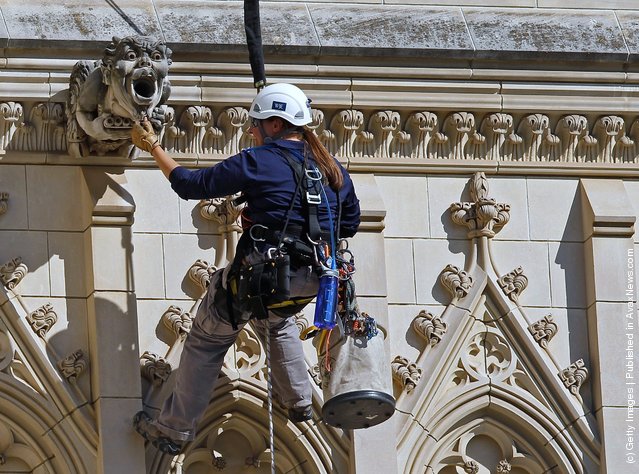
Katie Francis, a member of the Difficult Access Team from Wiss, Janney, Elstner Associates, inspects a gargoyle while rapelling down one of the north tower on the west front of the National Cathedral while looking for damage from August's magnitude 5.8 earthquake and high winds from Hurricane Irene October 17, 2011 in Washington, DC. DAT members used cameras, cell phones and iPad computers to record places on the cathedral's west front where damage was apparent. (Photo by Chip Somodevilla/Getty Images)
Details
18 Oct 2011 08:38:00
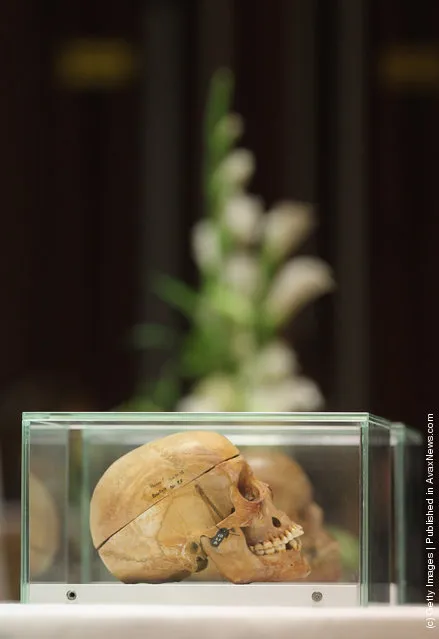
Charite Hospital Returns Herero Skulls To Namibia

Two of 20 skulls to be taken possession of by a delegation from Namibia stand on display at a ceremony at Charite hospital on September 30, 2011 in Berlin, Germany. The skulls are from Herero and Nama tribespeople taken by German colonial forces between 1904 and 1908, when the Germans violently suppressed an uprising in what was then German Southwest Africa, which is today's Namibia, and in the process killed tens of thousand of Herero and Nama. German scientists at the time took the skulls back to Berlin to demonstrate the racial superiority of Europeans over black Africans. Many Namibians demand a formal apology from the German government. (Photo by Sean Gallup/Getty Images)
Details
02 Oct 2011 11:42:00
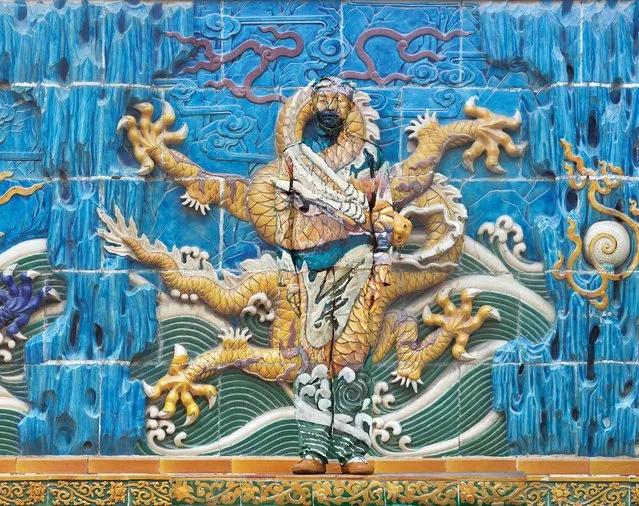
Optical illusions: artist Liu Bolin

“Liu Bolin is an artist born in China’s Shandong province in 1973, and he earned his Bachelor of Fine Arts from the Shandong College of Arts in 1995 and his Master of Fine Arts from the Central Academy of Fine Arts in Beijing in 2001. His work has been exhibited in museums around the world. Also known as “The Invisible Man”, Liu Bolin's most popular works are from his “Hiding in the City” series; photographic works that began as performance art in 2005”. – Wikipedia. (Photo by Reuters/China Daily)
Details
03 Oct 2013 09:29:00
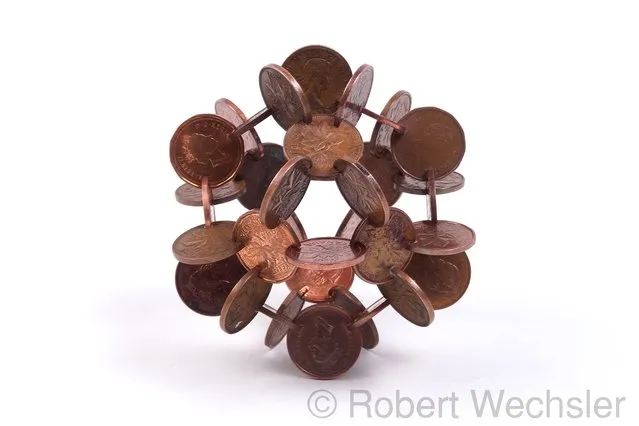
Mendicant By Robert Wechsler

American artist Robert Wechsler has realized a series of sculptural cubes made from thousands of pennies titled “The Mendicant“. Cubes achieved by notching and joining pennies in perfect orientation to one another. Joined at perpendicular angles, the coins create a lattice structure allowing tunnel like passages of light from certain angles. As one moves around them, the cubes seem to fluctuate from material to ethereal. The number of pennies increases exponentially with the size of the cube. Pictured here are three cubes differentiated with subtitles indicating the exact quantity used.
Details
21 Oct 2013 11:18:00
Students from St Andrews University are covered in foam as they take part in the traditional Raisin Weekend in the Lower College Lawn, at St Andrews in Scotland on October 22, 2018. (Photo by Russell Cheyne/Reuters)

Students from St Andrews University are covered in foam as they take part in the traditional Raisin Weekend in the Lower College Lawn, at St Andrews in Scotland on October 22, 2018. The “raisin weekend” stems from a gift of raisins (now flour and foam) traditionally given by a first year student to their academic “parents” in gratitude for their guidance. (Photo by Russell Cheyne/Reuters)
Details
24 Oct 2018 12:12:00
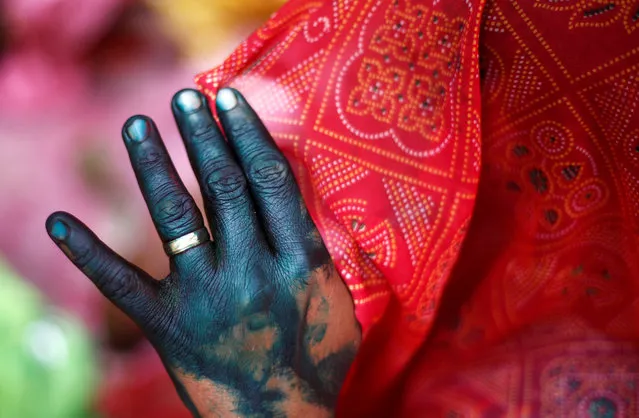
A woman holds her veil as she takes part in Huranga, a game played between men and women a day after Holi, at Dauji temple near Mathura, March 3, 2018. (Photo by Adnan Abidi/Reuters)

A woman holds her veil as she takes part in Huranga, a game played between men and women a day after Holi, at Dauji temple near Mathura, March 3, 2018. (Photo by Adnan Abidi/Reuters)
Details
12 Mar 2018 00:03:00
People enjoying the second day of the Greenman Festival in South Wales, Crickhowell, United Kingdom on August 20, 2021. (Photo by Chris Fairweather/Huw Evans/Rex Features/Shutterstock)

People enjoying the second day of the Greenman Festival in South Wales, Crickhowell, United Kingdom on August 20, 2021. (Photo by Chris Fairweather/Huw Evans/Rex Features/Shutterstock)
Details
21 Aug 2021 09:34:00
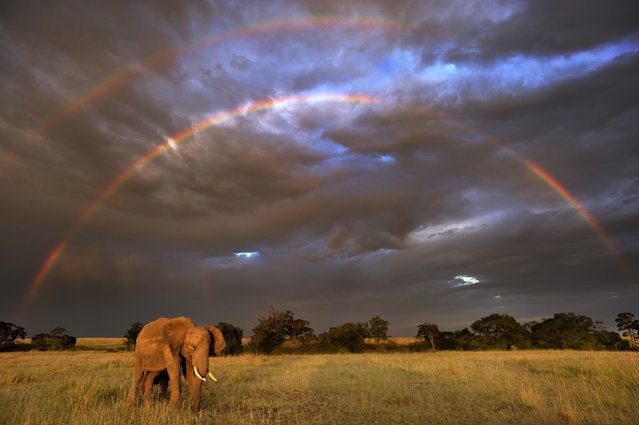
This photo provided by Netflix/naturepl.com and WWF-International shows an African Elephant (Loxodonta africana) in front of double rainbow, in Masai Mara, Kenya, included in the Netflix natural history series, “Our Planet”, in collaboration with Silverback Films and WWF. The eight-part series debuts in 2019. (Photo by Andy Rouse/Naturepl.com/WWF-International/Netflix via AP Photo)

This photo provided by Netflix/naturepl.com and WWF-International shows an African Elephant (Loxodonta africana) in front of double rainbow, in Masai Mara, Kenya, included in the Netflix natural history series, “Our Planet”, in collaboration with Silverback Films and WWF. The eight-part series debuts in 2019. (Photo by Andy Rouse/Naturepl/WWF-International/Netflix via AP Photo)
Details
09 Oct 2015 08:05:00