Loading...
Done
“Great White Shark of Guadalupe Island”. A great white shark very quiet under the boat and a lot of fish. The sun ray lighting the head of the shark. Location: Guadalupe Island, Mexico. (Photo and caption by Marc Henauer/National Geographic Traveler Photo Contest)

“Great White Shark of Guadalupe Island”. A great white shark very quiet under the boat and a lot of fish. The sun ray lighting the head of the shark. Location: Guadalupe Island, Mexico. (Photo and caption by Marc Henauer/National Geographic Traveler Photo Contest)

ATTENTION! All pictures are presented in high resolution. To see Hi-Res images – just TWICE click on any picture. In other words, click small picture – opens the BIG picture. Click BIG picture – opens VERY BIG picture.
Details
04 Jul 2013 09:49:00
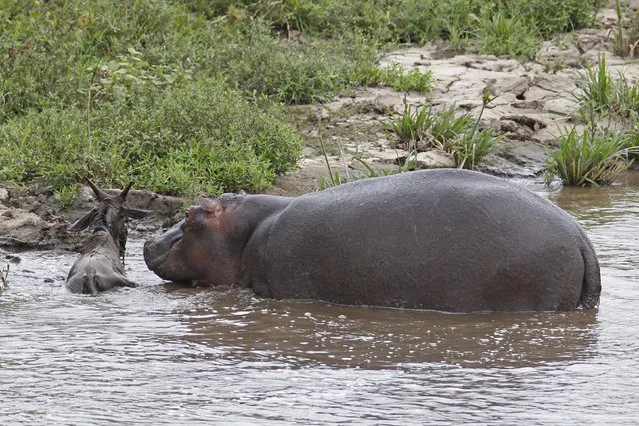
One of the biggest hippos protects the gnu as it makes its way back to the shoreline, guarding it from any further attacks. (Photo by Vadim Onishchenko/Caters News)

This is the amazing moment a heroic hippo saved a gnu from certain death. After being bitten by a crocodile, the large antelope is seen being dragged slowly under the water. But in a miraculous turn of events, a nearby hippo is seen making its way across the water to help the animal in its hour of need. Photo: One of the biggest hippos protects the gnu as it makes its way back to the shoreline, guarding it from any further attacks. (Photo by Vadim Onishchenko/Caters News)
Details
12 Mar 2014 06:09:00


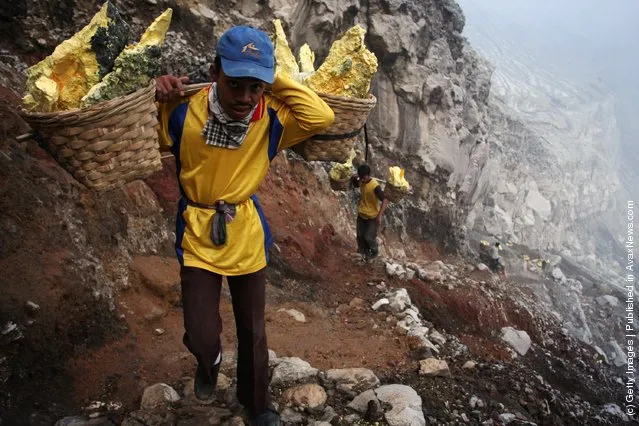
Traditional miners carry sulphur on the Ijen volcano complex on May 25, 2009 outside Banyuwangi, East Java, Indonesia. Miners carry the solidified yellow sulphur blocks from the crater floor to the rim for as many hours a day as they can tolerate, paid by the kilogram of sulphur they extract. The average wage is USD $.05 per kilogram of sulphur and a worker, depending on his strength and stamina, carry on average 3 baskets of 70-80kg per day, earning him around USD $11. (Photo by Ulet Ifansasti/Getty Images)
Details
08 Jul 2011 10:53:00
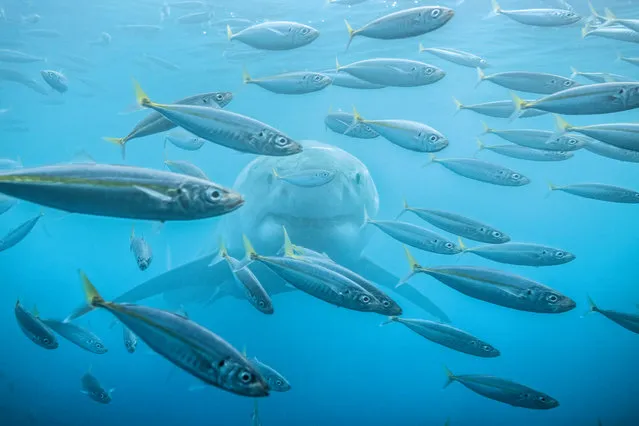
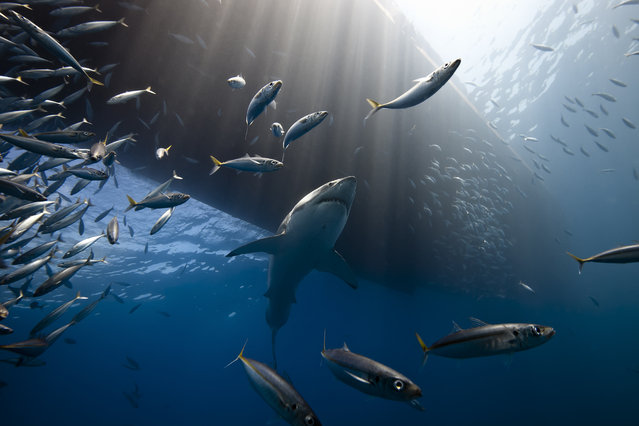
Under Exposed: Pekka Tuuri (Finland) – Great white shark, Isla Guadalupe, Mexico. Isla Guadalupe is the world capital when it comes to observing great white sharks, but cage diving seriously limits the possibilities to take ‘fresh’ pictures. When I took this, the water close to the surface was quite milky, making photography very challenging. From out of the ‘mist’, I saw this great white shark lurking behind a school of fusiliers. I quickly focused on the shark and set a wide aperture to get focus blur on the fish, along with a fast shutter to avoid excessive motion blur. (Photo by Pekka Tuuri/The Outdoor Photographer of the Year/The Guardian)

Under Exposed: Pekka Tuuri (Finland) – Great white shark, Isla Guadalupe, Mexico. “Isla Guadalupe is the world capital when it comes to observing great white sharks, but cage diving seriously limits the possibilities to take ‘fresh’ pictures. When I took this, the water close to the surface was quite milky, making photography very challenging. From out of the “mist”, I saw this great white shark lurking behind a school of fusiliers. I quickly focused on the shark and set a wide aperture to get focus blur on the fish, along with a fast shutter to avoid excessive motion blur”. (Photo by Pekka Tuuri/The Outdoor Photographer of the Year/The Guardian)
Details
25 Jan 2018 07:37:00
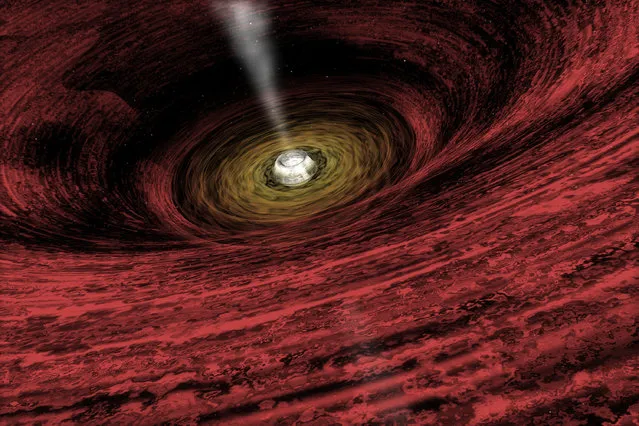
An artist's impression of a growing supermassive black hole located in the early Universe is seen in this NASA handout illustration released on June 15, 2011. Using the deepest X-ray image ever taken, astronomers found the first direct evidence that massive black holes were common in the early universe. This discovery from NASA's Chandra X-Ray Observatory shows that very young black holes grew more aggressively than previously thought, in tandem with the growth of their host galaxies. (Photo by Reuters/NASA/Chandra X-Ray Observatory/A.Hobart)

An artist's impression of a growing supermassive black hole located in the early Universe is seen in this NASA handout illustration released on June 15, 2011. Using the deepest X-ray image ever taken, astronomers found the first direct evidence that massive black holes were common in the early universe. This discovery from NASA's Chandra X-Ray Observatory shows that very young black holes grew more aggressively than previously thought, in tandem with the growth of their host galaxies. (Photo by Reuters/NASA/Chandra X-Ray Observatory/A.Hobart)
Details
11 Feb 2016 12:57:00
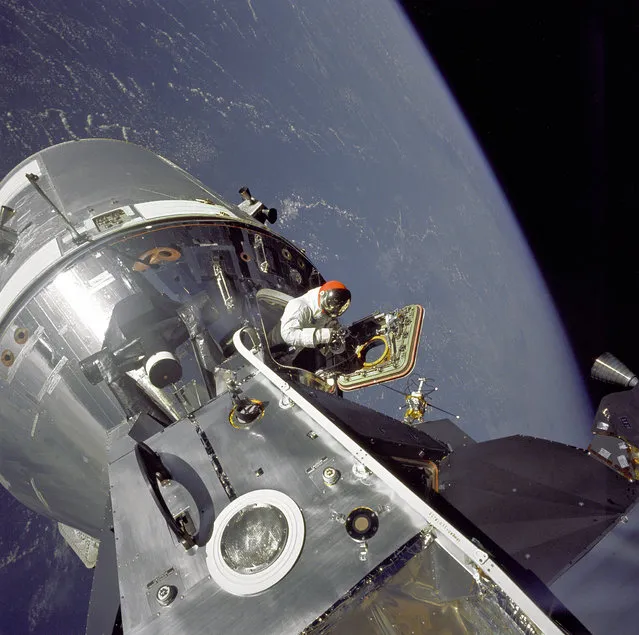
Apollo 9 Command/Service Modules (CSM) nicknamed “Gumdrop” and Lunar Module (LM), nicknamed “Spider” are shown docked together as Command Module pilot David R. Scott stands in the open hatch. Astronaut Russell L. Schweickart, Lunar Module pilot, took this photograph of Scott during his EVA as he stood on the porch outside the Lunar Module. Apollo 9 was an Earth orbital mission designed to test docking procedures between the CSM and LM as well as test fly the Lunar Module in the relative safe confines of Earth orbit. (Photo by NASA)

Apollo 9 Command/Service Modules (CSM) nicknamed “Gumdrop” and Lunar Module (LM), nicknamed “Spider” are shown docked together as Command Module pilot David R. Scott stands in the open hatch. Astronaut Russell L. Schweickart, Lunar Module pilot, took this photograph of Scott during his EVA as he stood on the porch outside the Lunar Module. Apollo 9 was an Earth orbital mission designed to test docking procedures between the CSM and LM as well as test fly the Lunar Module in the relative safe confines of Earth orbit. (Photo by NASA)
Details
20 Jul 2014 11:47:00
Base jumpers leap from the 300-metre high skydeck of Malaysia's landmark Kuala Lumpur Tower against the backdrop of the city's skyline on October 3, 2016 during the annual International KL Tower Base-Jump event. (Photo by Manan Vatsyayana/AFP Photo)

Base jumpers leap from the 300-metre high skydeck of Malaysia's landmark Kuala Lumpur Tower against the backdrop of the city's skyline on October 3, 2016 during the annual International KL Tower Base-Jump event. (Photo by Manan Vatsyayana/AFP Photo)
Details
04 Oct 2016 11:01:00
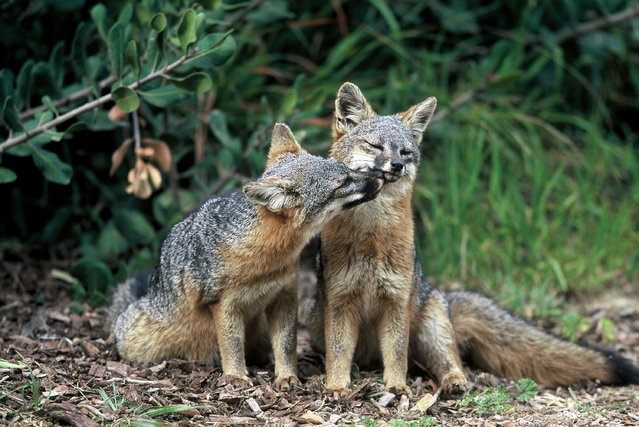
This undated photo provided by the U.S. Fish and Wildlife Service shows two island foxes in Channel Islands National Park, Calif. Three fox subspecies native to California's Channel Islands were removed from the list of endangered species Thursday, August 11, 2016, in what federal officials have called the fastest recovery of any mammal listed under the Endangered Species Act. (Photo by Chuck Graham/U.S. Fish and Wildlife Service via AP Photo)

This undated photo provided by the U.S. Fish and Wildlife Service shows two island foxes in Channel Islands National Park, Calif. Three fox subspecies native to California's Channel Islands were removed from the list of endangered species Thursday, August 11, 2016, in what federal officials have called the fastest recovery of any mammal listed under the Endangered Species Act. (Photo by Chuck Graham/U.S. Fish and Wildlife Service via AP Photo)
Details
12 Aug 2016 12:04:00