Loading...
Done
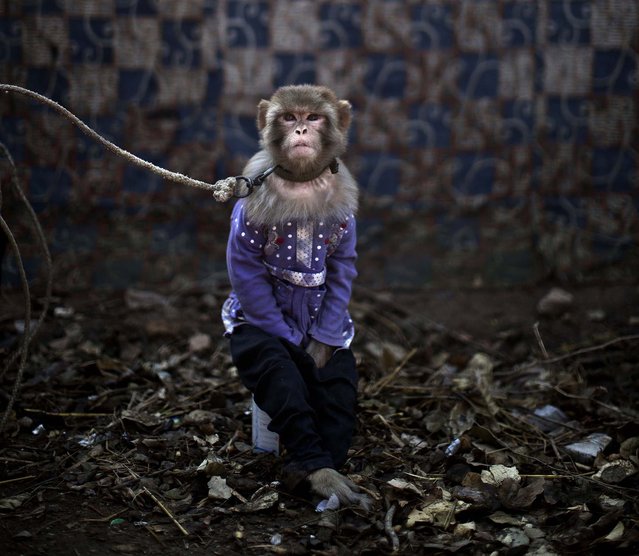
In this Tuesday, February 11, 2014, photo, a trained monkey, that makes a living for her Pakistani owner by performing to a crowd in public and private places, sits held by a leash, in Rawalpindi, Pakistan. For Pakistanis who raise and train the monkeys they are an important source of income in an impoverished country, and they form a strong bond with the animals. The monkeys are usually captured in the wild when they are babies and then trained. A trained monkey can fetch 20,000 to 30,000 rupees ($190 to $285). (Photo by Muhammed Muheisen/Associated Press)

In this Tuesday, February 11, 2014, photo, a trained monkey, that makes a living for her Pakistani owner by performing to a crowd in public and private places, sits held by a leash, in Rawalpindi, Pakistan. For Pakistanis who raise and train the monkeys they are an important source of income in an impoverished country, and they form a strong bond with the animals. The monkeys are usually captured in the wild when they are babies and then trained. A trained monkey can fetch 20,000 to 30,000 rupees ($190 to $285). (Photo by Muhammed Muheisen/Associated Press)
Details
23 Feb 2014 09:50:00
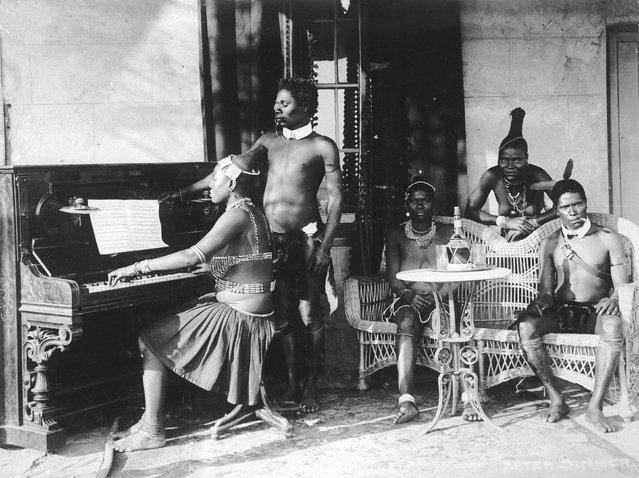
circa 1925:  A Zulu woman playing the piano while a group of others sit and listen.  (Photo by General Photographic Agency/Getty Images)

“The Zulu are the largest South African ethnic group, with an estimated 10–11 million people living mainly in the province of KwaZulu-Natal. Small numbers also live in Zimbabwe, Zambia, and Mozambique. Their language, Zulu, is a Bantu language; more specifically, part of the Nguni subgroup. The Zulu Kingdom played a major role in South African history during the 19th and 20th centuries. Under apartheid, Zulu people were classed as third-class citizens and suffered from state-sanctioned discrimination. They remain today the most numerous ethnic group in South Africa, and now have equal rights along with all other citizens”. – Wikipedia.

Photo: A Zulu woman playing the piano while a group of others sit and listen (to put it briefly, Englishmen scoff over Zulu). South Africa, circa 1925. (Photo by General Photographic Agency)

Details
03 Feb 2014 09:40:00
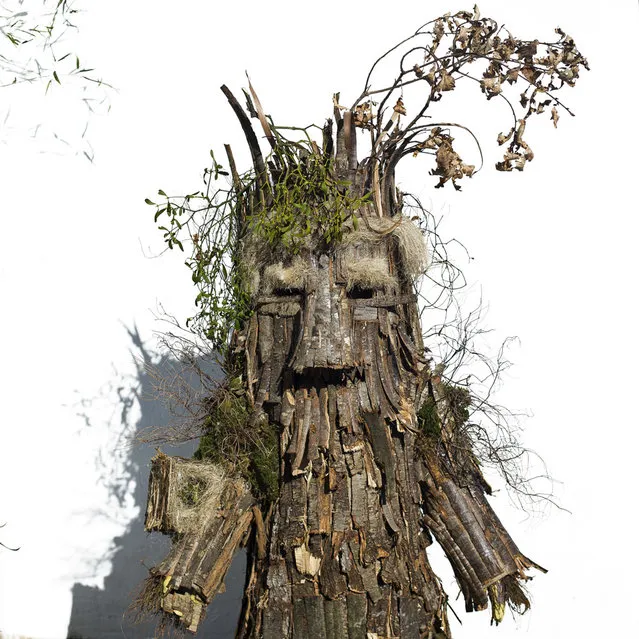
A man dressed as a  “Trapajon”, representing entities of nature, poses for a picture after taking part in the Vijanera Festival in Silio, northern Spain, Sunday, Jan. 6, 2013. The Vijanera masquerade, of pre-Roman origin, is the first carnival of the year in Europe symbolizing the triumph of good over evil and involving the participation of crowds of residents wearing different masks, animal skins and brightly colored clothing with its own complex function and symbolism and becoming the living example of the survival of archaic cults to nature. (Photo by Daniel Ochoa de Olza/AP Photo)

A man dressed as a “Trapajon”, representing entities of nature, poses for a picture after taking part in the Vijanera Festival in Silio, northern Spain, Sunday, Jan. 6, 2013. The Vijanera masquerade, of pre-Roman origin, is the first carnival of the year in Europe symbolizing the triumph of good over evil and involving the participation of crowds of residents wearing different masks, animal skins and brightly colored clothing with its own complex function and symbolism and becoming the living example of the survival of archaic cults to nature. (Photo by Daniel Ochoa de Olza/AP Photo)
Details
19 Jan 2013 13:01:00
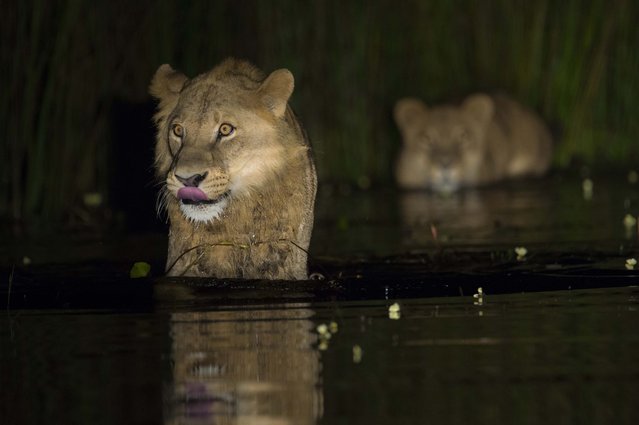
Lions submerged in water. (Photo by Wim van den Heever/Caters News)

These breath-taking photographs reveal the everyday lives of animals living in the wild. The incredible images were taken by wildlife photographer Wim van dan Heever, from Pretoria, South Africa, during trips to locations including Japan, Botswana and Svalbard. The 43-year-old has been photographing wildlife since he was a young boy and turned his passion for animals into a career and set up ODP Safaris. He has travelled across the globe to photograph wild animals – from lions and tigers, to elephants, dolphins and eagles – as they hunt, give birth and graze in their natural habitats. Here: Lions submerged in water. (Photo by Wim van den Heever/Caters News)
Details
07 Aug 2015 11:43:00
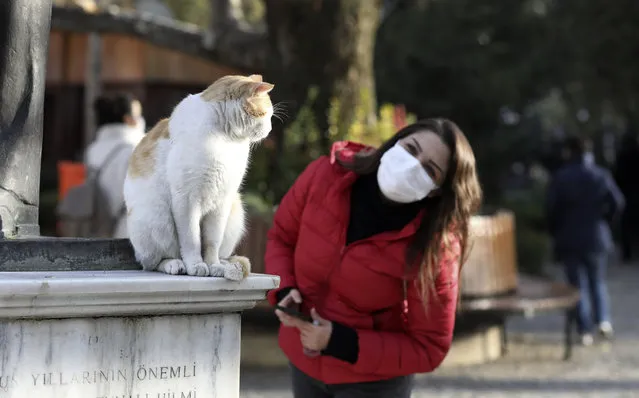
A woman wearing a mask to help protect against the spread of coronavirus, tries to communicate with Efe, a cat living in Kugulu public garden, in Ankara, Turkey, Monday, November 30, 2020.Turkey's President Recep Tayyip Erdogan has announced Monday the most widespread lockdown so far amid a surge in COVID-19 infections, extending curfews to weeknights and full lockdowns over weekends. (Photo by Burhan Ozbilici/AP Photo)

A woman wearing a mask to help protect against the spread of coronavirus, tries to communicate with Efe, a cat living in Kugulu public garden, in Ankara, Turkey, Monday, November 30, 2020.Turkey's President Recep Tayyip Erdogan has announced Monday the most widespread lockdown so far amid a surge in COVID-19 infections, extending curfews to weeknights and full lockdowns over weekends. (Photo by Burhan Ozbilici/AP Photo)
Details
29 Dec 2020 00:03:00
A dog poses in traditional Chinese dress on Yaowarat Road in Chinatown on the eve of Lunar New Year on January 20, 2023 in Bangkok, Thailand. The Chinese diaspora of Southeast Asia is celebrating a lively Lunar New Year as COVID-19 restrictions have been removed. It is traditionally a time for people to meet their relatives and take part in celebrations with families. In Thailand, which has a sizeable population of Chinese lineage, people gather with family and celebrate with feasts and visits to temples. (Photo by Lauren DeCicca/Getty Images)

A dog poses in traditional Chinese dress on Yaowarat Road in Chinatown on the eve of Lunar New Year on January 20, 2023 in Bangkok, Thailand. The Chinese diaspora of Southeast Asia is celebrating a lively Lunar New Year as COVID-19 restrictions have been removed. It is traditionally a time for people to meet their relatives and take part in celebrations with families. In Thailand, which has a sizeable population of Chinese lineage, people gather with family and celebrate with feasts and visits to temples. (Photo by Lauren DeCicca/Getty Images)
Details
09 Feb 2023 05:04:00
People protest getting evicted from land designated for a Petrobras refinery, at a settlement coined the “First of May Refugee Camp”, referring to the date people moved here and set up tents and shacks to live in during the new coronavirus pandemic in Itaguai, Rio de Janeiro state, Brazil, Thursday, July 1, 2021. (Photo by Silvia Izquierdo/AP Photo)

People protest getting evicted from land designated for a Petrobras refinery, at a settlement coined the “First of May Refugee Camp”, referring to the date people moved here and set up tents and shacks to live in during the new coronavirus pandemic in Itaguai, Rio de Janeiro state, Brazil, Thursday, July 1, 2021. (Photo by Silvia Izquierdo/AP Photo)
Details
02 Jul 2021 10:11:00
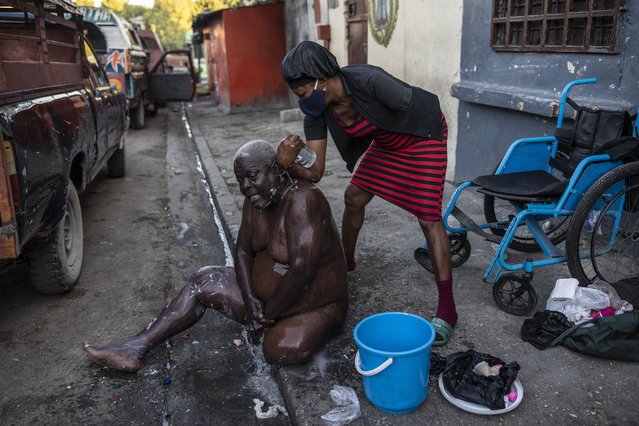
Marie Joseph bathes her friend Jean Robert outside a shelter for the internally displaced where they live due to police violence in Port-au-Prince, Haiti, Thursday, September 16, 2021. Most of the population of Port-au-Prince has no access to basic public services, no drinking water, electricity or garbage collection. (Photo by Rodrigo Abd/AP Photo)

Marie Joseph bathes her friend Jean Robert outside a shelter for the internally displaced where they live due to police violence in Port-au-Prince, Haiti, Thursday, September 16, 2021. Most of the population of Port-au-Prince has no access to basic public services, no drinking water, electricity or garbage collection. (Photo by Rodrigo Abd/AP Photo)
Details
26 Oct 2021 08:34:00