Loading...
Done
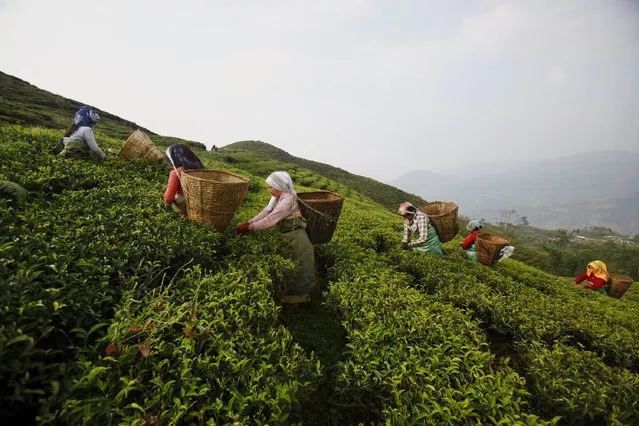
In this Sunday, November 16, 2014 photo, Nepalese women pick tea at a tea garden of Kanyam in Illam district, around 500 kilometers (310 miles) from Katmandu, Nepal. Illam is a hilly district of tea gardens and estates in eastern Nepal's Himalayan region with one of its largest and most productive tea estate being Kanyam estates. (Photo by Niranjan Shrestha/AP Photo)

In this Sunday, November 16, 2014 photo, Nepalese women pick tea at a tea garden of Kanyam in Illam district, around 500 kilometers (310 miles) from Katmandu, Nepal. Illam is a hilly district of tea gardens and estates in eastern Nepal's Himalayan region with one of its largest and most productive tea estate being Kanyam estates. The district produces orthodox tea, hand-processed or machine rolled, which is generally exported to international markets, specially Europe and the United States. Most of the tea pickers here are paid 186 Nepalese Rupees (US $ 2) for 8 hours of work everyday. (Photo by Niranjan Shrestha/AP Photo)
Details
19 Nov 2014 14:28:00
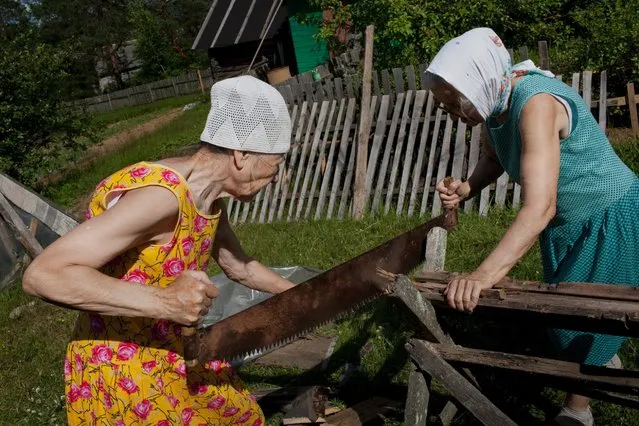
“Two-Handed Saw, 2014”. “Most of the neighbors have switched to power tools to run their households, the buzz of chain saws and weed-whackers overpowering the quieter sounds of country life, but my aunts hold on to the two-handed saw that's decades old, the sickle and scythe that need to be sharpened and polished after each use, the old axe that's becoming heavier each year. Each of these objects is familiar, holding memories of their brother, who succumbed to cancer a few years ago, of days before my grandfather lost his vision in the 50's, of busier days and longer futures”, Sablin told. (Photo by Nadia Sablin)

In northwest Russia, in a small village called Alekhovshchina, Nadia Sablin's aunts spend the warmer months together in the family home and live as the family has always lived, chopping wood to heat the house and making their own clothes. Sablin's book of photographs, “Aunties: The Seven Summers of Alevtina and Ludmila”, is published by Duke University Press. Here: “Two-Handed Saw, 2014”. (Photo by Nadia Sablin)
Details
25 Feb 2016 12:12:00
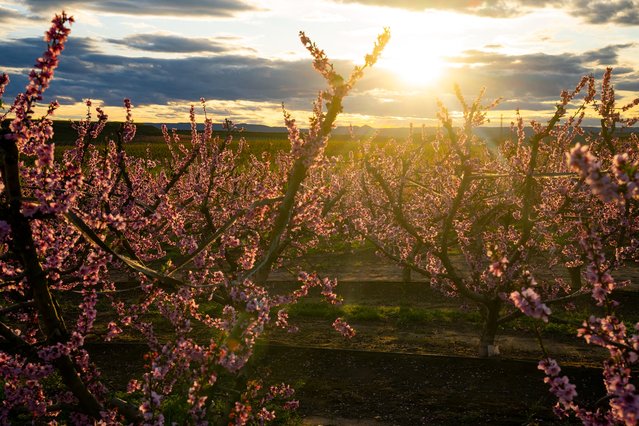
Rows of blossoming peach trees line the fields of Aitona, in the province of Lleida, north eastern Spain, on March 22, 2025. Every year in March the thousands of hectares of blossoming peach trees create a sort of nature tourism with hundreds of people visiting the area to take in the colorful blossoms. (Photo by Josep Lago/AFP Photo)

Rows of blossoming peach trees line the fields of Aitona, in the province of Lleida, north eastern Spain, on March 22, 2025. Every year in March the thousands of hectares of blossoming peach trees create a sort of nature tourism with hundreds of people visiting the area to take in the colorful blossoms. (Photo by Josep Lago/AFP Photo)
Details
20 Jun 2025 04:26:00
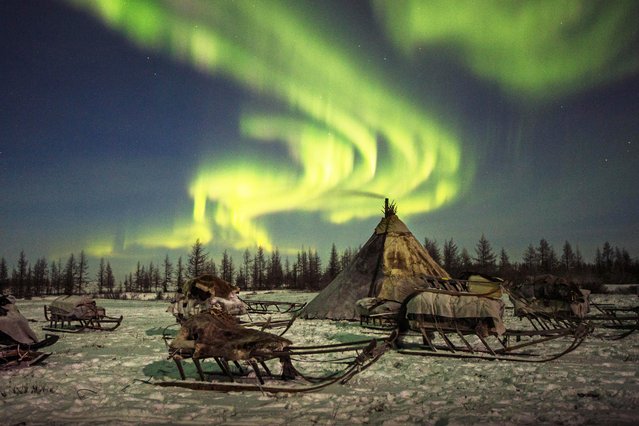
An empty camp is shown beneath a colourful sky in Siberia, December 2016. (Photo by Timothy Allen/Barcroft Productions)

A British photographer has captured life at the “edge of the world”. Timothy Allen, best known for his work on BBC's Human Planet, trekked through the freezing Siberian wilderness for 16 days as he joined part of an 800km migration of reindeer in the Yamal-Nenets region – a name that roughly translates to “edge of the world”. The stunning pictures feature the nomadic Nenets tribe, who drink blood to survive in -45°C temperatures. Timothy's epic journey, which will be revealed in an eight-minute documentary on Animal Planet USA, saw him travel across the bleak terrain of the frozen Ob River with the Nenets people in December last year. Here: An empty camp is shown beneath a colourful sky in Siberia, December 2016. (Photo by Timothy Allen/Barcroft Productions)
Details
19 Sep 2017 07:48:00
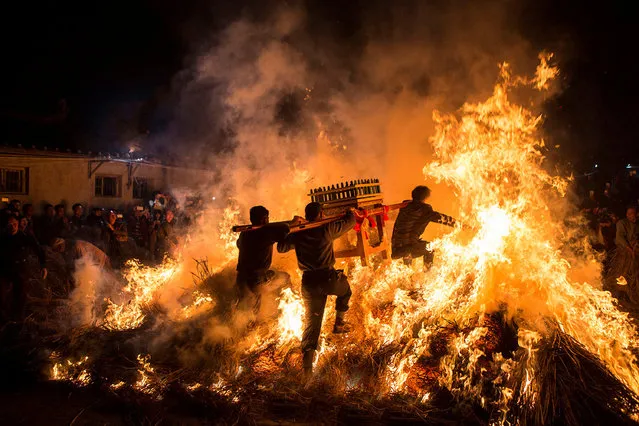
Men carrying a shrine jump over a bon fire, which means a wish for good luck during a traditional Chinese lunar new year celebration in Jieyang, Guangdong province, China, February 2, 2017. (Photo by Reuters/China Daily)

Men carrying a shrine jump over a bon fire, which means a wish for good luck during a traditional Chinese lunar new year celebration in Jieyang, Guangdong province, China, February 2, 2017. (Photo by Reuters/China Daily)
Details
09 Feb 2017 00:06:00
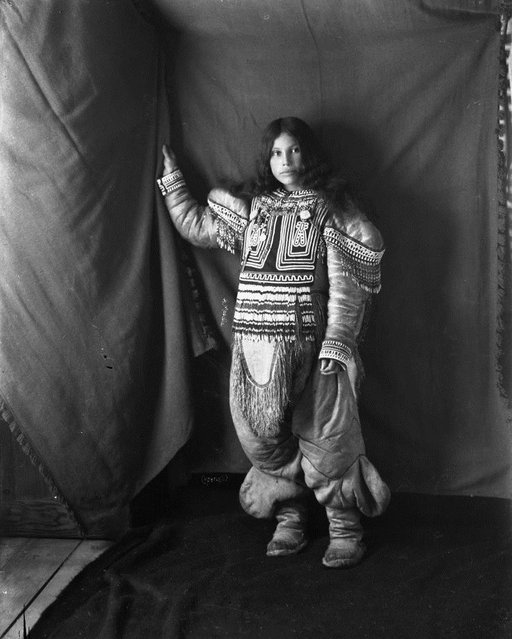
Moodie was born in 1854 in Toronto, and after a move to England she met and married John Douglas Moodie in 1878, and had six children. Here: Inuit woman, Kootucktuck, in her beaded attigi. Fullerton Harbour, Nunavut, February 1905. (Photo by Geraldine Moodie/The Guardian)

Geraldine Moodie overcame harsh conditions to become western Canada’s first professional female photographer, capturing beautiful images in the country’s most remote regions. An exhibition, “North of Ordinary: The Arctic Photographs of Geraldine and Douglas Moodie”, is at Glenbow, Calgary, 18 February – 10 September. Here: Inuit woman, Kootucktuck, in her beaded attigi. Fullerton Harbour, Nunavut, February 1905. (Photo by Geraldine Moodie/The Guardian)
Details
17 Feb 2017 00:04:00
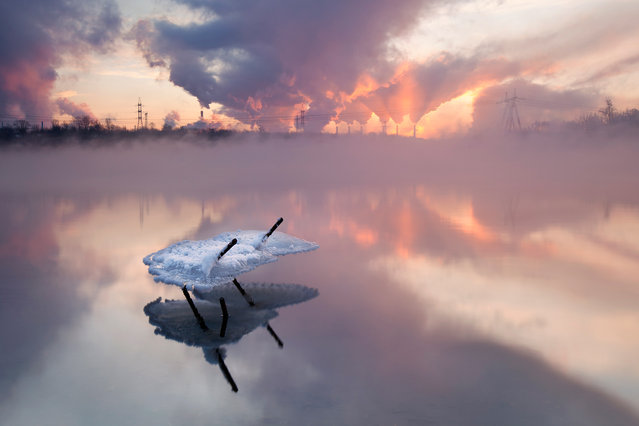
“Winter shapes, Moscow river”. Moscow river at this part is never covered by ice. When the temperature is very low it's possible to see a strong fog. Morning light and pipes of the oli factory creates a fantastic landscape. Photo location: Moscow, Russia. (Photo and caption by Sergey Rumyantsev/National Geographic Photo Contest)

“Winter shapes, Moscow river”. Moscow river at this part is never covered by ice. When the temperature is very low it's possible to see a strong fog. Morning light and pipes of the oli factory creates a fantastic landscape. Photo location: Moscow, Russia. (Photo and caption by Sergey Rumyantsev/National Geographic Photo Contest)
Details
11 Dec 2013 08:33:00
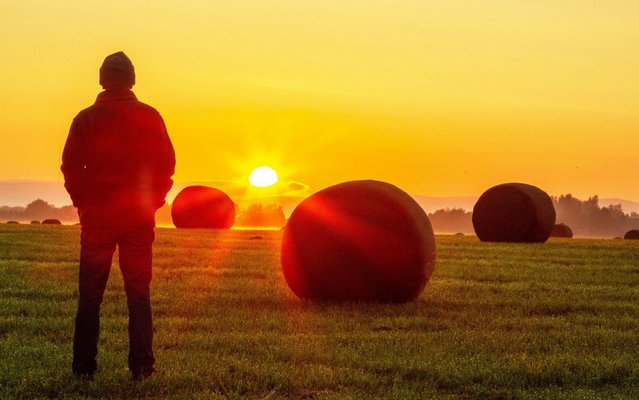
Sunrise over the fields of stemmy grassland in Burscough, Lancashire, UK on September 14, 2020 with wrapped bales of hay prepared for silage, haylage for animal winter feed. (Photo by MediaWorldImages/Alamy Live News)

Sunrise over the fields of stemmy grassland in Burscough, Lancashire, UK on September 14, 2020 with wrapped bales of hay prepared for silage, haylage for animal winter feed. (Photo by MediaWorldImages/Alamy Live News)
Details
21 Oct 2020 00:05:00