Loading...
Done
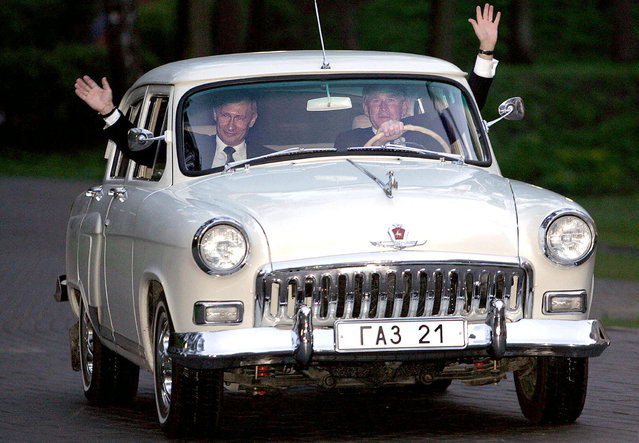
US President George W. Bush (R) and Russian President Vladimir Putin wave as the two presidents go for a ride in Putin's 1956 Volga before dinner 08 May 2005 at the his residence outside of Moscow. Bush hailed Russia's “bravery and sacrifice” in defeating Nazism, as he met Putin ahead of ceremonies marking the 60th anniversary of the end of World War II. Bush, who the previous day criticized the decades-long Soviet occupation of central Europe, said he was looking forward to the 09 May ceremony on Moscow's Red Square, to be attended by over 50 national leaders. (Photo by Tim Sloan/AFP Photo)

US President George W. Bush (R) and Russian President Vladimir Putin wave as the two presidents go for a ride in Putin's 1956 Volga before dinner 08 May 2005 at the his residence outside of Moscow. Bush hailed Russia's “bravery and sacrifice” in defeating Nazism, as he met Putin ahead of ceremonies marking the 60th anniversary of the end of World War II. Bush, who the previous day criticized the decades-long Soviet occupation of central Europe, said he was looking forward to the 09 May ceremony on Moscow's Red Square, to be attended by over 50 national leaders. (Photo by Tim Sloan/AFP Photo)
Details
24 Jun 2017 08:10:00


“Sektor gaza” (Russian: Сектор газа) was a Russian rock band formed on 5 December 1987 in the city of Voronezh, Russia. Despite only semi-officially existing (due to obscene lyrics), the group remains popular in Russia today. The group name was taken from an eponymous industrial district of Voronezh (itself named for high levels of environmental contamination). Their music style could be defined as Russian punk, integrated with elements of different musical genres such as rock, rap, and Russian folk. On 4 July 2000, group leader Yuri “Hoy” Klinskih complained of strong pains in his stomach and the left side of his chest. He suffered heart failure shortly thereafter. Klinskikh died in Voronezh (Russia)at the age of 35. He is buried in the Levoberezhniy Cemetery. The group ceased to exist.

About the music video: The First Chechen War, also known as the War in Chechnya, was a conflict between the Russian Federation and the Chechen Republic of Ichkeria, fought from December 1994 to August 1996. After the initial campaign of 1994 – 1995, culminating in the devastating Battle of Grozny, Russian federal forces attempted to seize control of the mountainous area of Chechnya but were set back by Chechen guerrilla warfare and raids on the flatlands in spite of Russia's overwhelming manpower, weaponry, and air support...

Details
24 May 2012 14:38:00
Members of the police forces of the Republic of Srpska march during a parade marking the 32nd anniversary of the Republic of Srpska, in the Bosnian town of Banja Luka, 240 kms northwest of Sarajevo, Tuesday, January 9, 2024. The United States on Tuesday warned that ongoing celebrations of a Bosnian Serb self-proclaimed national holiday were in violation of Bosnia's constitution and a 1995 peace agreement, and as such amounted to a criminal offense. The Jan. 9 holiday commemorates the date in 1992 when Bosnian Serbs declared the creation of their own state in Bosnia, igniting the country's devastating four-year war that killed more than 100,000 people. (Photo by Radivoje Pavicic/AP Photo)

Members of the police forces of the Republic of Srpska march during a parade marking the 32nd anniversary of the Republic of Srpska, in the Bosnian town of Banja Luka, 240 kms northwest of Sarajevo, Tuesday, January 9, 2024. The United States on Tuesday warned that ongoing celebrations of a Bosnian Serb self-proclaimed national holiday were in violation of Bosnia's constitution and a 1995 peace agreement, and as such amounted to a criminal offense. The Jan. 9 holiday commemorates the date in 1992 when Bosnian Serbs declared the creation of their own state in Bosnia, igniting the country's devastating four-year war that killed more than 100,000 people. (Photo by Radivoje Pavicic/AP Photo)
Details
27 Mar 2025 04:03:00
Spectacular images offering insight into the lives of the Huaorani people in the Ecuadorian Amazon have been revealed showing how they use traditional methods to hunt monkeys for food. The stunning pictures were taken by conservation photographer Pete Oxford from Torquay, Devon in the Ecuadorian Amazon. “The Huaorani Indians are a forest people highly in tune with their environment. Many are now totally acculturated since the 1950s by missionaries”, said Pete. “Today they face radical change to their culture to the proximity of oil exploration within their territory and the Yasuni National Park and Biosphere Reserve, they are vastly changed. Some still live very traditionally and for this shoot, through my Huaorani friend, a direct relative of those photographed he wanted to depict them as close to their original culture as possible. They still largely hunt with blow pipes and spears eating a lot of monkeys and peccaries”. The Huaorani are also known as the Waorani, Waodani or the Waos and are native Amerindians. Their lands are located between the Curaray and Napo rivers and speak the Huaorani language. Pete says that during his visit he was welcomed into the group and hopes that ancient cultures can be saved. Here: The tribe were seen celebrating after a hunter returned to camp with a wild pig. (Photo by Pete Oxford/Mediadrumworld.com)

Spectacular images offering insight into the lives of the Huaorani people in the Ecuadorian Amazon have been revealed showing how they use traditional methods to hunt monkeys for food. The stunning pictures were taken by conservation photographer Pete Oxford from Torquay, Devon in the Ecuadorian Amazon. Here: The tribe were seen celebrating after a hunter returned to camp with a wild pig. (Photo by Pete Oxford/Mediadrumworld.com)
Details
20 Jan 2017 07:58:00
A photo provided by the Atlanta Journal-Constitution shows Atlanta police officer T. R. Coxe removing painted material of a large swastika featuring a likeness of Republican presidential candidate, Donald Trump, along the northbound Buford Highway Connector just south of the Piedmont exit, in Atlanta, Georgia, USA, 09 December 2015. Just days after Donald Trump's call to ban Muslims from entering the United States, someone painted large swastikas featuring the Republican presidential candidate's face on at least two northeast Atlanta bridge supports. (Photo by John Spink/EPA/AJC)

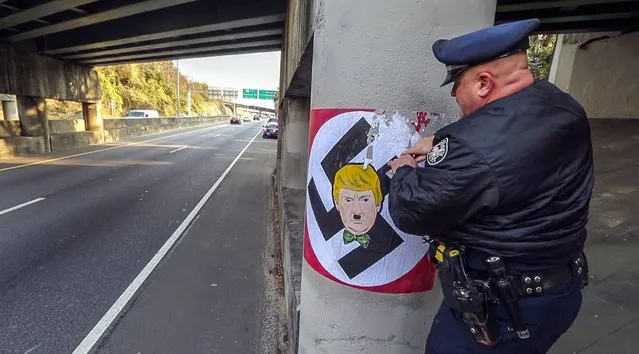
A photo provided by the Atlanta Journal-Constitution shows Atlanta police officer T. R. Coxe removing painted material of a large swastika featuring a likeness of Republican presidential candidate, Donald Trump, along the northbound Buford Highway Connector just south of the Piedmont exit, in Atlanta, Georgia, USA, 09 December 2015. Just days after Donald Trump's call to ban Muslims from entering the United States, someone painted large swastikas featuring the Republican presidential candidate's face on at least two northeast Atlanta bridge supports. The symbol, which includes a cartoon of Trump sporting a Hitler-like mustache, was painted along the Buford Highway Connector. A second, similar image was found on a concrete bridge support on nearby Piedmont Road. Trump said in a statement released on 07 December that there should be a total and complete shutdown of Muslims entering the United States. (Photo by John Spink/EPA/AJC)
Details
11 Dec 2015 11:49:00
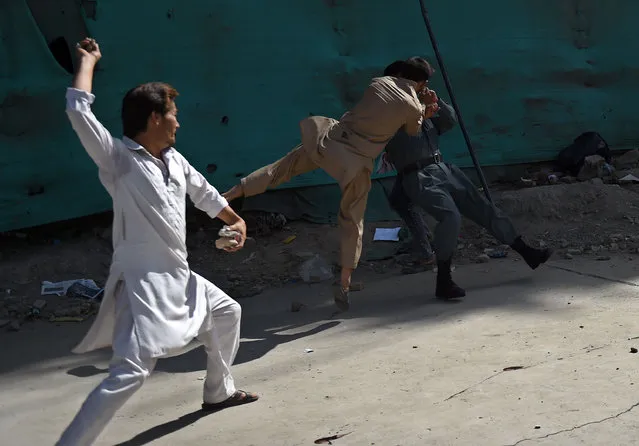
Afghan protesters beat a policeman after a suicide attack that targeted crowds of minority Shiite Hazaras during a demonstration at the Deh Mazang Circle of Kabul on July 23, 2016. Islamic State jihadists claimed responsibility for twin explosions July 23 that ripped through crowds of Shiite Hazaras in Kabul, killing at least 61 people and wounding 207 others in apparently their deadliest attack in the Afghan capital. The bombings during a huge protest over a power transmission line could deepen sectarian divisions in a country well known for communal harmony despite decades of war. (Photo by Wakil Kohsar/AFP Photo)

Afghan protesters beat a policeman after a suicide attack that targeted crowds of minority Shiite Hazaras during a demonstration at the Deh Mazang Circle of Kabul on July 23, 2016. Islamic State jihadists claimed responsibility for twin explosions July 23 that ripped through crowds of Shiite Hazaras in Kabul, killing at least 61 people and wounding 207 others in apparently their deadliest attack in the Afghan capital. The bombings during a huge protest over a power transmission line could deepen sectarian divisions in a country well known for communal harmony despite decades of war. (Photo by Wakil Kohsar/AFP Photo)
Details
25 Jul 2016 11:46:00
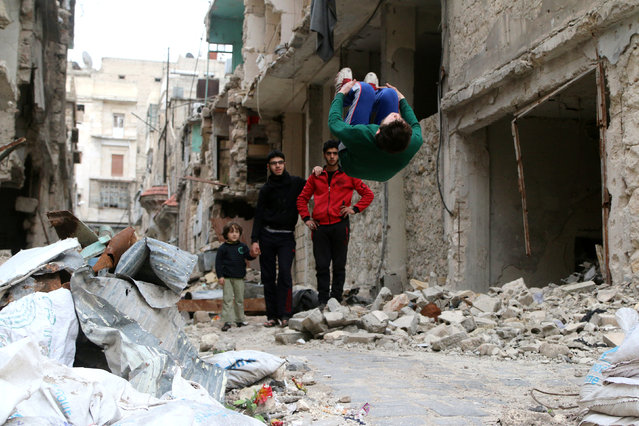
Gymnast Ahmad al-Sawas performs gymnastic moves near damaged buildings in the rebel-held Bustan al-Qasr neighbourhood of Aleppo, Syria March 26, 2016. As Syrian gymnast Ahmad al-Sawas watched his country fall apart, his Olympic dream collapsed too. The last national champion before the fighting began, he knew that supporting the anti-government side in the five-year-old civil war would prevent him from being selected for the Rio Games. “I chose to be an athlete who participates in the revolution”, said Ahmad, who trains where he can for two hours a day – be it on a mattress on a soccer field, in a local hall or somersaulting off a wall. (Photo by Abdalrhman Ismail/Reuters)

Gymnast Ahmad al-Sawas performs gymnastic moves near damaged buildings in the rebel-held Bustan al-Qasr neighbourhood of Aleppo, Syria March 26, 2016. As Syrian gymnast Ahmad al-Sawas watched his country fall apart, his Olympic dream collapsed too. The last national champion before the fighting began, he knew that supporting the anti-government side in the five-year-old civil war would prevent him from being selected for the Rio Games. (Photo by Abdalrhman Ismail/Reuters)
Details
05 Aug 2016 13:25:00
The Wadi al-Salam cemetery, Arabic for “Peace Valley”, is seen in Najaf, south of Baghdad, Iraq August 3, 2016. The world's largest cemetery, in Iraq's Shi'ite holy city of Najaf, is expanding at double its usual rate as Shi'ite militias bury their dead from the war against Islamic State. The Wadi al-Salam cemetery, Arabic for “Peace Valley” has a special place in the hearts of Shi'ite Muslims as it surrounds the Mausoleum of their first imam, Ali Bin Abi Talib, a cousin and son-in-law of Prophet Mohammad. (Photo by Alaa Al-Marjani/Reuters)

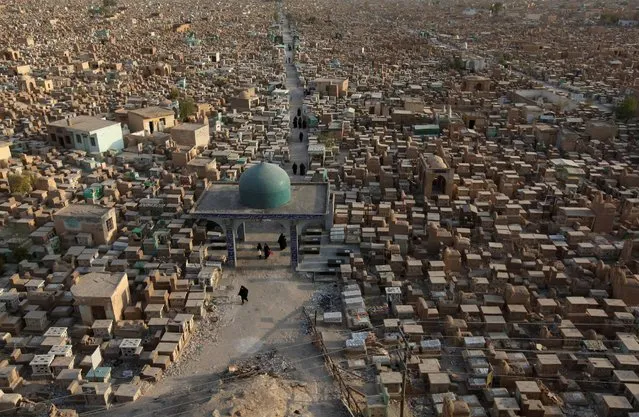
The Wadi al-Salam cemetery, Arabic for “Peace Valley”, is seen in Najaf, south of Baghdad, Iraq August 3, 2016. The world's largest cemetery, in Iraq's Shi'ite holy city of Najaf, is expanding at double its usual rate as Shi'ite militias bury their dead from the war against Islamic State. The Wadi al-Salam cemetery, Arabic for “Peace Valley” has a special place in the hearts of Shi'ite Muslims as it surrounds the Mausoleum of their first imam, Ali Bin Abi Talib, a cousin and son-in-law of Prophet Mohammad. (Photo by Alaa Al-Marjani/Reuters)
Details
24 Aug 2016 11:38:00