Loading...
Done
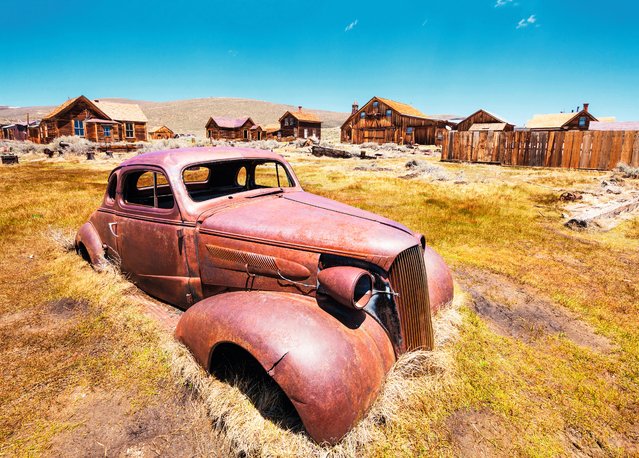
Bodie, Mono County, California. Gold was discovered at Bodie in 1859 (just after the initial California gold rush) and it went from mining camp to boomtown. Its decline began in 1880, when word spread of new boomtowns elsewhere. The Standard Consolidated Mine closed in 1913, and four years later the Bodie Railway was abandoned. By 1940 the population was down to 40. Today, Bodie is maintained in a state of arrested decay as a visitor attraction. (Photo by Alamy Stock Photo)

Kieron Connolly’s new book of photographs of more than 100 once-busy and often elegant buildings gives an idea of how the world might look if humankind disappeared. Here: Bodie, Mono County, California. Gold was discovered at Bodie in 1859 (just after the initial California gold rush) and it went from mining camp to boomtown. Its decline began in 1880, when word spread of new boomtowns elsewhere. The Standard Consolidated Mine closed in 1913, and four years later the Bodie Railway was abandoned. By 1940 the population was down to 40. Today, Bodie is maintained in a state of arrested decay as a visitor attraction. (Photo by Alamy Stock Photo)
Details
07 Sep 2016 09:50:00
Young men play basketball on an improvised court wedged between a construction site and the shells of once grand colonial homes in Havana, July 20, 2015. As much as the young in Cuba welcome political opening and economic reform, such changes are unlikely to filter down to their lives anytime soon. (Photo by Meridith Kohut/The New York Times)

Young men play basketball on an improvised court wedged between a construction site and the shells of once grand colonial homes in Havana, July 20, 2015. As much as the young in Cuba welcome political opening and economic reform, such changes are unlikely to filter down to their lives anytime soon. (Photo by Meridith Kohut/The New York Times)
Details
07 Aug 2015 11:11:00
Student protestors, including one girl with a camera, struggle with soldiers from the Chinese Army, the PLA. Tiananmen Square, 1989. (Photo by Jeff Widener/Associated Press)

Student protestors, including one girl with a camera, struggle with soldiers from the Chinese Army, the PLA. Tiananmen Square, 1989. (Photo by Jeff Widener/Associated Press)
Details
04 Jun 2013 07:57:00
Pakistani brides attend a mass marriage ceremony in Karachi late March 26, 2013.  Some 110 couples participated in the mass wedding ceremony organised by a local charity welfare trust Al Ghousia. (Photo by Asif Hassan/AFP Photo)

Pakistani brides attend a mass marriage ceremony in Karachi late March 26, 2013. Some 110 couples participated in the mass wedding ceremony organised by a local charity welfare trust Al Ghousia. (Photo by Asif Hassan/AFP Photo)
Details
27 Mar 2013 08:54:00
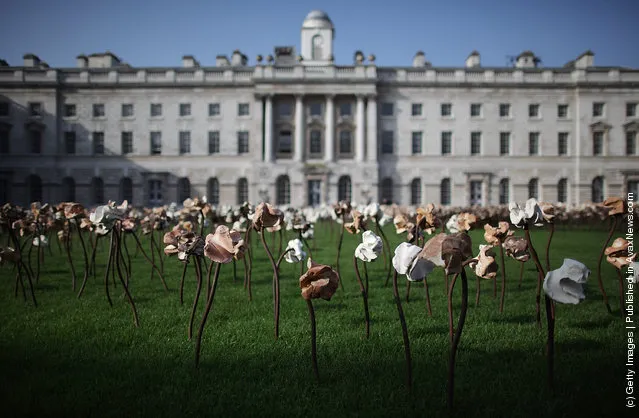
London based Chilean artist Fernando Casasempere poses with his 'Out of Sync' art installation on a grass meadow at Somerset Housein London

In spring sunsunshine the “Out of Sync” art installation is unveiled on a grass meadow at Somerset House on March 15, 2012 in London, England. Chilean artist Fernando Casasempere hand crafted the 10,000 clay flowers that dominate the Edmond J. Safra Fountain Court. The installation is open to the public at Somerset House from March 16th to April 27th 2012. (Photo by Peter Macdiarmid/Getty Images for Somerset House Trust)
Details
17 Mar 2012 11:51:00
Giant Pandas In Beijing Zoo

A pair of giant pandas play in their enclosure at the Beijing Zoo on June 5, 2012 in Beijing, China. With an estimated 1,600 living in the wild, the endangered giant panda dwell in a few mountain ranges in central China, in Sichuan, Shaanxi, and Gansu provinces. (Photo by Lintao Zhang)
Details
06 Jun 2012 12:02:00
Ginny - The Dog Who Rescues Cats

Ginny, a seventeen-year old schnauzer-husky mix from Long Beach, Long Island who was famous for rescuing cats, was killed off by her owner, Philip Gonzalez, on August 25th. At the time of her death she had stopped eating and was incontinent and arthritic.
Details
06 Oct 2012 12:16:00
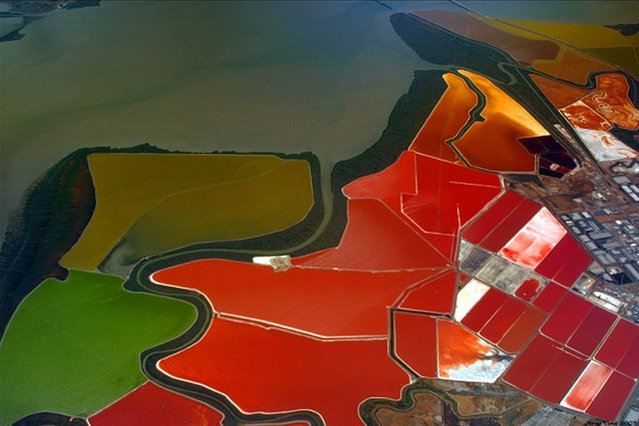
Salt ponds in San Francisco Bay

Salt evaporation ponds, also called salterns or salt pans, are shallow artificial ponds designed to produce salts from sea water or other brines. The seawater or brine is fed into large ponds and water is drawn out through natural evaporation which allows the salt to be subsequently harvested. The ponds also provide a productive resting and feeding ground for many species of waterbirds, which may include endangered species. The ponds are commonly separated by levees.
Details
11 Oct 2012 12:49:00