Loading...
Done


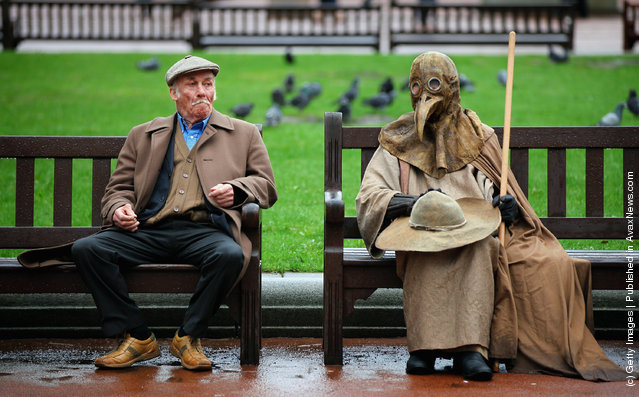
Glasgow based artist dressed Frank To dressed in a medieval Plague Doctor costume sits beside 72-year-old Willie Kennedy from Glasgow on March 31, 2011 in Glasgow, Scotland. The artist is promoting his first major exhibition in two years, “The Human Condition”, which opens tomorrow at the Leith Gallery in Edinburgh. The artist is showing a series of pictures which depict Mediaeval Plague Doctors, which have fascinated the artist for the last three years. (Photo by Jeff J Mitchell/Getty Images)
Details
01 Apr 2011 13:37:00
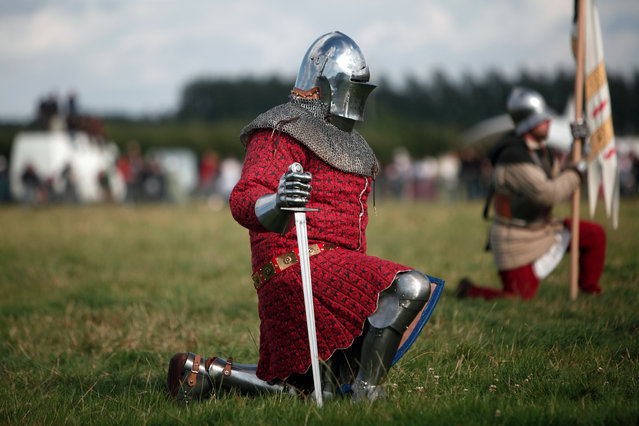
A man wearing an armor attends a reenactment of the Battle of Agincourt, in Agincourt, northern France, Saturday, July 25, 2015. (Photo by Thibault Camus/AP Photo)

A man wearing an armor attends a reenactment of the Battle of Agincourt, in Agincourt, northern France, Saturday, July 25, 2015. The French are hosting a reenactment of the clash with England this weekend. More than 800 people in Medieval garb are gathering at the site to commemorate the battle, which was a turning point in the Hundred Years' War. (Photo by Thibault Camus/AP Photo)
Details
27 Jul 2015 11:20:00
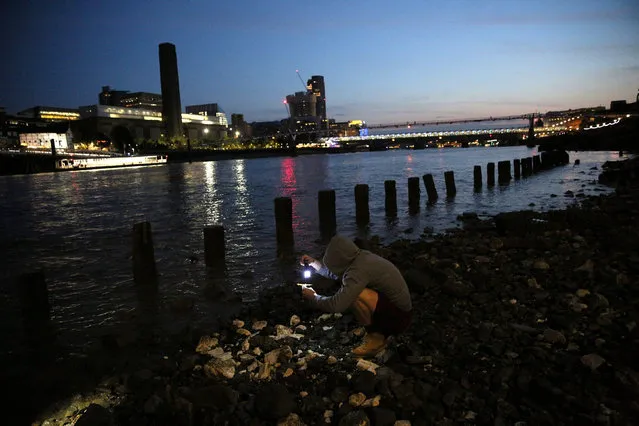
A mudlark uses a torch to look for items on the bank of the River Thames in London, Britain June 06, 2016. Mudlarking is believed to trace its origins to the 18th and 19th century, when scavengers searched the Thames' shores for items to sell. These days, history and archaeology fans are the ones hoping to find old relics such as coins, ceramics, artifacts or everyday items from across centuries. They wait for the low tide and then scour specific areas of exposed shores. "If you're in a field you could be out all day long, with the river you're restricted to about two or three hours," mudlark Nick Stevens said. While many just use the naked eye for their searches, others rely on metal detectors for which a permit from the Port of London Authority is needed. Digging also requires consent. (Photo by Neil Hall/Reuters)

A mudlark uses a torch to look for items on the bank of the River Thames in London, Britain June 06, 2016. Mudlarking is believed to trace its origins to the 18th and 19th century, when scavengers searched the Thames' shores for items to sell. These days, history and archaeology fans are the ones hoping to find old relics such as coins, ceramics, artifacts or everyday items from across centuries. their finds with the Portable Antiquities Scheme. Any item over 300 years old must be recorded. (Photo by Neil Hall/Reuters)
Details
27 Aug 2016 10:43:00
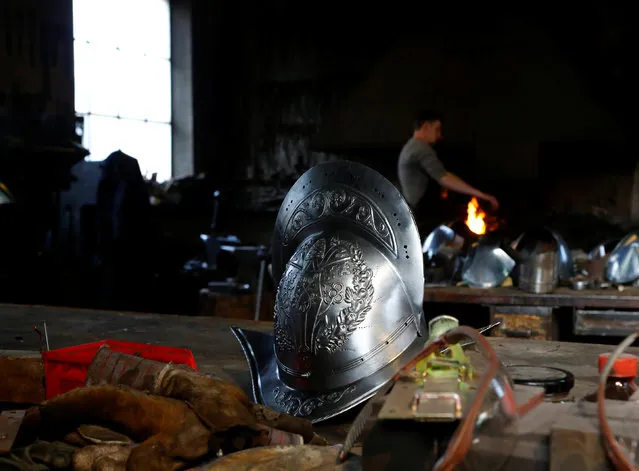
Blacksmith Johann Schmidberger works on a suit of armour for the Vatican's Swiss Guards at his workshop in Molln, Austria, March 29, 2017. (Photo by Leonhard Foeger/Reuters)

Blacksmith Johann Schmidberger works on a suit of armour for the Vatican's Swiss Guards at his workshop in Molln, Austria, March 29, 2017. Austrian blacksmiths who produce ceremonial suits of armour for the Vatican's Swiss Guards are close to the end of their current deal to do so, and say supplying the suits will not now be an issue for many years to come. One of the drawbacks of the Swiss Guards' medieval uniforms is that the craftsmanship needed to make them is disappearing. (Photo by Leonhard Foeger/Reuters)
Details
06 Apr 2017 09:08:00
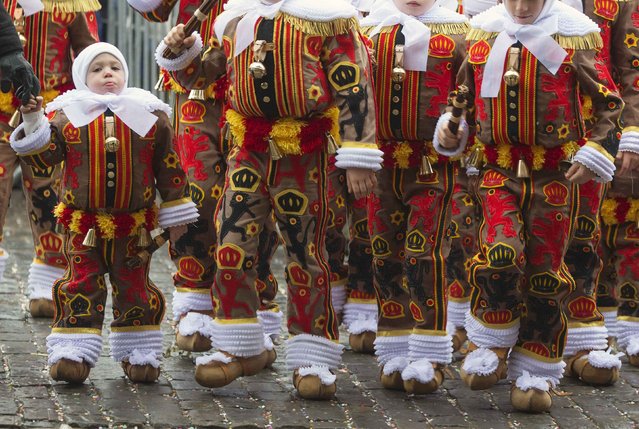
Hugo Belleri (L), a three-year-old boy and the youngest Gilles of Binche, takes part in the parade of Young Gilles of Binche during the carnival event in Binche February 17, 2015. (Photo by Yves Herman/Reuters)

Hugo Belleri (L), a three-year-old boy and the youngest Gilles of Binche, takes part in the parade of Young Gilles of Binche during the carnival event in Binche February 17, 2015. The Binche carnival, a UNESCO World Heritage event, is the biggest and the liveliest annual event in Belgium. Up to 1,000 Gilles parade in the city centre of Binche, wearing a red, yellow and black medieval costume hung with bells and decorated with fluffy lace at the neck, wrists and ankles. (Photo by Yves Herman/Reuters)
Details
18 Feb 2015 12:32:00
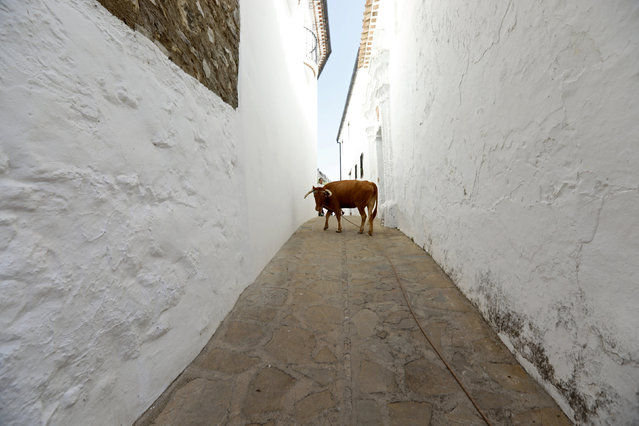
A heifer, tied with a rope, turns during “Toro de Cuerda” in the white village of Villaluenga del Rosario, southern Spain September 3, 2016. Dazzling clusters of cube-shaped houses perched on top of Andalusia's olive tree-studded mountains, the “Pueblos Blancos”, or white villages, of southern Spain are named for the lime wash the buildings are painted with to keep the interiors cool. The labyrinths of narrow alleyways are a throwback to when this region was known as Al-Andalus and was part of a medieval Muslim territory. While this region is stunningly beautiful and a big draw to tourists visiting the south of Spain, it is also one of the poorest areas in the country and has one of the highest unemployment rates in the European Union. (Photo by Marcelo del Pozo/Reuters)

A heifer, tied with a rope, turns during “Toro de Cuerda” in the white village of Villaluenga del Rosario, southern Spain September 3, 2016. Dazzling clusters of cube-shaped houses perched on top of Andalusia's olive tree-studded mountains, the “Pueblos Blancos”, or white villages, of southern Spain are named for the lime wash the buildings are painted with to keep the interiors cool. The labyrinths of narrow alleyways are a throwback to when this region was known as Al-Andalus and was part of a medieval Muslim territory. While this region is stunningly beautiful and a big draw to tourists visiting the south of Spain, it is also one of the poorest areas in the country and has one of the highest unemployment rates in the European Union. (Photo by Marcelo del Pozo/Reuters)
Details
20 Oct 2016 11:09:00
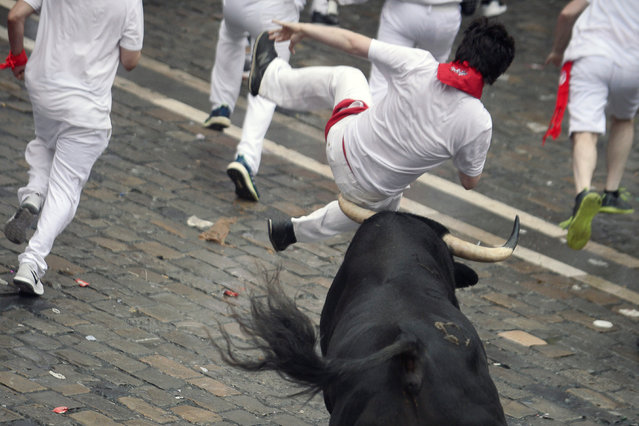
A bull hits a reveller during the first running of the bulls of the San Fermin festival in Pamplona, Spain, July 7, 2018. (Photo by Vincent West/Reuters)

A bull hits a reveller during the first running of the bulls of the San Fermin festival in Pamplona, Spain, July 7, 2018. Each day at 8am hundreds of people race with six bulls, charging along a winding, 848.6-metre (more than half a mile) course through narrow streets to the city's bull ring, where the animals are killed in a bullfight or corrida, during this festival dating back to medieval times and also featuring religious processions, folk dancing, concerts and round-the-clock drinking. (Photo by Vincent West/Reuters)
Details
11 Jul 2018 00:05:00
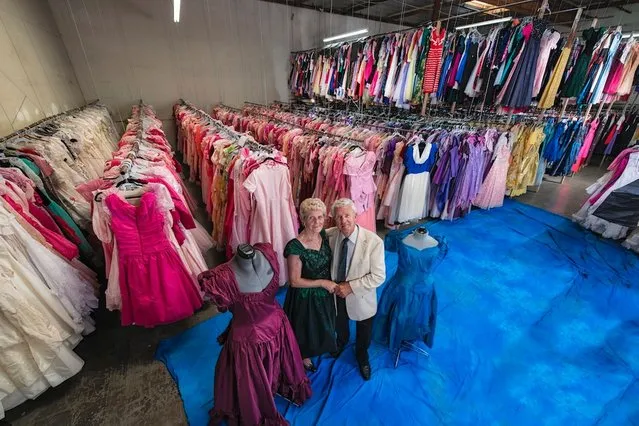
Paul Brockmans Collection Of 55,000 Dresses Bought For His Wife

There are many types of collections. Some are formed by purposefully collecting certain objects, such as stamps or coins. However, some collections are only a byproduct of an obsession, a quirk of mind. For example, Paul Brockmann got into the habit of buying his girlfriend and later his wife a dress every time they went ballroom dancing. It might seem excessive to some, but it was his way of showing his affection. Overtime, this collection grew to be enormous, counting 55,000 dresses in total. Basic math tells us that either they went ballroom dancing three times per day for every day of their lives, or he bought them in huge bundles every time.
Details
28 Mar 2015 10:11:00