Loading...
Done
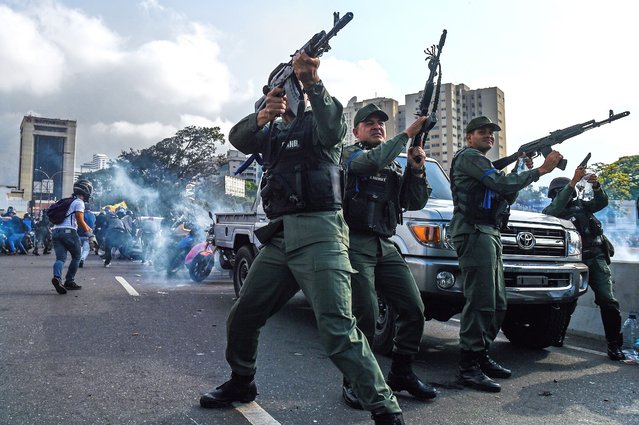
Members of the Bolivarian National Guard who joined Venezuelan opposition leader and self-proclaimed acting president Juan Guaido fire into the air to repel forces loyal to President Nicolas Maduro who arrived to disperse a demonstration near La Carlota military base in Caracas on April 30, 2019. Guaido – accused by the government of attempting a coup Tuesday – said there was “no turning back” in his attempt to oust President Nicolas Maduro from power. (Photo by Federico Parra/AFP Photo)

Members of the Bolivarian National Guard who joined Venezuelan opposition leader and self-proclaimed acting president Juan Guaido fire into the air to repel forces loyal to President Nicolas Maduro who arrived to disperse a demonstration near La Carlota military base in Caracas on April 30, 2019. Guaido – accused by the government of attempting a coup Tuesday – said there was “no turning back” in his attempt to oust President Nicolas Maduro from power. (Photo by Federico Parra/AFP Photo)
Details
02 May 2019 00:05:00
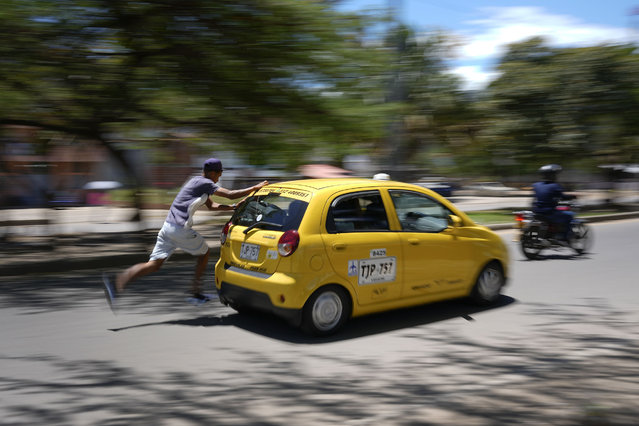
A porter runs behind a taxi carrying clients to Colombia's border with Venezuela in hopes of getting hired by the passengers to help carry their belongings across the border, which Venezuela partially closed seven years prior, in Cucuta, Colombia, early Monday, August 8, 2022. Colombia’s incoming foreign minister and his Venezuelan counterpart announced in late July that the border will gradually reopen after the two nations restore diplomatic ties. (Photo by Matias Delacroix/AP Photo)

A porter runs behind a taxi carrying clients to Colombia's border with Venezuela in hopes of getting hired by the passengers to help carry their belongings across the border, which Venezuela partially closed seven years prior, in Cucuta, Colombia, early Monday, August 8, 2022. Colombia’s incoming foreign minister and his Venezuelan counterpart announced in late July that the border will gradually reopen after the two nations restore diplomatic ties. (Photo by Matias Delacroix/AP Photo)
Details
31 Aug 2022 04:52:00
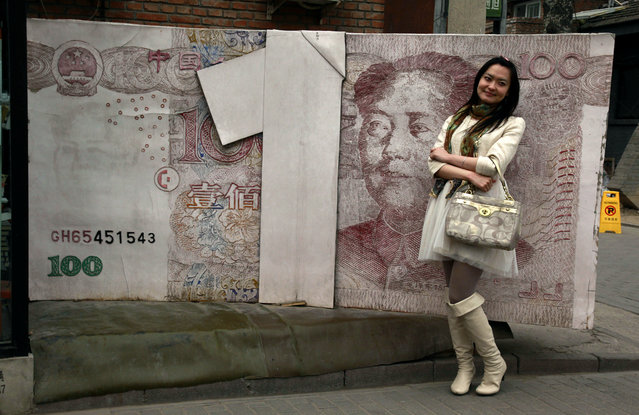
In this March 15, 2012 file photo, a Chinese woman poses for photos near a sculpture depicting a Chinese yuan note at an art district in Beijing, China. China devalued its tightly controlled currency on Tuesday, August 11,2015,  following a slump in trade, triggering the yuan's biggest one-day decline in a decade. The central bank said the yuan's 1.3 percent fall was due to a change aimed at making its exchange rate controls more market-oriented. But any change raises the risk of tensions with China's trading partners. (Photo by Ng Han Guan/AP Photo)

In this March 15, 2012 file photo, a Chinese woman poses for photos near a sculpture depicting a Chinese yuan note at an art district in Beijing, China. China devalued its tightly controlled currency on Tuesday, August 11,2015, following a slump in trade, triggering the yuan's biggest one-day decline in a decade. The central bank said the yuan's 1.3 percent fall was due to a change aimed at making its exchange rate controls more market-oriented. But any change raises the risk of tensions with China's trading partners. (Photo by Ng Han Guan/AP Photo)
Details
12 Aug 2015 13:11:00
A man holds up for a picture a one hundred trillion Zimbabwean dollars note inside a shop in Harare, Zimbawe, June 12, 2015. (Photo by Philimon Bulawayo/Reuters)

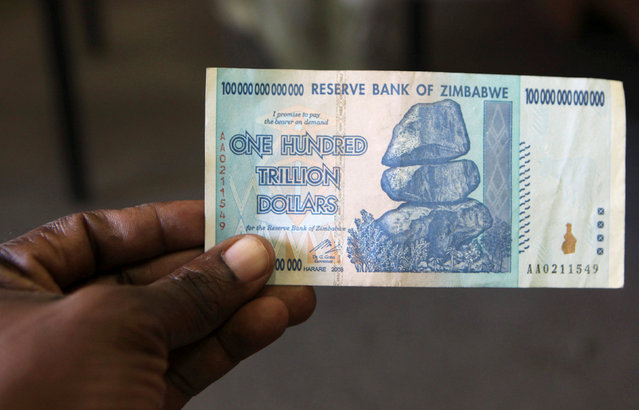
A man holds up for a picture a one hundred trillion Zimbabwean dollars note inside a shop in Harare, Zimbawe, June 12, 2015. Hyperinflation in Zimbabwe was a period of currency instability that began in the late 1990s shortly after the confiscation of private farms from landowners, towards the end of Zimbabwean involvement in the Second Congo War. During the height of inflation from 2008 to 2009, it was difficult to measure Zimbabwe's hyperinflation because the government of Zimbabwe stopped filing official inflation statistics. However, Zimbabwe's peak month of inflation is estimated at 79.6 billion percent in mid-November 2008. (Photo by Philimon Bulawayo/Reuters)
Details
25 Oct 2016 10:08:00
Carlos Martinez (L), a representative of the Guinness World Records, examines the cooking process of a chocolate coin during an attempt to break the Guinness World Record for the biggest chocolate coin in Caracas, Venezuela, October 1, 2015. (Photo by Carlos Garcia Rawlins/Reuters)

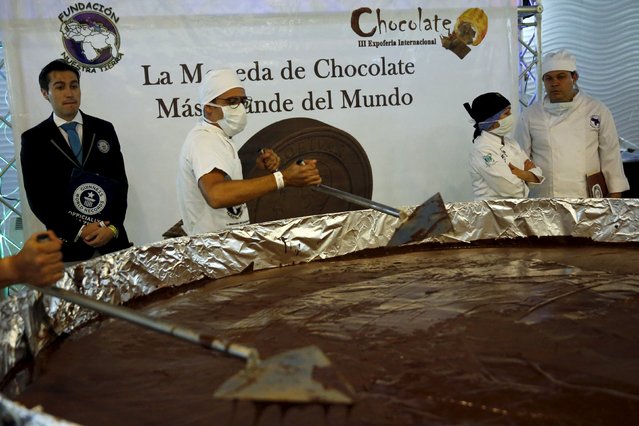
Carlos Martinez (L), a representative of the Guinness World Records, examines the cooking process of a chocolate coin during an attempt to break the Guinness World Record for the biggest chocolate coin in Caracas, Venezuela, October 1, 2015. More than 80 people will work with 100% Venezuelan cacao to create the coin that is estimated to weigh 1,000 kg, according to local media. (Photo by Carlos Garcia Rawlins/Reuters)
Details
04 Oct 2015 08:06:00
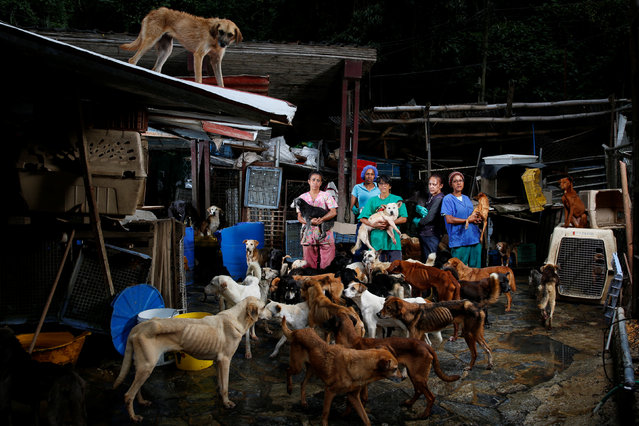
(L-R) Maria Silva, Milena Cortes, Maria Arteaga, Jackeline Bastidas and Gissy Abello pose for a picture at the Famproa dogs shelter where they work, in Los Teques, Venezuela, August 25, 2016. Venezuelans struggling to feed their families let alone their pets are dumping animals on the streets, in parks and at makeshift homes overrun with scrawny animals amid an economic crisis. An hour from Caracas in Los Teques, hundreds of dogs bark and run around the streets scavenging for food outside a makeshift shelter. People come by every few hours to hand over scrawny dogs which are fed by volunteers every day. Venezuela is undergoing a major economic and social crisis, with shortages of basic foods and medicines. Triple digit inflation is hitting everybody hard, including those who own pets. (Photo by Carlos Garcia Rawlins/Reuters)

(L-R) Maria Silva, Milena Cortes, Maria Arteaga, Jackeline Bastidas and Gissy Abello pose for a picture at the Famproa dogs shelter where they work, in Los Teques, Venezuela, August 25, 2016. Venezuelans struggling to feed their families let alone their pets are dumping animals on the streets, in parks and at makeshift homes overrun with scrawny animals amid an economic crisis. An hour from Caracas in Los Teques, hundreds of dogs bark and run around the streets scavenging for food outside a makeshift shelter. (Photo by Carlos Garcia Rawlins/Reuters)
Details
08 Sep 2016 10:01:00
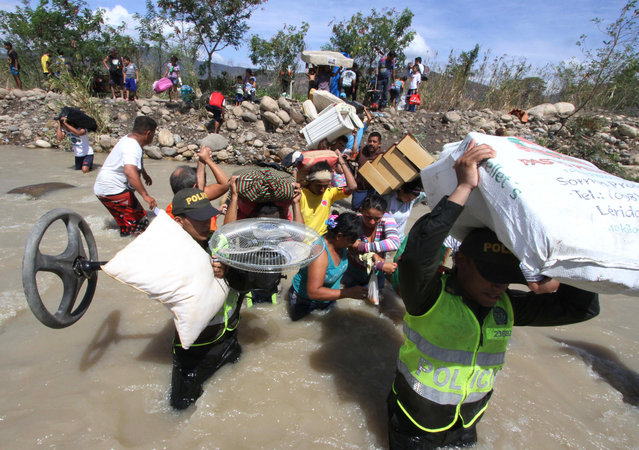
Colombian police help carry people's household belongings across the Tachira River from Venezuela, top, to Colombia, on the border that separates San Antonio del Tachira, Venezuela from Villa del Rosario, Colombia, Tuesday, August 25, 2015, during a mass exodus of Colombians. (Photo by Eliecer Mantilla/AP Photo)

Colombian police help carry people's household belongings across the Tachira River from Venezuela, top, to Colombia, on the border that separates San Antonio del Tachira, Venezuela from Villa del Rosario, Colombia, Tuesday, August 25, 2015, during a mass exodus of Colombians. Venezuelan President Nicolas Maduro vowed to extend a crackdown on illegal migrants from neighboring Colombia he blames for rampant crime and widespread shortages, while authorities across the border struggled to attend to droves of returning deportees. (Photo by Eliecer Mantilla/AP Photo)
Details
26 Aug 2015 09:18:00
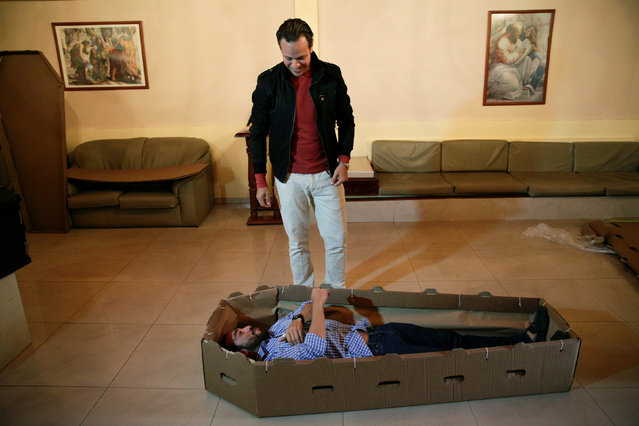
Elio Angulo (bottom C) lies inside a cardboard coffin next to Alejandro Blanchard as they introduce their product to potential customers at a mortuary in Valencia, in the state of Carabobo, Venezuela August 25, 2016. (Photo by Marco Bello/Reuters)

Elio Angulo (bottom C) lies inside a cardboard coffin next to Alejandro Blanchard as they introduce their product to potential customers at a mortuary in Valencia, in the state of Carabobo, Venezuela August 25, 2016. When Venezuelan entrepreneurs Alejandro Blanchard and Elio Angulo decided to create cardboard coffins, they were looking for an ecological selling point to compete against classic wood and brass caskets. Three years on, with the oil-rich country mired in deep economic crisis, their “bio-coffins” are becoming a viable option because of high prices for wooden coffins and shortages of brass ones. (Photo by Marco Bello/Reuters)
Details
27 Aug 2016 11:18:00