Loading...
Done
A firefighter holds a red panda (Ailurus fulgens) from its tail while removing it from a tree at a residential area in Kunming, Yunnan province, July 3, 2014. (Photo by Reuters/Stringer)

A firefighter holds a red panda (Ailurus fulgens) from its tail while removing it from a tree at a residential area in Kunming, Yunnan province, July 3, 2014. The animal was spotted in the residential area and was brought down from the tree after residents reported its sighting to the police, local media reported. (Photo by Reuters/Stringer)
Details
05 Jul 2014 12:53:00
A man removes ice from an ice-covered car with a hammer in Postojna, Slovenia, on February 5, 2014. Cars stand entombed in a crystal-like casing near the deserted railway station in Postojna. Trees and electricity pylons lie felled in the snow by the sheer weight of ice enveloping them. (Photo by Srdjan Zivulovic/Reuters)

A man removes ice from an ice-covered car with a hammer in Postojna, Slovenia, on February 5, 2014. Cars stand entombed in a crystal-like casing near the deserted railway station in Postojna. Trees and electricity pylons lie felled in the snow by the sheer weight of ice enveloping them. (Photo by Srdjan Zivulovic/Reuters)
Details
06 Feb 2014 11:14:00
U.S. Capitol Police remove protesters after they began shouting in a Senate Appropriations Committee hearing as Office of Management and Budget director Russell Vought begins to testify on the rescissions package, at the Capitol in Washington, Wednesday, June 25, 2025. (Photo by J. Scott Applewhite/AP Photo)

U.S. Capitol Police remove protesters after they began shouting in a Senate Appropriations Committee hearing as Office of Management and Budget director Russell Vought begins to testify on the rescissions package, at the Capitol in Washington, Wednesday, June 25, 2025. (Photo by J. Scott Applewhite/AP Photo)
Details
05 Jul 2025 03:48:00
A mudlark uses a torch to look for items on the bank of the River Thames in London, Britain June 06, 2016. Mudlarking is believed to trace its origins to the 18th and 19th century, when scavengers searched the Thames' shores for items to sell. These days, history and archaeology fans are the ones hoping to find old relics such as coins, ceramics, artifacts or everyday items from across centuries. They wait for the low tide and then scour specific areas of exposed shores. "If you're in a field you could be out all day long, with the river you're restricted to about two or three hours," mudlark Nick Stevens said. While many just use the naked eye for their searches, others rely on metal detectors for which a permit from the Port of London Authority is needed. Digging also requires consent. (Photo by Neil Hall/Reuters)

A mudlark uses a torch to look for items on the bank of the River Thames in London, Britain June 06, 2016. Mudlarking is believed to trace its origins to the 18th and 19th century, when scavengers searched the Thames' shores for items to sell. These days, history and archaeology fans are the ones hoping to find old relics such as coins, ceramics, artifacts or everyday items from across centuries. their finds with the Portable Antiquities Scheme. Any item over 300 years old must be recorded. (Photo by Neil Hall/Reuters)
Details
27 Aug 2016 10:43:00
Oil Paintings By Paul David Bond

Paul Bond's art lives in the spaces between dreaming and reality. Drawing from the Latin American genre of Magic Realism where symbolic, surreal and fantastic elements blend with realistic atmospheres, they remove the veil on a world where everything is possible.
Details
31 May 2013 15:58:00
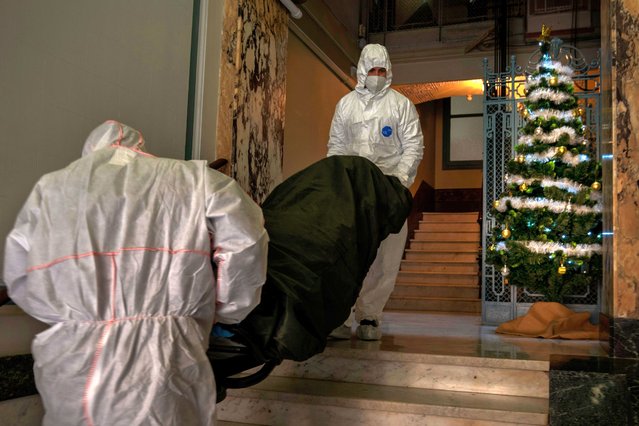
Family members mourn the passing of Manuela Chavez, who died from symptoms related to the new coronavirus at the age of 88, as a government team prepares to remove her body from inside her home, in the Shipibo Indigenous community of Pucallpa, in Peru's Ucayali region, Monday, August 31, 2020. While the lucky are cured with ancestral ailments, the less fortunate often die at home. A government team travels from one spartan, thatch-roofed home to the next, removing the dead from their homes where they took their last breaths. (Photo by Rodrigo Abd/AP Photo)

Family members mourn the passing of Manuela Chavez, who died from symptoms related to the new coronavirus at the age of 88, as a government team prepares to remove her body from inside her home, in the Shipibo Indigenous community of Pucallpa, in Peru's Ucayali region, Monday, August 31, 2020. While the lucky are cured with ancestral ailments, the less fortunate often die at home. A government team travels from one spartan, thatch-roofed home to the next, removing the dead from their homes where they took their last breaths. (Photo by Rodrigo Abd/AP Photo)
Details
18 Sep 2020 00:03:00
Tourists play at a beach covered by a thick layer of green algae in Qingdao, China, on July 3, 2013. A large quantity of non-poisonous green seaweed, enteromorpha prolifera, hit China's Qingdao coast last month. More than 20,000 tons of such seaweed has been removed from the city's beaches. This has now become an annual summer event. (Photo by Whitehotpix/ZumaPress.com)

Tourists play at a beach covered by a thick layer of green algae in Qingdao, China, on July 3, 2013. A large quantity of non-poisonous green seaweed, enteromorpha prolifera, hit China's Qingdao coast last month. More than 20,000 tons of such seaweed has been removed from the city's beaches. This has now become an annual summer event. (Photo by Whitehotpix/ZumaPress.com)
Details
04 Aug 2013 09:19:00
In this Friday, December 4, 2018 photo, a half sunken cruise ship lays on its side, in the Gulf of Elefsina, west of Athens. Dozens of abandoned cargo and passenger ships lie semi-submerged or completely sunken around the Gulf of Elefsina, near Greece’s major port of Piraeus. Now authorities are beginning to remove the dilapidated ships. Some of them have been there for decades, leaking hazards like oil into the environment and creating a danger to modern shipping. One expert calls the abandoned ships “an environmental bomb”. (Photo by Thanassis Stavrakis/AP Photo)

In this Friday, December 4, 2018 photo, a half sunken cruise ship lays on its side, in the Gulf of Elefsina, west of Athens. Dozens of abandoned cargo and passenger ships lie semi-submerged or completely sunken around the Gulf of Elefsina, near Greece’s major port of Piraeus. Now authorities are beginning to remove the dilapidated ships. Some of them have been there for decades, leaking hazards like oil into the environment and creating a danger to modern shipping. One expert calls the abandoned ships “an environmental bomb”. (Photo by Thanassis Stavrakis/AP Photo)
Details
08 Jan 2019 00:05:00