Loading...
Done
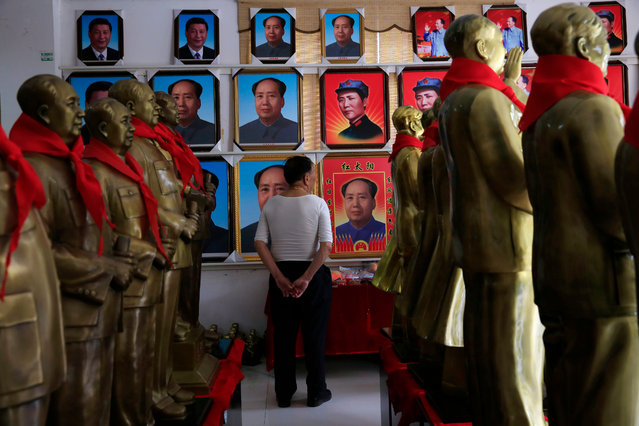
A visitor looks at portraits of Mao Zedong amid his statues on display at a wholesale souvenir store in Shaoshan, Hunan Province in central China, 28 April 2016. Shaoshan is the hometown of former Communist leader Mao Zedong, popularly known as Chairman Mao. Thousands of visitors descend on this small Chinese town burrowed in the hills of Central China's Hunan province to pay homage to the “Great Helmsman” everyday. (Photo by How Hwee Young/EPA)

A visitor looks at portraits of Mao Zedong amid his statues on display at a wholesale souvenir store in Shaoshan, Hunan Province in central China, 28 April 2016. Shaoshan is the hometown of former Communist leader Mao Zedong, popularly known as Chairman Mao. Thousands of visitors descend on this small Chinese town burrowed in the hills of Central China's Hunan province to pay homage to the “Great Helmsman” everyday. It is one of the core sites of the “Red Tourism” industry, where communist party cadres and ordinary Chinese tourists alike seek to relive the experiences and rekindle the spirit of the revolutionaries. (Photo by How Hwee Young/EPA)
Details
08 May 2016 11:19:00
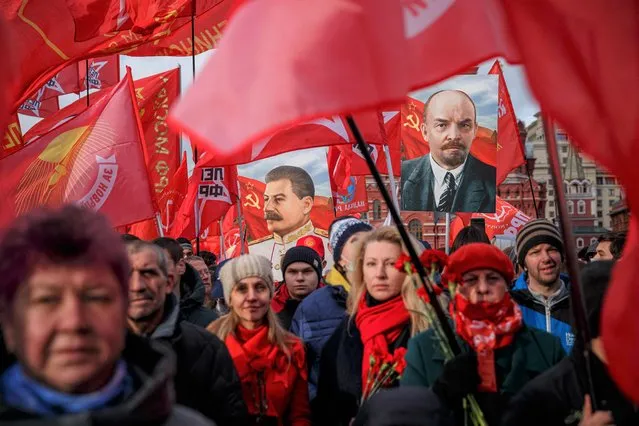
Russian Communist party activists and supporters carry portraits of Soviet founder Vladimir Lenin (R) and Soviet dictator Josef Stalin (L) as they attend a flowers-laying ceremony at the Lenin's Mausoleum on Red Square in downtown Moscow on November 7, 2021, marking the 104th anniversary of the Bolshevik Revolution also known as the October Revolution. (Photo by Dimitar Dilkoff/AFP Photo)

Russian Communist party activists and supporters carry portraits of Soviet founder Vladimir Lenin (R) and Soviet dictator Josef Stalin (L) as they attend a flowers-laying ceremony at the Lenin's Mausoleum on Red Square in downtown Moscow on November 7, 2021, marking the 104th anniversary of the Bolshevik Revolution also known as the October Revolution. (Photo by Dimitar Dilkoff/AFP Photo)
Details
18 Nov 2021 08:34:00
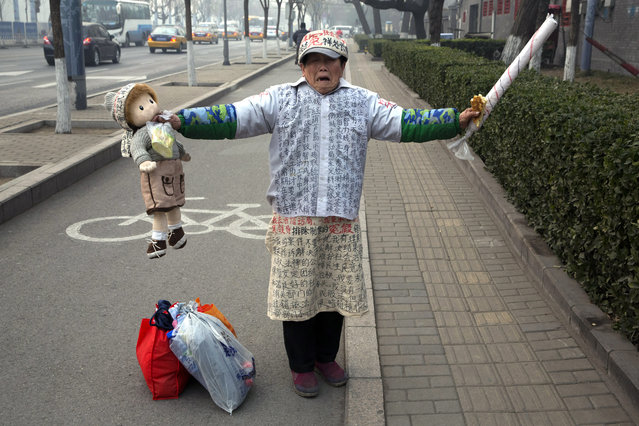
A petitioner with her grievances written on her clothes walks along a street in Beijing Tuesday, December 22, 2015. After months behind bars, Pu Zhiqiang, one of China's most prominent human rights lawyers, left a detention center Tuesday after receiving a suspended prison sentence in a case involving online comments critical of the ruling Communist Party. (Photo by Ng Han Guan/AP Photo)

A petitioner with her grievances written on her clothes walks along a street in Beijing Tuesday, December 22, 2015. After months behind bars, Pu Zhiqiang, one of China's most prominent human rights lawyers, left a detention center Tuesday after receiving a suspended prison sentence in a case involving online comments critical of the ruling Communist Party. (Photo by Ng Han Guan/AP Photo)
Details
26 Dec 2015 08:05:00
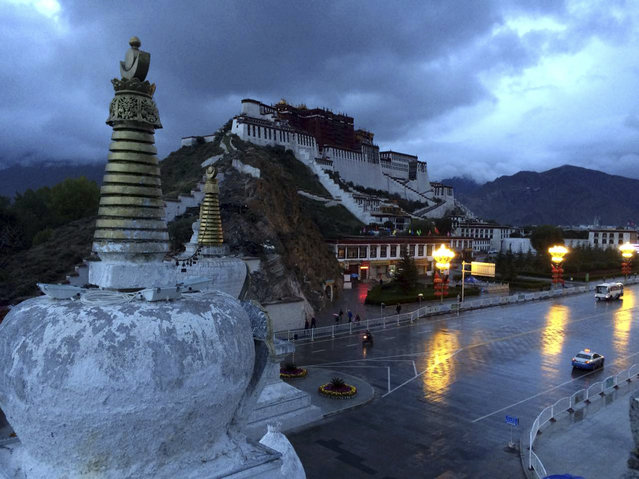
Pedestrians and vehicles make their way past the Potala Palace early on a rainy morning in Lhasa, capital of the Tibet Autonomous Region in China, Saturday, September 19, 2015. (Photo by Aritz Parra/AP Photo)

Pedestrians and vehicles make their way past the Potala Palace early on a rainy morning in Lhasa, capital of the Tibet Autonomous Region in China, Saturday, September 19, 2015. Chinese officials have taken foreign journalists on a visit to the region, normally off-limits to them, weeks after Communist Party officials commemorated the 50th anniversary of the establishment of the Tibet Autonomous Region. (Photo by Aritz Parra/AP Photo)
Details
19 Sep 2015 12:22:00


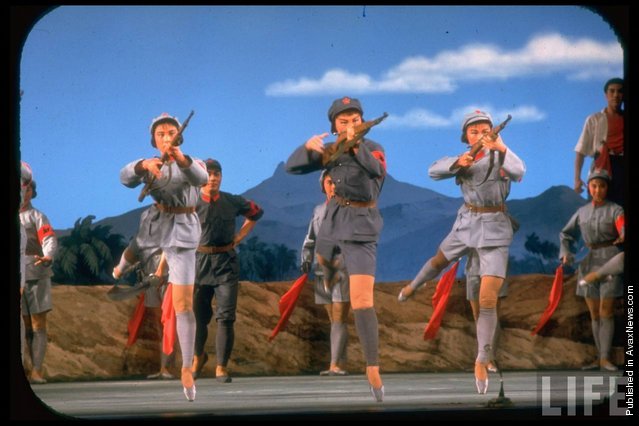
“«The Red Detachment of Women» (simplified Chinese: 红色娘子军) is a Chinese ballet which premiered in 1964. It is perhaps best known in the West as the ballet performed for U.S. President Richard Nixon on his visit to China in February 1972. Adapted from the earlier film of the same title under the personal direction of Zhou Enlai, which in turn adapted from the novel by Liang Xin, it depicts the liberation of a peasant girl in Hainan Island and her rise in the Chinese Communist Party”.
Details
11 Mar 2011 11:36:00
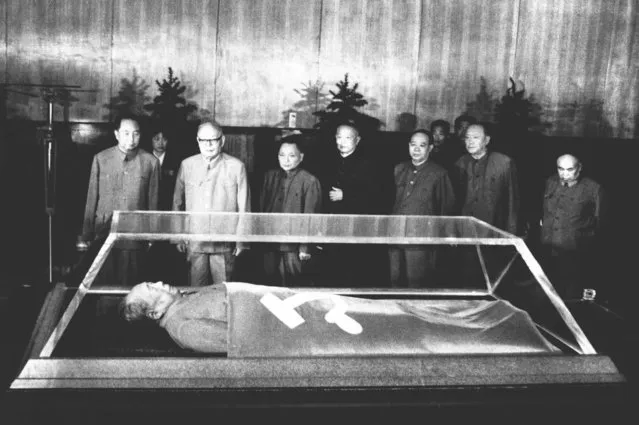
In this September 10, 1977, file photo, from left, Hua Guofeng, Chinese Communist Party (CCP) chairman and Mao Zedong's immediate successor; Ye Jianying, CCP vice chairman and future ceremonial head of state; Deng Xiaoping, no formal titles at the time but soon to emerge as paramount leader during the reform era; Li Xiannian, CCP vice chairman and future president; Wang Dongxing, head of the leadership bodyguard unit who helped topple the Gang of Four, view the body of later Chinese leader Mao Zedong in Beijing. (Photo via AP Photo)

In this September 10, 1977, file photo, from left, Hua Guofeng, Chinese Communist Party (CCP) chairman and Mao Zedong's immediate successor; Ye Jianying, CCP vice chairman and future ceremonial head of state; Deng Xiaoping, no formal titles at the time but soon to emerge as paramount leader during the reform era; Li Xiannian, CCP vice chairman and future president; Wang Dongxing, head of the leadership bodyguard unit who helped topple the Gang of Four, view the body of later Chinese leader Mao Zedong in Beijing. (Photo via AP Photo)
Details
13 Jun 2016 10:34:00
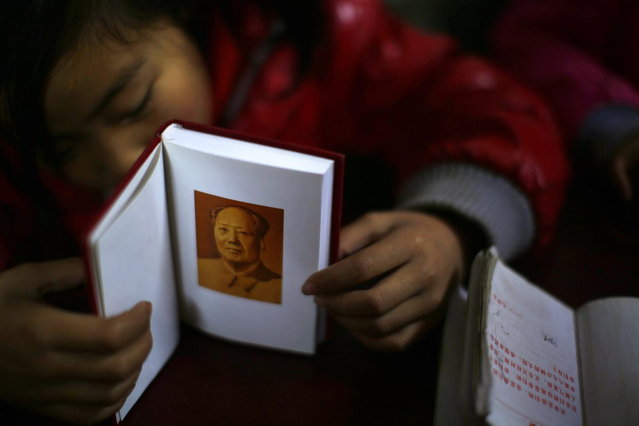
A student falls asleep as she holds a book containing a portrait of China's late chairman Mao Zedong during a lesson at the Democracy Elementary and Middle School in Sitong town, Henan province December 3, 2013. (Photo by Carlos Barria/Reuters)

A student falls asleep as she holds a book containing a portrait of China's late chairman Mao Zedong during a lesson at the Democracy Elementary and Middle School in Sitong town, Henan province December 3, 2013. In a remote part of central China, the day starts at the Democracy Elementary and Middle School with a pre-dawn jog, some revolutionary songs and then an activity long since forgotten at other schools: reciting quotations from Mao Zedong's famed “Little Red Book”. While the ruling Communist Party that Mao led continues to hold him in esteem as the leader of the Communist Revolution, his radical policies and teachings have been largely shelved since his death in 1976 in favour of a pro-market approach that has turned China from a backwater into the world's second biggest economy. The 120th anniversary of Mao's birth is on December 26, 2013. (Photo by Carlos Barria/Reuters)
Details
19 Dec 2013 09:40:00
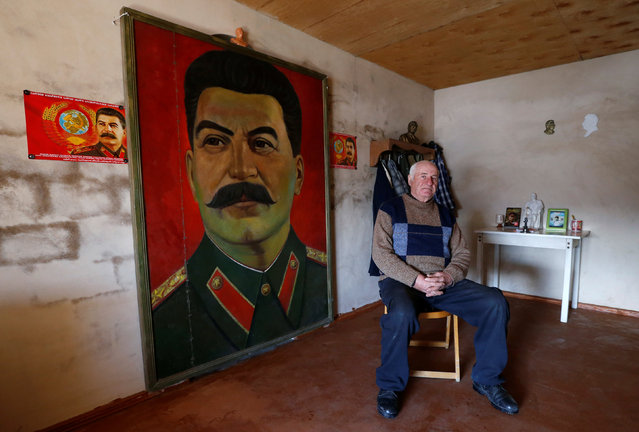
Retired builder Vasili Sidamonidze, 70, poses for a portrait at his home in Gori, Georgia, December 6, 2016. “Unfortunately, Stalin is not popular nowadays. Our people don't respect him. Only we, members of the (Communist) Party, respect him”, Sidamonidze said. “I always try to attend Stalin's birthday anniversaries in Gori. Unfortunately many people don't want to join us even if they live nearby. They look at us from their windows”. Stalin, who was born in Gori in 1878 and died in 1953, is largely reviled today in Georgia, which regained its independence during the 1991 collapse of the Soviet Union. Over the years, his memorials have been dismantled, most recently in 2010 when authorities removed a statue of the dictator from Gori's central square. But Stalin is still revered by a small group of mainly elderly supporters who stress his role in the industrialisation of the Soviet Union and in defeating Nazi Germany in World War Two. Each Dec. 21, a few dozen people mark his birthday by gathering outside a Gori museum dedicated to Stalin, where they make speeches and walk to the square where a 6-meter-high bronze statue of him once stood, calling for it to be reinstated. Opponents say it was a symbol of Moscow's still lingering shadow. In 2008, Russia fought a brief war with Georgia and recognised its breakaway regions of Abkhazia and South Ossetia as independent states. (Photo by David Mdzinarishvili/Reuters)

Retired builder Vasili Sidamonidze, 70, poses for a portrait at his home in Gori, Georgia, December 6, 2016. “Unfortunately, Stalin is not popular nowadays. Our people don't respect him. Only we, members of the (Communist) Party, respect him”, Sidamonidze said. “I always try to attend Stalin's birthday anniversaries in Gori. Unfortunately many people don't want to join us even if they live nearby. They look at us from their windows”. (Photo by David Mdzinarishvili/Reuters)
Details
17 Dec 2016 07:59:00