Loading...
Done
Women wearing traditional hats, known as a non la, sell fruits in Hoi An, Vietnam April 4, 2016. (Photo by Jorge Silva/Reuters)

Women wearing traditional hats, known as a non la, sell fruits in Hoi An, Vietnam April 4, 2016. The non la hats are made of readily available materials such as palm leaves, tree bark and bamboo and are visible everywhere in the city, a UNESCO World Heritage site. Hoi An's history as a busy trading port is evident throughout its architecture, a mix of eras and styles, with traditional wooden Vietnamese houses, Chinese temples and French colonial buildings. (Photo by Jorge Silva/Reuters)
Details
11 May 2016 11:32:00
A man pours red wine on a girl's head during the Batalla del Vino (Battle of Wine) in Haro, on June 29, 2015. Every year thousands of locals and tourists climb a mountain in the northern Spanish province of La Rioja to celebrate St. Peter's day covering each other in red wine while tanker trucks filled with wine distribute the alcoholic beverage to water pistols, back mounted spraying devices, buckets which are randomly poured on heads and into any other available container. (Photo by Cesar Manso/AFP Photo)

A man pours red wine on a girl's head during the Batalla del Vino (Battle of Wine) in Haro, on June 29, 2015. Every year thousands of locals and tourists climb a mountain in the northern Spanish province of La Rioja to celebrate St. Peter's day covering each other in red wine while tanker trucks filled with wine distribute the alcoholic beverage to water pistols, back mounted spraying devices, buckets which are randomly poured on heads and into any other available container. More than nine thousand people threw around 130,000 litres of wine during this year's Haro Wine Festival, according to local media. (Photo by Cesar Manso/AFP Photo)
Details
30 Jun 2015 11:56:00
A view of traditional bolinhos de bacalhau (fried codfish balls) in Rio de Janeiro, Brazil, May 7, 2016. (Photo by Sergio Moraes/Reuters)

If the most popular foods of Rio de Janeiro have one thing in common, it is their informality. You can find fine restaurants in the city, but they do not set Rio apart from other places. What does set it apart, and what invariably brings its residents, known as "Cariocas," together is the unpretentious food they eat in bright, loud, crowded bars and restaurants, on busy street corners, or after a day at the beach. Here: A view of traditional bolinhos de bacalhau (fried codfish balls) in Rio de Janeiro, Brazil, May 7, 2016. (Photo by Sergio Moraes/Reuters)
Details
05 Aug 2016 13:20:00
A catholic faithful smeared in burnt oil, takes part in the opening of the ten-day celebration of the Santo Domingo de Guzman festival in Managua, on August 1, 2019. (Photo by Inti Ocon/AFP Photo)

A catholic faithful smeared in burnt oil, takes part in the opening of the ten-day celebration of the Santo Domingo de Guzman festival in Managua, on August 1, 2019. In Central America the black devil, or El Cadejo, is an evil dog-like spirit with glowing red eyes that locals believe eats new born puppies. (Photo by Inti Ocon/AFP Photo)
Details
06 Aug 2019 00:01:00
Panopticons: Singing Ringing Tree

“Panopticons is an arts and regeneration project of the East Lancashire Environmental Arts Network managed by Mid Pennine Arts. It involved the construction of series of 21st-century landmarks, or Panopticons (structures providing a comprehensive view), across East Lancashire, England, as symbols of the renaissance of the area”. – Wikipedia

Photo: “Singing Ringing Tree. The Singing Ringing Tree is a musical sculpture overlooking Burnley. It was designed by architects Mike Tonkin and Anna Liu of Tonkin Liu and constructed from pipes of galvanised steel”. (Photos by WandereringSoul/Mark Tighe)
Details
09 Apr 2012 12:18:00
A police officer pepper sprays a protester as another protester stands in front of the race director's car during a farmers' protest who attempted to block the stage' s route, during the 16 th stage of the 105 th edition of the Tour de France cycling race, between Carcassonne and Bagneres- de- Luchon, southwestern France, on July 24, 2018. The race was halted for several minutes on July 24 after tear gas was used as protesting farmers attempted to block the route. (Photo by Stephane Mahe/Reuters)

A police officer pepper sprays a protester as another protester stands in front of the race director's car during a farmers' protest who attempted to block the stage' s route, during the 16 th stage of the 105 th edition of the Tour de France cycling race, between Carcassonne and Bagneres- de- Luchon, southwestern France, on July 24, 2018. The race was halted for several minutes on July 24 after tear gas was used as protesting farmers attempted to block the route. (Photo by Stephane Mahe/Reuters)
Details
26 Jul 2018 00:01:00
Salar de Uyuni

Salar de Uyuni (or Salar de Tunupa) is the world's largest salt flat at 10,582 square kilometers (4,086 sq mi). It is located in the Potosí and Oruro departments in southwest Bolivia, near the crest of the Andes, and is elevated 3,656 meters (11,995 ft) above mean sea level. The Salar was formed as a result of transformations between several prehistoric lakes. It is covered by a few meters of salt crust, which has an extraordinary flatness with the average altitude variations within one meter over the entire area of the Salar.
Details
04 Aug 2012 08:42:00
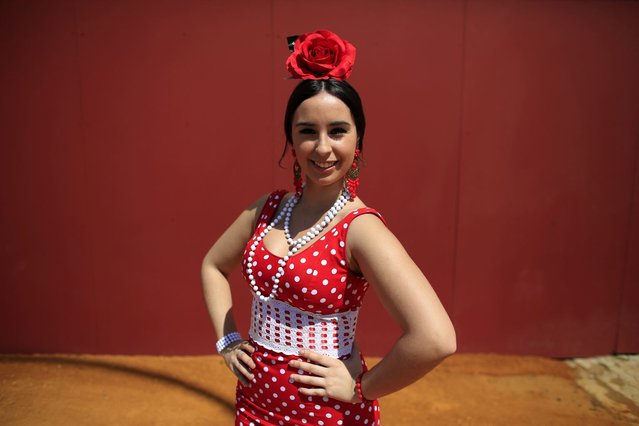
Maria, 18, wearing a traditional Sevillana outfit, poses for a portrait during the traditional Feria de Abril (April fair) in the Andalusian capital of Seville April 16, 2013. (Photo by Marcelo del Pozo/Reuters)

Maria, 18, wearing a traditional Sevillana outfit, poses for a portrait during the traditional Feria de Abril (April fair) in the Andalusian capital of Seville April 16, 2013. (Photo by Marcelo del Pozo/Reuters)
Details
22 Apr 2013 06:34:00