Loading...
Done
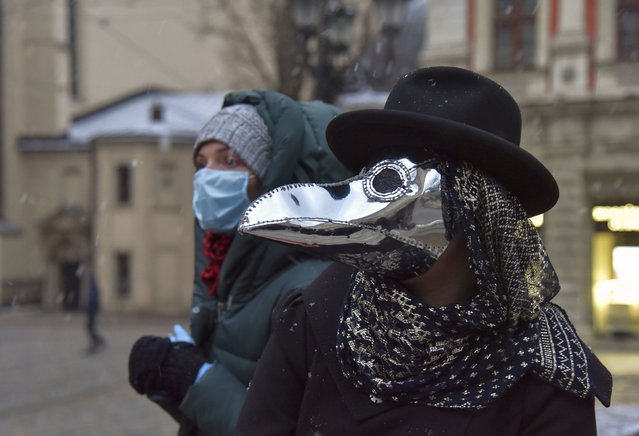
A woman wearing a protective mask is seen behind a girl dressed in a Plague Doctor Mask in Western-Ukrainian city of Lviv, Ukraine, 22 March 2020. Ukrainian Designer Anastasia Markovska sewed protective masks looking like Plague Doctor Masks, the traditional costume of Venice Carnival, for herself and her friends due to the ongoing pandemic of the COVID-19 disease caused by the SARS-CoV-2 coronavirus. In Ukraine had been 47 laboratory-confirmed cases of COVID-19, including three deaths and one recovery as Ukraine's Health Ministry announced. (Photo by Pavlo Palamarchuk/EPA/EFE)

A woman wearing a protective mask is seen behind a girl dressed in a Plague Doctor Mask in Western-Ukrainian city of Lviv, Ukraine, 22 March 2020. Ukrainian Designer Anastasia Markovska sewed protective masks looking like Plague Doctor Masks, the traditional costume of Venice Carnival, for herself and her friends due to the ongoing pandemic of the COVID-19 disease caused by the SARS-CoV-2 coronavirus. In Ukraine had been 47 laboratory-confirmed cases of COVID-19, including three deaths and one recovery as Ukraine's Health Ministry announced. (Photo by Pavlo Palamarchuk/EPA/EFE)
Details
02 May 2020 00:05:00
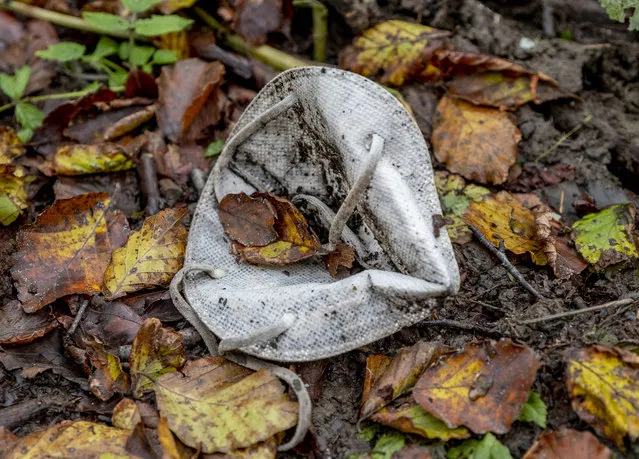
A face mask discarded in a forest in the Taunus region near Frankfurt, Germany, Sunday, October 18, 2020. (Photo by Michael Probst/AP Photo)

A face mask discarded in a forest in the Taunus region near Frankfurt, Germany, Sunday, October 18, 2020. (Photo by Michael Probst/AP Photo)
Details
20 Oct 2020 00:07:00
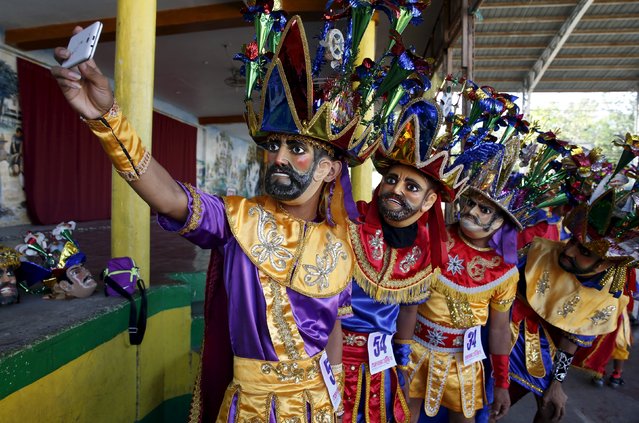
Penitents wearing masks, known locally as “Morions” take a selfie during the start of Holy Week celebrations in Mogpog, Marinduque in central Philippines March 21, 2016. (Photo by Erik De Castro/Reuters)

Penitents wearing masks, known locally as “Morions” take a selfie during the start of Holy Week celebrations in Mogpog, Marinduque in central Philippines March 21, 2016. The Moriones is an annual festival held on Holy Week on the island of Marinduque, Philippines. The “Moriones” are men and women in costumes and masks replicating the garb of biblical Roman soldiers as interpreted by local folks. (Photo by Erik De Castro/Reuters)
Details
22 Mar 2016 11:29:00
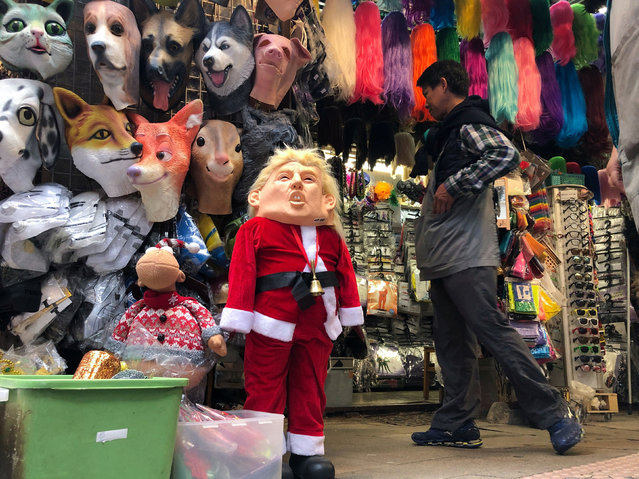
A U.S. President Donald Trump mask is seen for sale in a market in Hong Kong, China, December 23, 2019. (Photo by Lucy Nicholson/Reuters)

A U.S. President Donald Trump mask is seen for sale in a market in Hong Kong, China on December 23, 2019. (Photo by Lucy Nicholson/Reuters)
Details
25 Dec 2019 00:03:00
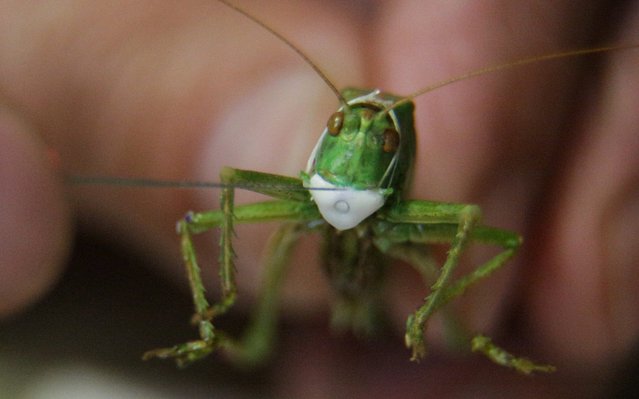
A grasshopper in a protective mask created by microminiaturist Anatoly Konenko in Omsk, Russia on May 21, 2020. Mini-masks about the size of a rice grain are made of a special high-density medical fabric with a built-in air filter. Anatoly Konenko is one of Russia's most famous microminiaturists; his works include a grasshopper playing a violin, a shod flea, a miniature bass guitar, a camel train in a needle's eye, and over 200 miniature books. (Photo by Yevgeny Sofiychuk/TASS)

A grasshopper in a protective mask created by microminiaturist Anatoly Konenko in Omsk, Russia on May 21, 2020. Mini-masks about the size of a rice grain are made of a special high-density medical fabric with a built-in air filter. Anatoly Konenko is one of Russia's most famous microminiaturists; his works include a grasshopper playing a violin, a shod flea, a miniature bass guitar, a camel train in a needle's eye, and over 200 miniature books. (Photo by Yevgeny Sofiychuk/TASS)
Details
23 May 2020 00:07:00
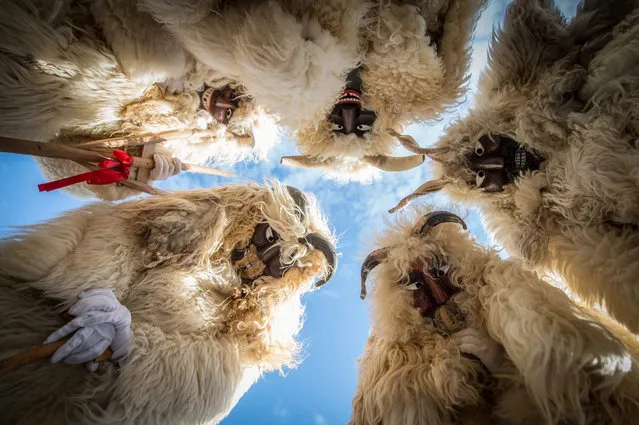
Participants wearing costumes and masks take part in the first day of the traditional carnival parade in Mohacs, Hungary, 23 February 2017. The carnival parade of so-called busos, dressed in costumes with frightening wooden masks and using various noisy wooden rattlers, is traditionally held on the seventh weekend before Easter to drive away winter. (Photo by Sandor Ujvari/EPA)

Participants wearing costumes and masks take part in the first day of the traditional carnival parade in Mohacs, Hungary, 23 February 2017. The carnival parade of so-called busos, dressed in costumes with frightening wooden masks and using various noisy wooden rattlers, is traditionally held on the seventh weekend before Easter to drive away winter. (Photo by Sandor Ujvari/EPA)
Details
25 Feb 2017 10:35:00
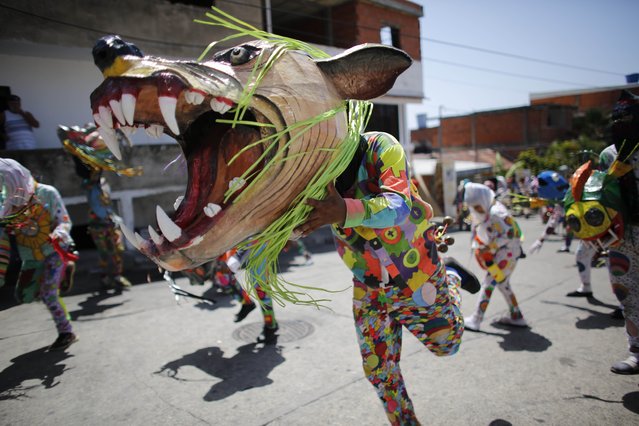
People dressed as a dancing devils with giant mask dance on a street, during a traditional celebration in Naiguata, Venezuela, Thursday, May 31, 2018. Carrying in their hands striking masks mostly animals and sea monsters, hundreds of men, women and children went out to dance frantically as possessed by evil spirits in an ancient ritual known as Dancing Devils of Naiguata, the unorthodox way of the coastal towns of Venezuela to venerate God during the celebrations of Corpus Christi. (Photo by Ariana Cubillos/AP Photo)

People dressed as a dancing devils with giant mask dance on a street, during a traditional celebration in Naiguata, Venezuela, Thursday, May 31, 2018. Carrying in their hands striking masks mostly animals and sea monsters, hundreds of men, women and children went out to dance frantically as possessed by evil spirits in an ancient ritual known as Dancing Devils of Naiguata, the unorthodox way of the coastal towns of Venezuela to venerate God during the celebrations of Corpus Christi. (Photo by Ariana Cubillos/AP Photo)
Details
02 Jun 2018 07:20:00
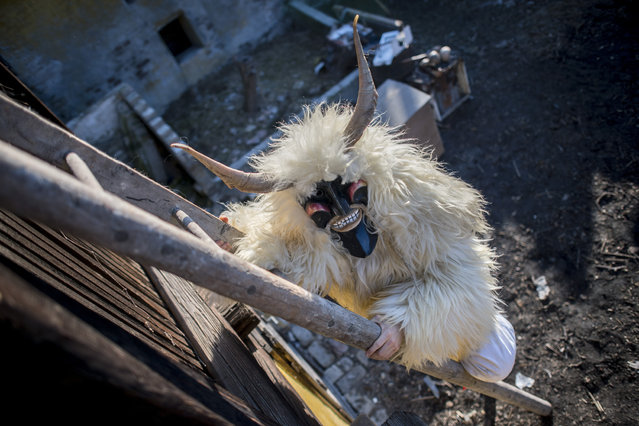
A man wears a busho mask and a costume made of sheep pelt while climbing up a ladder outside a barn in Mohacs, Hungary, 20 February 2020, on the first day of carnival. The traditional Busho carnival, which marks the end of winter, dates back to the 16th century. According to local legend, members of an ethnic South Slavic group living in Mohacs at the time dressed up in similar costumes and wore wooden masks to scare away Ottoman invaders, who mistook them for demons. (Photo by Tamas Soki/EPA/EFE)

A man wears a busho mask and a costume made of sheep pelt while climbing up a ladder outside a barn in Mohacs, Hungary, 20 February 2020, on the first day of carnival. The traditional Busho carnival, which marks the end of winter, dates back to the 16th century. According to local legend, members of an ethnic South Slavic group living in Mohacs at the time dressed up in similar costumes and wore wooden masks to scare away Ottoman invaders, who mistook them for demons. (Photo by Tamas Soki/EPA/EFE)
Details
23 Feb 2020 00:07:00