Loading...
Done
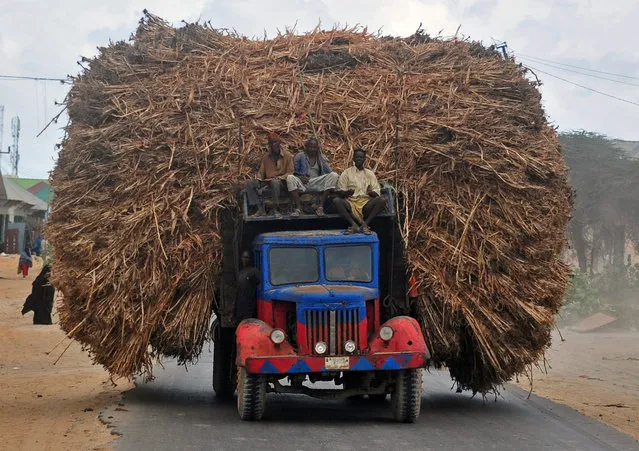
People sit on the top of a truck heavily piled with corn-stalks plies as they head for Mogadishu from Afgooye on October 19, 2016. At least four police officers were killed on October 18 when a suicide bomb attacker rammed an explosives-packed car into a police station before fighters from the Al-Qaeda-linked Shabaab group subsequently stormed the area killing at least 10 people, including soldiers and civilians. (Photo by Mohamed Abdiwahab/AFP Photo)

People sit on the top of a truck heavily piled with corn-stalks plies as they head for Mogadishu from Afgooye on October 19, 2016. At least four police officers were killed on October 18 when a suicide bomb attacker rammed an explosives-packed car into a police station before fighters from the Al-Qaeda-linked Shabaab group subsequently stormed the area killing at least 10 people, including soldiers and civilians. (Photo by Mohamed Abdiwahab/AFP Photo)
Details
20 Oct 2016 11:24:00
This handout photo taken on February 12, 2017 and released on February 16 by the International Federation of Red Cross and Red Crescent Societies (IFRC) shows Mongolian herder Munkhbat Bazarragchaa (C) dragging two sheep – which recently died due to the weather - to a pile of dead animals behind his “ger” in Khuvsgul province, northern Mongolia. Thousands of Mongolian herders face disastrous livestock losses from dreaded severe weather  known as the “dzud”, the Red Cross said on February 16, 2017 in launching an international emergency aid appeal. (Photo by Mirva Helenius/AFP Photo/IFRC)

This handout photo taken on February 12, 2017 and released on February 16 by the International Federation of Red Cross and Red Crescent Societies (IFRC) shows Mongolian herder Munkhbat Bazarragchaa (C) dragging two sheep – which recently died due to the weather - to a pile of dead animals behind his “ger” in Khuvsgul province, northern Mongolia. Thousands of Mongolian herders face disastrous livestock losses from dreaded severe weather known as the “dzud”, the Red Cross said on February 16, 2017 in launching an international emergency aid appeal. (Photo by Mirva Helenius/AFP Photo/IFRC)
Details
17 Feb 2017 11:40:00
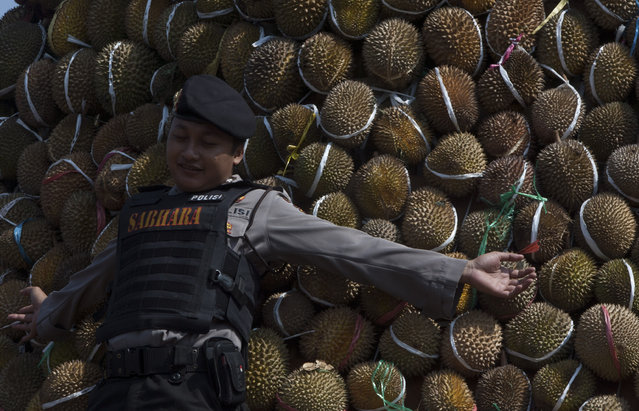
A police poses on the durians during festival durian on the giant mount of durian at northern slopes of Mount Arjuna in East Java. (Photo by Sigit Pamungkas/JG Photo)

A police poses on the durians during festival durian on the giant mount of durian at northern slopes of Mount Arjuna in East Java. Each year, nine villages in Wonosalam district hold a festival to give thanks for an abundance of this stinky, spiky fruit, which they pile in a 10-meter-high pyramid and distribute among the hungry masses. (Photo by Sigit Pamungkas/JG Photo)
Details
08 Apr 2015 11:07:00
Live fish. Vietnam has the highest number of motorbikes in all of south-east Asia – Hanoi alone has 5m of them, and only half a million cars. Now the city is planning to ban them by 2030 to cut pollution. (Photo by Jon Enoch/The Guardian)

From footballs to live fish, delivery mopeds piled high with unwieldy, unlikely goods are one of the Vietnamese capital’s most distinctive sights. As the city plans to ban motorbikes altogether, photographer Jon Enoch captured the drivers at work. (Photo by Jon Enoch/The Guardian)

Details
11 May 2019 00:05:00
The Pothole Gardener

Steve Wheen understands that nobody likes to pay a pile of taxes only to hit potholes on their way to work every day, so he started filling up the pesky cracks in East London with mini living worlds comprised of soil, plants, and adorable props. The guerrilla gardener creates these mini (mostly domestic) scenes on quiet streets, dead end lanes, and foot paths, snaps photographs of his work, and then removes the props so that nobody gets a chair in their tire! When he's satisfied with his projects, he documents them over at The Pothole Gardener.
Details
17 Nov 2012 10:02:00
Thai officials inspect counterfeit watches before destroying them at Khlongluang Transportation Station in Pathumtani province, on the outskirts of Bangkok April 9, 2015. (Photo by Chaiwat Subprasom/Reuters)

Thai officials inspect counterfeit watches before destroying them at Khlongluang Transportation Station in Pathumtani province, on the outskirts of Bangkok April 9, 2015. The counterfeit goods, which included piles of CDs, DVDs, handbags, clothes, brand name shoes, cell phones, caps, glasses, computers, cosmetics and watches are worth over 3.7 billion Thai baht ($ 115,790,901), according to local authorities. (Photo by Chaiwat Subprasom/Reuters)
Details
10 Apr 2015 06:44:00
Santa Claus rides in his sleigh as he prepares for Christmas in the Arctic Circle near Rovaniemi, Finland December 15, 2016. (Photo by Pawel Kopczynski/Reuters)

Santa Claus rides in his sleigh as he prepares for Christmas in the Arctic Circle near Rovaniemi, Finland December 15, 2016. At Santa Claus' Lapland home in Finland, his helpers sort out piles of letters from around the world, each detailing children's requests for this Christmas. (Photo by Pawel Kopczynski/Reuters)
Details
18 Dec 2016 08:04:00
A dhobi, or a washerman washes cloths on the banks of the River Gomti in Lucknow, India, Saturday, September 12, 2020. Dhobis are traditional laundry workers who wash clothes by hand and dry them in the sun, an occupation which has been in existence for generations. Most cities in India have a Dhobi Ghat, or washermen's area, where the city's pile of clothes is laundered. This practice is still popular in India, despite of modern technology. Around 1,000 families work in Lucknow's Dhobi Ghat. However, in light of the novel coronavirus, their wages have decreased drastically. With each family earning around US$100-200 per month. (Photo by Rajesh Kumar Singh/AP Photo)

A dhobi, or a washerman washes cloths on the banks of the River Gomti in Lucknow, India, Saturday, September 12, 2020. Dhobis are traditional laundry workers who wash clothes by hand and dry them in the sun, an occupation which has been in existence for generations. Most cities in India have a Dhobi Ghat, or washermen's area, where the city's pile of clothes is laundered. This practice is still popular in India, despite of modern technology. Around 1,000 families work in Lucknow's Dhobi Ghat. However, in light of the novel coronavirus, their wages have decreased drastically. With each family earning around US$100-200 per month. (Photo by Rajesh Kumar Singh/AP Photo)
Details
25 Sep 2020 00:03:00