Loading...
Done
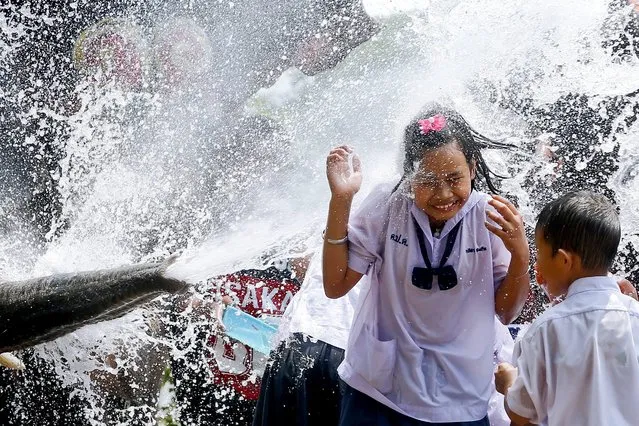
A schoolgirl is soaked with water thrown by an elephant in a preview of the upcoming Songkran Festival celebration, the Thai traditional New Year, also known as the water festival in the ancient world heritage city of Ayutthaya, Thailand, 11 April 2016. The annual elephant Songkran is held to promote the tourism industry prior the three-day Songkran Festival which starts on 13-15 April annually and is celebrated with splashing water and putting powder on each others faces as a symbolic sign of cleansing and washing away the sins from the old year. (Photo by Diego Azubel/EPA)

A schoolgirl is soaked with water thrown by an elephant in a preview of the upcoming Songkran Festival celebration, the Thai traditional New Year, also known as the water festival in the ancient world heritage city of Ayutthaya, Thailand, 11 April 2016. The annual elephant Songkran is held to promote the tourism industry prior the three-day Songkran Festival which starts on 13-15 April annually and is celebrated with splashing water and putting powder on each others faces as a symbolic sign of cleansing and washing away the sins from the old year. (Photo by Diego Azubel/EPA)
Details
12 Apr 2016 11:32:00
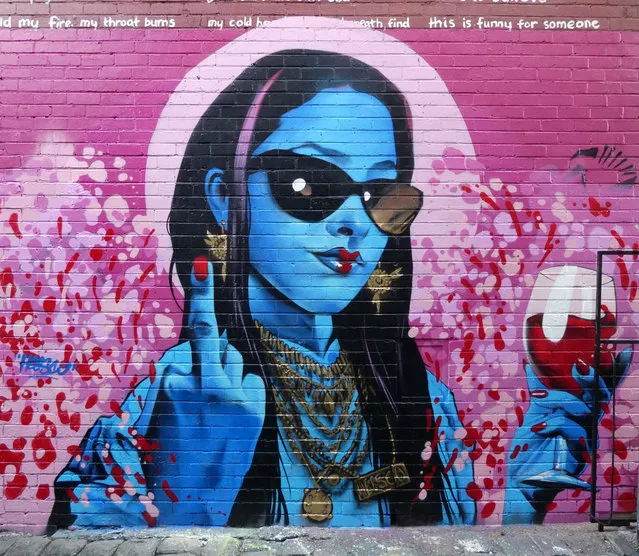
Heesco, Windsor. Born and raised in Mongolia and now living and working in Melbourne, Heesco is well known for his skill in rendering photo-realistic portraits. They speak to the viewer in a way that the subtext is enjoyable to decipher. Just what is the Blue Lady’s message? The sunglasses might mask the confronting gaze but her body language fills in the gaps. Heesco’s characters often wear traditional jewellery and clothing that remind us of his Mongolian cultural heritage. (Photo by Lou Chamberlin/The Guardian)

Heesco, Windsor. Born and raised in Mongolia and now living and working in Melbourne, Heesco is well known for his skill in rendering photo-realistic portraits. They speak to the viewer in a way that the subtext is enjoyable to decipher. Just what is the Blue Lady’s message? The sunglasses might mask the confronting gaze but her body language fills in the gaps. Heesco’s characters often wear traditional jewellery and clothing that remind us of his Mongolian cultural heritage. (Photo by Lou Chamberlin/The Guardian)
Details
26 Dec 2017 08:28:00
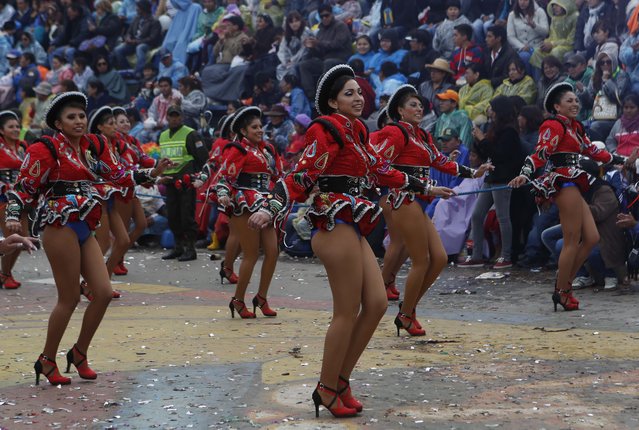
Caporal dancers perform during the carnival celebrations in Oruro, Bolivia, Saturday February 14, 2015. The Carnival of Oruro which is a religious festival dating back more than 2000 years in an ongoing pagan-catholic blend of religious practice in the region, and is one of UNESCO's Masterpieces of the Oral and Intangible Heritage of Humanity. (Photo by Juan Karita/AP Photo)

Caporal dancers perform during the carnival celebrations in Oruro, Bolivia, Saturday February 14, 2015. The Carnival of Oruro which is a religious festival dating back more than 2000 years in an ongoing pagan-catholic blend of religious practice in the region, and is one of UNESCO's Masterpieces of the Oral and Intangible Heritage of Humanity. (Photo by Juan Karita/AP Photo)
Details
17 Feb 2015 12:25:00
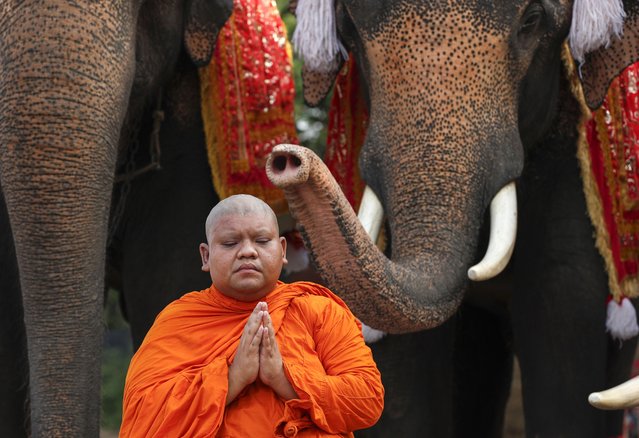
A Thai Buddhist monk performs a religious rite blessing elephants and mahouts to mark the National Elephant Day at the Ayutthaya Elephant Palace and Royal Kraal in the world heritage city of Ayutthaya, Thailand, 13 March 2025. The National Elephant Day has been observed annually on 13 March since 1998 when it was established by the Thai government, in an effort to protect and conserve Thai elephants, who are part of the Asian elephant family classified as an endangered species. (Photo by Rungroj Yongrit/EPA)

A Thai Buddhist monk performs a religious rite blessing elephants and mahouts to mark the National Elephant Day at the Ayutthaya Elephant Palace and Royal Kraal in the world heritage city of Ayutthaya, Thailand, 13 March 2025. The National Elephant Day has been observed annually on 13 March since 1998 when it was established by the Thai government, in an effort to protect and conserve Thai elephants, who are part of the Asian elephant family classified as an endangered species. (Photo by Rungroj Yongrit/EPA)
Details
03 Apr 2025 04:25:00
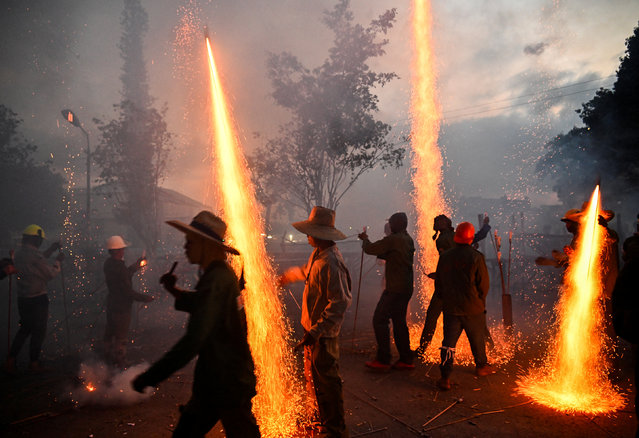
People paly with fireworks during Parrandas de Camajuani, Cuba on March 22, 2025. Two neighborhoods of the city, San Jose, represented by a toad, and Santa Teresa, represented by a goat, fight with carnival shows that involve the whole town in a party with bands, huge floats and fireworks. The Parrandas de Camajuani with more than 130 years, are recognized as Intangible Cultural Heritage of Humanity since 2018. (Photo by Yamil Lage/AFP Photo)

People paly with fireworks during Parrandas de Camajuani, Cuba on March 22, 2025. Two neighborhoods of the city, San Jose, represented by a toad, and Santa Teresa, represented by a goat, fight with carnival shows that involve the whole town in a party with bands, huge floats and fireworks. The Parrandas de Camajuani with more than 130 years, are recognized as Intangible Cultural Heritage of Humanity since 2018. (Photo by Yamil Lage/AFP Photo)
Details
24 Oct 2025 04:44:00
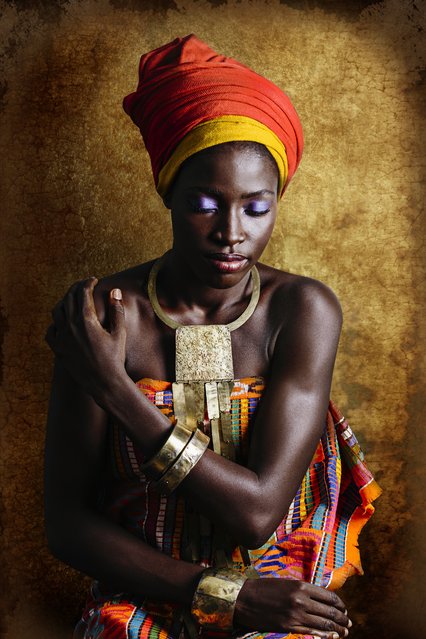
Ebrié Akan. Another series meanwhile goes behind the scenes of an Ivorian mannequin manufacturer, to highlight the construction of African beauty ideals. (Photo by Joana Choumali/The Guardian)

African women in their grandmothers' clothes: Joana Choumali’s portraits show modern African women swapping jeans for kente cloth – and diving into the dazzling cultural heritage of their families. (Photo by Joana Choumali/The Guardian)
Details
04 May 2016 11:43:00
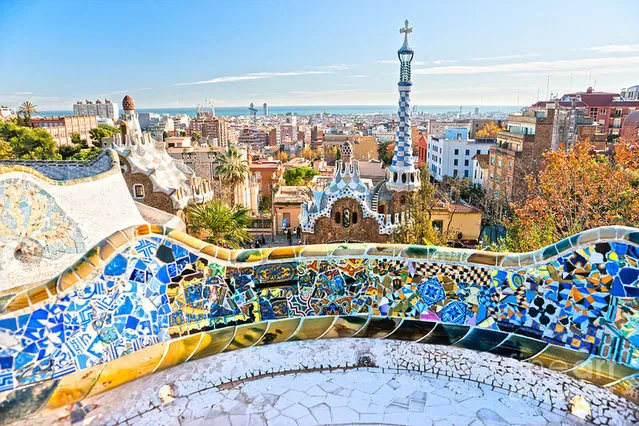
Barcelona in ParK Güell

Park Güell is a garden complex with architectural elements situated on the hill of El Carmel in the Gràcia district of Barcelona, Catalonia, Spain. It was designed by the Catalan architect Antoni Gaudí and built in the years 1900 to 1914. It has an extension of 17.18 ha (0.1718 km²), which makes it one of the largest architectural works in south Europe. It is part of the UNESCO World Heritage Site "Works of Antoni Gaudí".
Details
24 Apr 2013 10:58:00
A street artist dances tango in Buenos Aires, Argentina, Tuesday, January 20, 2015. Tango is a partner dance that originated in the 1890's along the Rio de la Plata, the border between Uruguay and Argentina. UNESCO approved in 2009, a joint proposal by the two nations to include the dance in its Intangible Cultural Heritage List. (Photo by Rodrigo Abd/AP Photo)

A street artist dances tango in Buenos Aires, Argentina, Tuesday, January 20, 2015. Tango is a partner dance that originated in the 1890's along the Rio de la Plata, the border between Uruguay and Argentina. UNESCO approved in 2009, a joint proposal by the two nations to include the dance in its Intangible Cultural Heritage List. (Photo by Rodrigo Abd/AP Photo)
Details
23 Jan 2015 12:56:00