David Nickerson, 28, competes dressed as artist Bob Ross, during the ZJ Boarding House Halloween Surf Contest in Santa Monica, California October 26, 2013. (Photo by Lucy Nicholson/Reuters)
Youths pose for a photo, while doing their homework in an area once home to chop houses, where gangs dismembered enemies, but is now a “humanitarian space” in Buenaventura, Colombia, Wednesday, August 16, 2023. (Photo by Fernando Vergara/AP Photo)
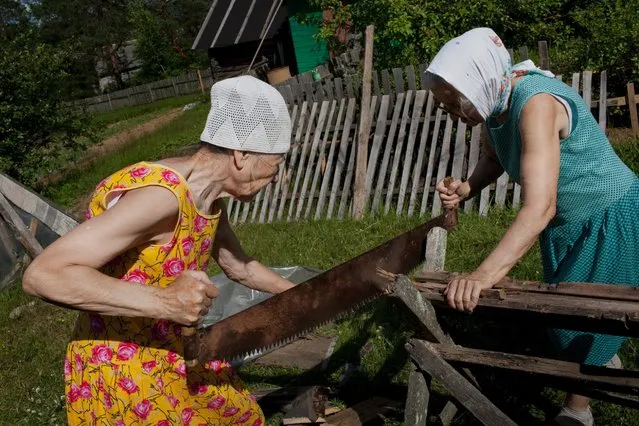
In northwest Russia, in a small village called Alekhovshchina, Nadia Sablin's aunts spend the warmer months together in the family home and live as the family has always lived, chopping wood to heat the house and making their own clothes. Sablin's book of photographs, “Aunties: The Seven Summers of Alevtina and Ludmila”, is published by Duke University Press. Here: “Two-Handed Saw, 2014”. (Photo by Nadia Sablin)
In this July 10, 2014 photo, Chris Minore, of Orange, Conn., performs the under chop technique at the Adirondack Woodsmen's School at Paul Smith's College in Paul Smiths, N.Y. Eighteen young students in matching gray sports shirts took part recently in a weeklong crash course on old-school lumberjack skills such as sawing, chopping, ax throwing, log boom running and pole climbing. (Photo by Mike Groll/AP Photo)
A woman chops a fish at her stall as a train passes by at a morning market near Duri train station in Jakarta in this February 12, 2009 file photo. (Photo by Reuters/Beawiharta)
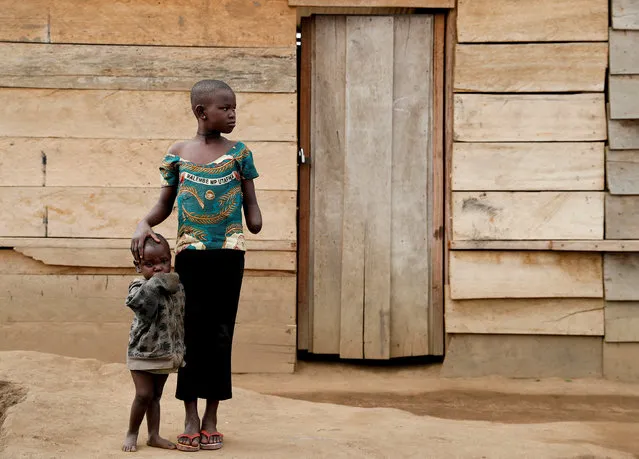
Mave Grace, 11, who had part of her arm chopped off by militiamen when they attacked the village of Tchee, stands with her sister Racahele-Ngabausi, aged two, in an Internally Displaced Camp in Bunia, Ituri province, eastern Democratic Republic of Congo, April 12, 2018. (Photo by Goran Tomasevic/Reuters)
A dog named Izzy licks its chops as Craig Morland of Crofton, Maryland, buys a bucket of Thrashers famous fries on the first day of eased coronavirus disease (COVID-19) restrictions for the beach and boardwalk in Ocean City, Maryland, U.S., May 9, 2020. (Photo by Kevin Lamarque/Reuters)
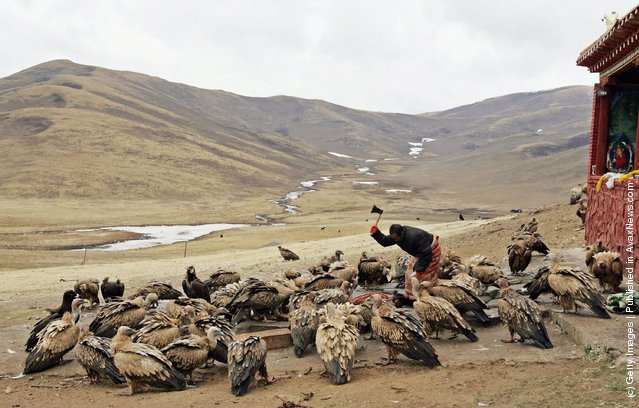
“Sky burial or ritual dissection was once a common funerary practice in Tibet wherein a human corpse is cut in specific locations and placed on a mountaintop, exposing it to the elements or the mahabhuta and animals – especially to birds of prey. The location of the sky burial preparation and place of execution are understood in the Vajrayana traditions as charnel grounds. In Tibet the practice is known as jhator, which literally means, «giving alms to the birds»”. – Wikipedia
Photo: A burial master chops bones of a body to feed vultures during a celestial burial ceremony on April 19, 2006 in Dari County of Guoluo Prefecture, Qinghai Province, northwest China. Celestial burial is a traditional funeral of Tibetan people, which began in the 7th century. (Photo by China Photos/Getty Images)