Loading...
Done
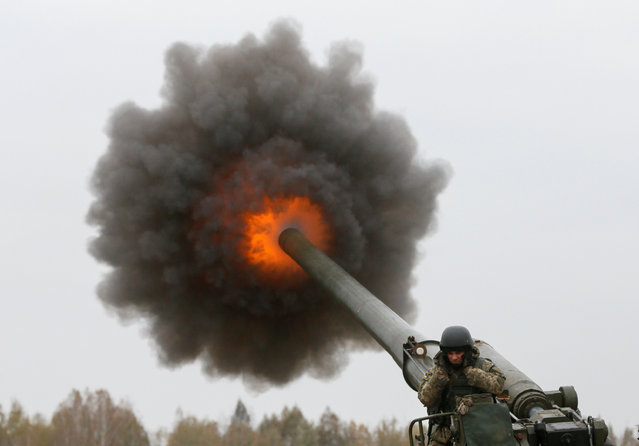
Ukrainian soldiers of the 71st Jaeger Brigade fire a M101 howitzer towards Russian positions at the frontline, near Avdiivka, Donetsk region, Ukraine, Friday, March 22, 2024. (Photo by Efrem Lukatsky/AP Photo)

Ukrainian soldiers of the 71st Jaeger Brigade fire a M101 howitzer towards Russian positions at the frontline, near Avdiivka, Donetsk region, Ukraine, Friday, March 22, 2024. (Photo by Efrem Lukatsky/AP Photo)
Details
24 Apr 2024 05:14:00
A Ukrainian serviceman stands on a flag of Russia's mercenary group Wagner near the Russian border in Sumy region, Ukraine on August 13, 2024. (Photo by Viacheslav Ratynskyi/Reuters)

A Ukrainian serviceman stands on a flag of Russia's mercenary group Wagner near the Russian border in Sumy region, Ukraine on August 13, 2024. (Photo by Viacheslav Ratynskyi/Reuters)
Details
23 Aug 2024 04:00:00
A Ukrainian serviceman hugs his relative after returning from captivity during a POWs exchange between Russia and Ukraine, in Ukraine, Monday December 30, 2024. (Photo by Evgeniy Maloletka/AP Photo)

A Ukrainian serviceman hugs his relative after returning from captivity during a POWs exchange between Russia and Ukraine, in Ukraine, Monday December 30, 2024. (Photo by Evgeniy Maloletka/AP Photo)
Details
20 Jan 2025 00:10:00
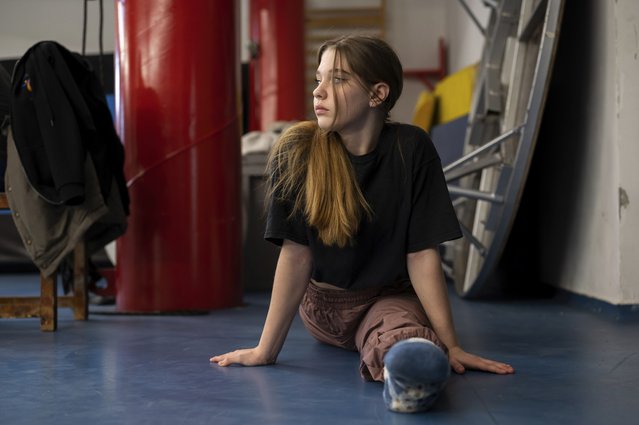
Ukrainian refugee circus student Mariia Lysytska stretching in a training room in Budapest, Hungary, Monday, February 13, 2023. More than 100 Ukrainian refugee circus students, between the ages of 5 and 20, found a home with the Capital Circus of Budapest after escaping the embattled cities of Kharkiv and Kyiv amid Russian bombings. (Photo by Denes Erdos/AP Photo)

Ukrainian refugee circus student Mariia Lysytska stretching in a training room in Budapest, Hungary, Monday, February 13, 2023. More than 100 Ukrainian refugee circus students, between the ages of 5 and 20, found a home with the Capital Circus of Budapest after escaping the embattled cities of Kharkiv and Kyiv amid Russian bombings. (Photo by Denes Erdos/AP Photo)
Details
12 Mar 2023 06:11:00
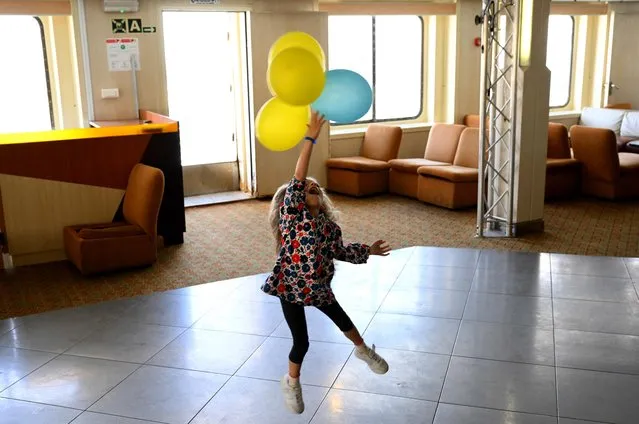
A Ukrainian girl plays with balloons with the colours of her country's flag aboard the Corsica Linea ferry “Mediterranee” in Marseille, southern France, on April 26, 2022. Anna and her children enjoy the sun on the deck of a ferry moored in Marseille: they are not vacationers but Ukrainian refugees who, on this boat, have finally found safety, “like in a village”, with 700 others compatriots. The “Mediterranean” usually serves Algeria, for the Corsica Linea. But it is now docked, at the Joliette ferry terminal in Marseille, with its unusual passengers. (Photo by Nicolas Tucat/AFP Photo)

A Ukrainian girl plays with balloons with the colours of her country's flag aboard the Corsica Linea ferry “Mediterranee” in Marseille, southern France, on April 26, 2022. Anna and her children enjoy the sun on the deck of a ferry moored in Marseille: they are not vacationers but Ukrainian refugees who, on this boat, have finally found safety, “like in a village”, with 700 others compatriots. The “Mediterranean” usually serves Algeria, for the Corsica Linea. But it is now docked, at the Joliette ferry terminal in Marseille, with its unusual passengers. (Photo by Nicolas Tucat/AFP Photo)
Details
28 Apr 2022 05:49:00
A woman looks at traditional Ukrainian Easter eggs “Pysanka”, installed as part of the upcoming celebrations of Easter, in central Kiev, Ukraine, April 29, 2016. A pysanka is a Ukrainian Easter egg, decorated with traditional Ukrainian folk designs using a wax-resist (batik) method. The word pysanka comes from the verb pysaty, “to write”, as the designs are not painted on, but written with beeswax. Many other eastern European ethnic groups decorate eggs using wax resist for Easter. These include the Belarusians, Bulgarians, Croats, Czechs, Hungarians, Lithuanians, Poles, Romanians, Serbs, Slovaks, Slovenes and Sorbs. (Photo by Valentyn Ogirenko/Reuters)

A woman looks at traditional Ukrainian Easter eggs “Pysanka”, installed as part of the upcoming celebrations of Easter, in central Kiev, Ukraine, April 29, 2016. A pysanka is a Ukrainian Easter egg, decorated with traditional Ukrainian folk designs using a wax-resist (batik) method. The word pysanka comes from the verb pysaty, “to write”, as the designs are not painted on, but written with beeswax. Many other eastern European ethnic groups decorate eggs using wax resist for Easter. These include the Belarusians, Bulgarians, Croats, Czechs, Hungarians, Lithuanians, Poles, Romanians, Serbs, Slovaks, Slovenes and Sorbs. (Photo by Valentyn Ogirenko/Reuters)
Details
30 Apr 2016 09:00:00
A Ukrainian man stands in protest in front of gunmen in unmarked uniforms as they stand guard in Balaklava, on the outskirts of Sevastopol, Ukraine, Saturday, March 1, 2014. (Photo by Andrew Lubimov/AP Photo)

A Ukrainian man stands in protest in front of gunmen in unmarked uniforms as they stand guard in Balaklava, on the outskirts of Sevastopol, Ukraine, Saturday, March 1, 2014. (Photo by Andrew Lubimov/AP Photo)
Details
02 Mar 2014 08:11:00
A man and a woman both wounded by what locals say was recent shelling by Ukrainian forces, react as they sit in an ambulance in Donetsk August 23, 2014. (Photo by Maxim Shemetov/Reuters)

A man and a woman both wounded by what locals say was recent shelling by Ukrainian forces, react as they sit in an ambulance in Donetsk August 23, 2014. (Photo by Maxim Shemetov/Reuters)
Details
26 Aug 2014 10:21:00