Loading...
Done
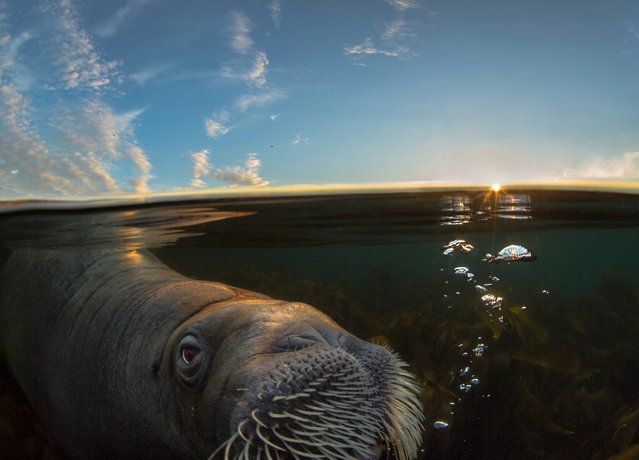
The Wildscreen festival is the world’s biggest celebration of screen-based natural history storytelling which takes place every two years in Bristol. Here: “Walrus in Midnight Sun”. Walrus feed mostly on bivalves in productive, shallow and often sandy habitats in the Arctic. This individual, though, arrived on a beach outside Tromsø, northern Norway, and found comfort on a stranded dead sperm whale. After two weeks he approached Audun, and only half a metre away he stretched his tusk forward and touched his hand gently. “This was one of the most memorable moments of my life”, Rikardsen says. He named the 500kg male Buddy. After two months, the dead whale was decomposed and Buddy suddenly disappeared. (Photo by Audun Rikardsen/Wildscreen 2016)

The Wildscreen festival is the world’s biggest celebration of screen-based natural history storytelling which takes place every two years in Bristol. Here: “Walrus in Midnight Sun”. Walrus feed mostly on bivalves in productive, shallow and often sandy habitats in the Arctic. This individual, though, arrived on a beach outside Tromsø, northern Norway, and found comfort on a stranded dead sperm whale. After two weeks he approached Audun, and only half a metre away he stretched his tusk forward and touched his hand gently. “This was one of the most memorable moments of my life”, Rikardsen says. He named the 500kg male Buddy. After two months, the dead whale was decomposed and Buddy suddenly disappeared. (Photo by Audun Rikardsen/Wildscreen 2016)
Details
07 Oct 2016 10:02:00
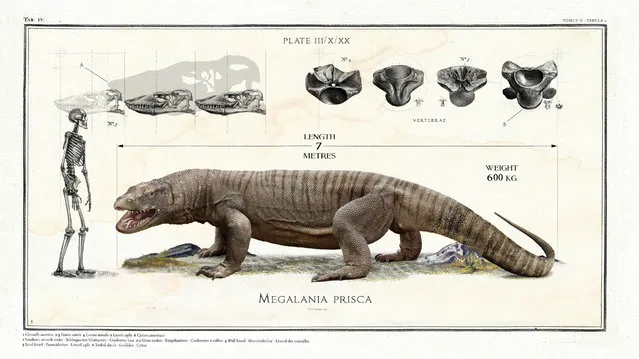
Fossil records indicate that this early lizard, Megalina prisca, was a whopping seven metres in length. (Photo by Sky TV/The Guardian)

Fossil records indicate that this early lizard, Megalania (Megalania prisca or Varanus priscus), was a whopping seven metres in length. They were part of a megafaunal assemblage that inhabited southern Australia during the Pleistocene. The youngest fossil remains date to around 50,000 years ago. The first aboriginal settlers of Australia might have encountered them and been a factor in their extinction. (Photo by Sky TV/The Guardian)
Details
12 Jun 2018 00:05:00
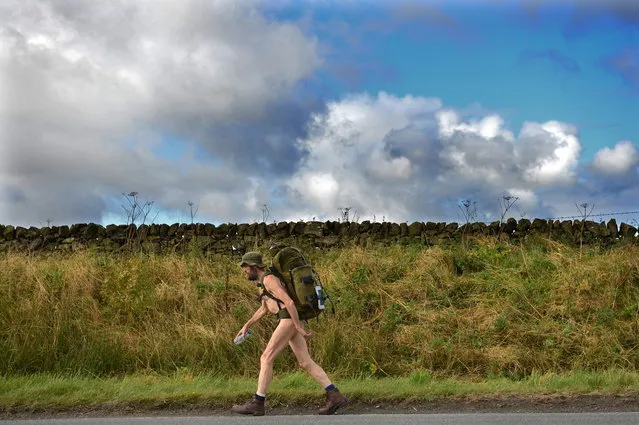
Stephen Gough the naked rambler makes his way south through Peebles in the Scottish Borders, following his release from Saughton Prison yesterday after serving his latest sentence on October 6, 2012 in Peebles, Scotland. The rambler has 18 convictions and has been in prison on and off since 2006 with offences ranging from not wearing clothes in front of the sheriff, breach of the peace and contempt of court. (Photo by Jeff J. Mitchell)

“Stephen Gough (born c. 1959), also known as Steve Gough and the Naked Rambler, is an activist, and a British former Royal Marine. In 2003-2004, he walked the length of Great Britain naked. He did it again in 2005-2006, but was arrested in England and in Scotland. He subsequently spent six years in prison, having been repeatedly rearrested for public nudity within a short period, each time he was released. He has spent most of his sentences in Saughton and Perth prisons, in Scotland”. – Wikipedia

Photo: Stephen Gough the naked rambler makes his way south through Peebles in the Scottish Borders, following his release from Saughton Prison yesterday after serving his latest sentence on October 6, 2012 in Peebles, Scotland. (Photo by Jeff J. Mitchell)
Details
07 Oct 2012 08:18:00
Ocean voyage

Do you think that history is a science? Well, not exactly. First, and foremost, history is the state's “legend of wars”, it’s official regalia. Of course, public historians are not interested in scientific truth – quite the opposite. In this respect, any attempt to present a state’s history as altruistic and benevolent as possible is welcomed and encouraged – as opposed to any revisionism attempts that may be more accurate. In this matter, Chinese have surpassed us all – they revised in highly creative manner (but rather shamelessly) the technology already invented by Europeans, a process that resulted in oldest state on the planet. Here is an interesting paradox: ask any sinologist about the Middle Kingdom during second century B.C., and he will describe it to you in such a vivid manner as if he has been living there all his life – but as soon as you will ask him to describe Chinese history in the 19-20th centuries… let's say, his eagerness will be greatly diminished. However, we will discuss China in a different article, and in the meantime we will try to understand how exactly historic “legend of wars” is formed and functions – based on a specific and well-known example. A great example is Ferdinand Magellan's first voyage around the world.
Details
14 Nov 2011 09:11:00
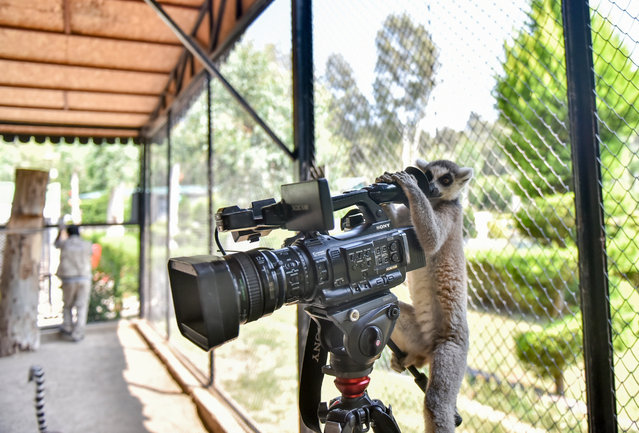
A lemur inspects a camera at Tarsus Nature Park in Mersin, Turkey on July 25, 2021. The population of lemurs, one of the inhabitants of Tarsus Nature Park, increases with new births every year. Lemurs are among the most interesting species in the zoo. (Photo by Serkan Avci/Anadolu Agency via Getty Images)

A lemur inspects a camera at Tarsus Nature Park in Mersin, Turkey on July 25, 2021. The population of lemurs, one of the inhabitants of Tarsus Nature Park, increases with new births every year. Lemurs are among the most interesting species in the zoo. (Photo by Serkan Avci/Anadolu Agency via Getty Images)
Details
15 Aug 2021 07:27:00
One of three young oriental small-clawed otters eats a meatball on June 18, 2015 in a zoo in Dresden, eastern Germany. The oriental small-clawed otter female Fussi gave birth to 3 healthy pups. Its pups now leave their burrow to explore the environment. (Photo by Arno Burgi/AFP Photo/DPA)

One of three young oriental small-clawed otters eats a meatball on June 18, 2015 in a zoo in Dresden, eastern Germany. The oriental small-clawed otter female Fussi gave birth to 3 healthy pups. Its pups now leave their burrow to explore the environment. (Photo by Arno Burgi/AFP Photo/DPA)
Details
29 Jun 2015 12:27:00


“Kumbh Mela is a mass Hindu pilgrimage in which Hindus gather at the Ganges river. The normal Kumbh Mela is celebrated every 3 years, the Ardh (half) Kumbh Mela is celebrated every six years at Haridwar and Prayag, the Purna (complete) Kumbh takes place every twelve years, at four places (Prayag (Allahabad), Haridwar, Ujjain, and Nashik). The Maha (great) Kumbh Mela which comes after 12 “Purna Kumbh Melas”, or 144 years, is held at Allahabad.

The last Ardh Kumbh Mela was held over a period of 45 days beginning in January 2007, more than 70 million Hindu pilgrims took part in the Ardh Kumbh Mela at Prayag, and on January 15, the most auspicious day of the festival of Makar Sankranti, more than 5 million participated. The previous Maha Kumbh Mela, held in 2001, was attended by around 60 million people, making it at the time the largest gathering anywhere in the world in recorded history”. – Wikipedia

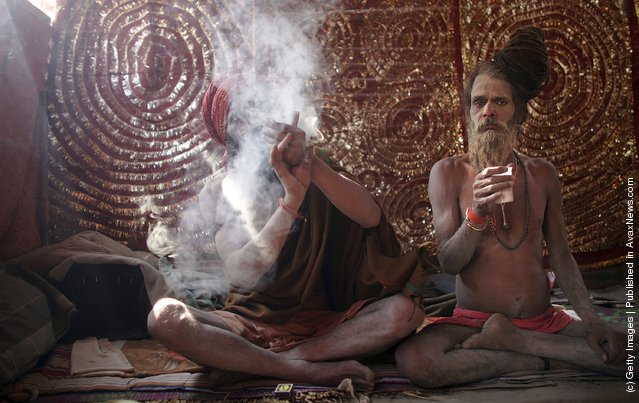
Photo: Sadhus (holy men) smoke at their camp near the ritual site at Sangam, the confluence of the Ganges, Yamuna and mythical Saraswati rivers during the Ardh Kumbh Mela festival (Half Pitcher festival) January 18, 2007 in Allahabad, India. Millions of Hindu pilgrims have flocked to the largest religious gathering in the world which lasts for 45 days in northern India. The festival commemorates the mythical conflict between gods and demons over a pitcher filled with the “nectar of immortality”. Devotees believe that taking a holy dip in the Ganges at this time washes away their sins and paves the path to salvation. (Photo by Mario Tama/Getty Images)
Details
30 Jun 2011 10:27:00
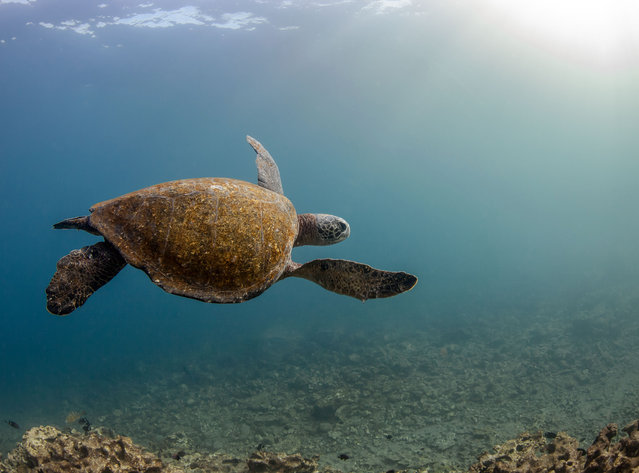
Green turtles take special care of their carapace, scraping algae off on rocks or letting cleaner fish remove parasites. Thanks to long-term protection of nesting sites, and measures to reduce the numbers caught in fishing gear, some green turtle populations are starting to recover. (Photo by Philip Hamilton/The Guardian)

Teeming with images of spectacular underwater scenes from around the world, Call of the Blue is the culmination of a five-year project by the photographer and ocean conservationist Philip Hamilton. This groundbreaking book includes contributions from acclaimed scientists and ocean “guardians”, who reveal what drove them to answer the call of the blue. (Photo by Philip Hamilton/The Guardian)
Details
23 Nov 2018 00:03:00