Loading...
Done
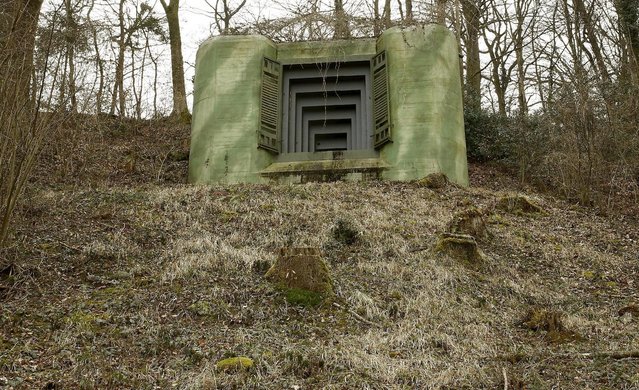
A bunker at aformer Swiss artillery fortress called Heldsberg stands near the town of St. Margareten, Switzerland March 22, 2015. Heldsberg fortress, located on the Swiss-Austrian border near the River Rhine and Lake Constance was built from 1938 to 1940 and remained in military use until 1992. Since 1993 it is open to the public as Fortress Museum Heldsberg. (Photo by Arnd Wiegmann/Reuters)

A bunker at aformer Swiss artillery fortress called Heldsberg stands near the town of St. Margareten, Switzerland March 22, 2015. Heldsberg fortress, located on the Swiss-Austrian border near the River Rhine and Lake Constance was built from 1938 to 1940 and remained in military use until 1992. Since 1993 it is open to the public as Fortress Museum Heldsberg. (Photo by Arnd Wiegmann/Reuters)
Details
09 Jan 2016 08:03:00
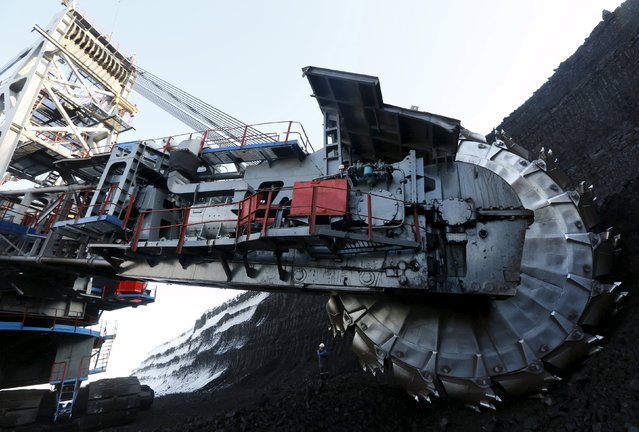
Master Sergey Suprun uses a portable radio set as he stands near a rotary dredge which works on the coal face of the Borodinsky opencast colliery, near the Siberian town of Borodino, east of Krasnoyarsk, Russia October 27, 2015. The Borodinsky colliery, 9 km (5.6 miles) long and more than 100 meters (328 feet) deep, annually produces more than 20 million tons of coal and is considered to be the biggest opencast coal mine in Russia, according to official representatives. (Photo by Ilya Naymushin/Reuters)

Master Sergey Suprun uses a portable radio set as he stands near a rotary dredge which works on the coal face of the Borodinsky opencast colliery, near the Siberian town of Borodino, east of Krasnoyarsk, Russia October 27, 2015. The Borodinsky colliery, 9 km (5.6 miles) long and more than 100 meters (328 feet) deep, annually produces more than 20 million tons of coal and is considered to be the biggest opencast coal mine in Russia, according to official representatives. (Photo by Ilya Naymushin/Reuters)
Details
31 Oct 2015 08:01:00
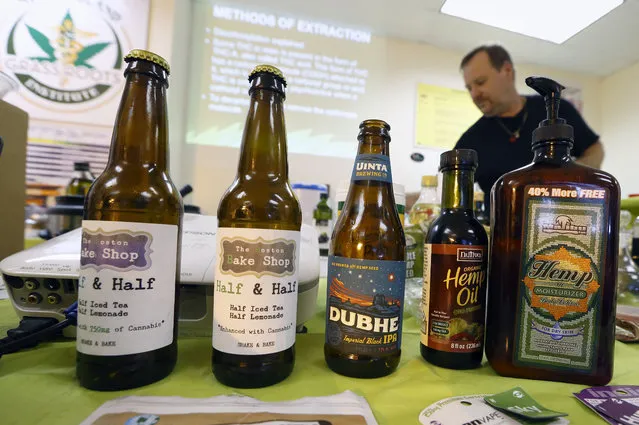
In this Thursday, July 10, 2014, photo, Mike Fitzgerald, right, teaches behind a sample display of cannabis-infused products during a cooking class at the New England Grass Roots Institute in Quincy, Mass. Some pot users turn to edibles because they don't like to inhale or smell the smoke, or just want variety or a longer lasting, more intense high. (Photo by Michael Dwyer/AP Photo)

The proliferation of marijuana edibles for both medical and recreational purposes is giving rise to a cottage industry of baked goods, candies, infused oils, cookbooks and classes that promises a slow burn as more states legalize the practice and awareness spreads about the best ways to deliver the drug. Edibles and infused products such as snack bars, olive oils and tinctures popular with medical marijuana users have flourished into a gourmet market of chocolate truffles, whoopie pies and hard candies as Colorado and Washington legalized the recreational use of marijuana in the past year. Photo: In this Thursday, July 10, 2014, photo, Mike Fitzgerald, right, teaches behind a sample display of cannabis-infused products during a cooking class at the New England Grass Roots Institute in Quincy, Mass. (Photo by Michael Dwyer/AP Photo)
Details
21 Jul 2014 11:02:00
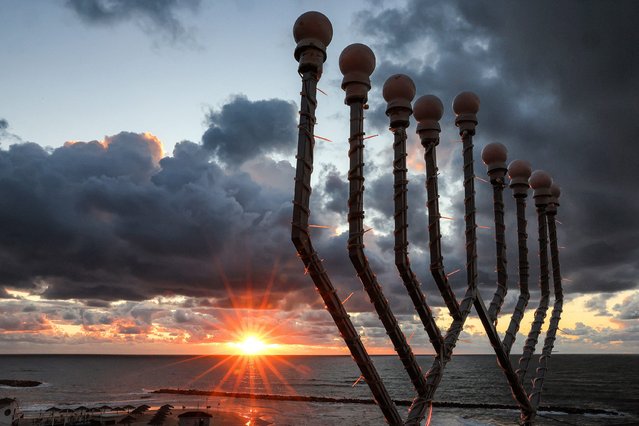
The sun sets over the Mediterranean sea as a nine-branched Hanukkah menorah (Hanukkiah) is pictured by the coast in Netanya on December 31, 2024. (Photo by Jack Guez/AFP Photo)

The sun sets over the Mediterranean sea as a nine-branched Hanukkah menorah (Hanukkiah) is pictured by the coast in Netanya on December 31, 2024. (Photo by Jack Guez/AFP Photo)
Details
13 Feb 2025 03:21:00
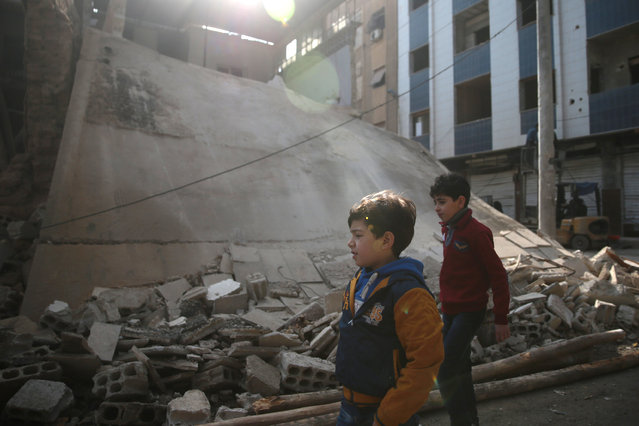
Boys walk near a damaged building in the rebel held besieged city of Douma, in the eastern Damascus suburb of Ghouta, Syria December 30, 2016. (Photo by Bassam Khabieh/Reuters)

Boys walk near a damaged building in the rebel held besieged city of Douma, in the eastern Damascus suburb of Ghouta, Syria December 30, 2016. (Photo by Bassam Khabieh/Reuters)
Details
31 Dec 2016 09:42:00
An Israeli soldier of the Caracal battalion smiles during a 23-kilometer march marking the end of their training in Israel's Negev desert, near Kibbutz Sde Boker February 14, 2013. The “Caracal” battalion, two-thirds of whose members are women, was established in 2004 with the purpose of incorporating female soldiers in combat units. The main mission of Caracal is routine patrols on Israel's border with Egypt to intercept infiltrators and smuggling from the Sinai desert. (Photo by Darren Whiteside/Reuters)

An Israeli soldier of the Caracal battalion smiles during a 23-kilometer march marking the end of their training in Israel's Negev desert, near Kibbutz Sde Boker February 14, 2013. The “Caracal” battalion, two-thirds of whose members are women, was established in 2004 with the purpose of incorporating female soldiers in combat units. The main mission of Caracal is routine patrols on Israel's border with Egypt to intercept infiltrators and smuggling from the Sinai desert. (Photo by Darren Whiteside/Reuters)
Details
23 Sep 2014 13:22:00
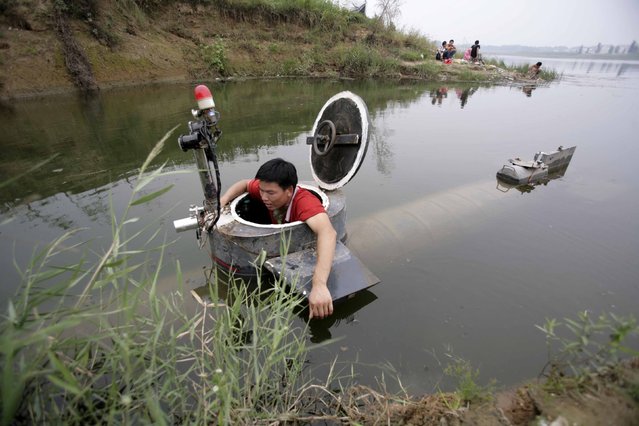
Tao Xiangli gets out of his homemade submarine after operating it in a lake on the outskirts of Beijing September 3, 2009. Amateur inventor Tao, 34,  made a fully functional submarine, which has a periscope, depth control tanks, electric motors, manometer, and two propellers, from old oil barrels and tools which he bought at a second-hand market. He took 2 years to invent and test the submarine which costs 30,000 yuan ($4,385). (Photo by Christina Hu/Reuters)

Tao Xiangli gets out of his homemade submarine after operating it in a lake on the outskirts of Beijing September 3, 2009. Amateur inventor Tao, 34, made a fully functional submarine, which has a periscope, depth control tanks, electric motors, manometer, and two propellers, from old oil barrels and tools which he bought at a second-hand market. He took 2 years to invent and test the submarine which costs 30,000 yuan ($4,385). (Photo by Christina Hu/Reuters)
Details
05 May 2013 12:06:00
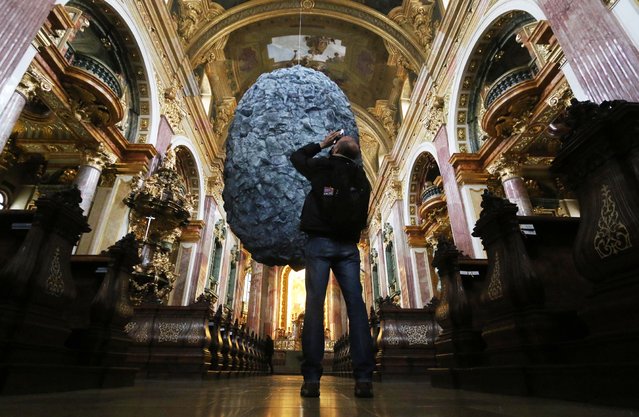
A visitor takes a photo of a boulder plastic made of synthetic material called “To be in Limbo” hangs from the ceiling of the 20 meter high Jesuit Church in Vienna, Austria, Tuesday, November 25, 2014. (Photo by Ronald Zak/AP Photo)

A visitor takes a photo of a boulder plastic made of synthetic material called “To be in Limbo” hangs from the ceiling of the 20 meter high Jesuit Church in Vienna, Austria, Tuesday, November 25, 2014. The eight meter high, hollow and 700 kilogram heavy sculpture from the artists group Steinbrener/Dempf and Huber is supposed to symbolize faith and its threatening moments. The installation will remain until April 19, 2015 and then move to a church in Hamburg, Germany. (Photo by Ronald Zak/AP Photo)
Details
29 Nov 2014 12:08:00