Loading...
Done
Revelers celebrate New Years Eve in socially distanced pods at Times Square on December 31, 2020, in New York City. On average, about one million revelers are drawn to the Crossroads of the World to watch performances and celebrate the New Year. This year a limited live audience of about 40 first responders and essential workers will be allowed to watch the New Years' ball drop from a secure area in Times Square. (Photo by David Dee Delgado/Getty Images)

Revelers celebrate New Years Eve in socially distanced pods at Times Square on December 31, 2020, in New York City. On average, about one million revelers are drawn to the Crossroads of the World to watch performances and celebrate the New Year. This year a limited live audience of about 40 first responders and essential workers will be allowed to watch the New Years' ball drop from a secure area in Times Square. (Photo by David Dee Delgado/Getty Images)
Details
05 Jan 2021 00:07:00
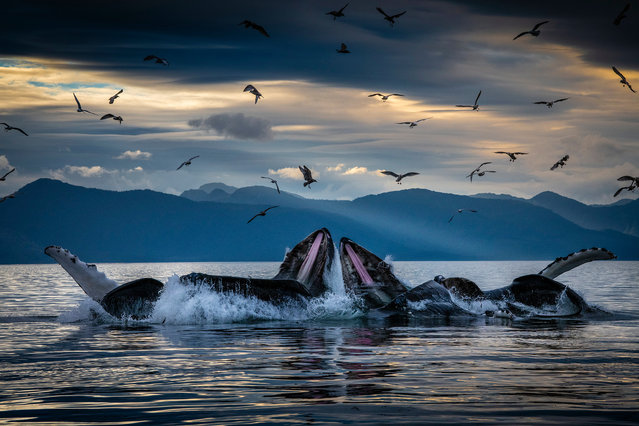
“Secrets of the Whales”. Skerry’s photographs celebrate the lives and culture of whales, illuminating recent research and their diverse behaviours. His latest work focuses on four key species: sperm whales, humpbacks, orca and beluga whales. Humpback whales bubble-net feeding off the coast of Alaska. They work cooperatively to feed on herring by blowing a perfect ring of bubbles underwater to form a net encircling the fish. The whales then swim up through the centre of the bubble net with their mouths open. (Photo by Brian Skerry/National Geographic Photo/Visa pour l'Image)

“Secrets of the Whales”. Skerry’s photographs celebrate the lives and culture of whales, illuminating recent research and their diverse behaviours. His latest work focuses on four key species: sperm whales, humpbacks, orca and beluga whales. Humpback whales bubble-net feeding off the coast of Alaska. They work cooperatively to feed on herring by blowing a perfect ring of bubbles underwater to form a net encircling the fish. The whales then swim up through the centre of the bubble net with their mouths open. (Photo by Brian Skerry/National Geographic Photo/Visa pour l'Image)
Details
04 Sep 2021 09:02:00
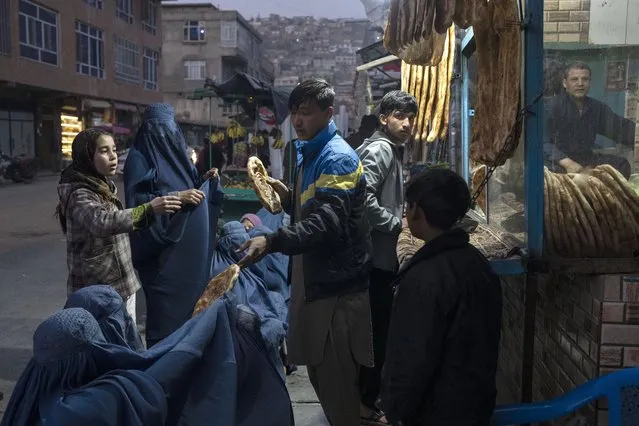
A man distributes bread to Burka-wearing Afghan women outside a bakery in Kabul, Afghanistan, Thursday, December 2, 2021. According to U.N. figures from early November, almost 24 million people in Afghanistan, around 60% percent of the population, suffer from acute hunger, including 8.7 million living in near famine. Increasing numbers of malnourished children have filled hospital wards. (Photo by Petros Giannakouris/AP Photo)

A man distributes bread to Burka-wearing Afghan women outside a bakery in Kabul, Afghanistan, Thursday, December 2, 2021. According to U.N. figures from early November, almost 24 million people in Afghanistan, around 60% percent of the population, suffer from acute hunger, including 8.7 million living in near famine. Increasing numbers of malnourished children have filled hospital wards. (Photo by Petros Giannakouris/AP Photo)
Details
17 Dec 2021 10:10:00
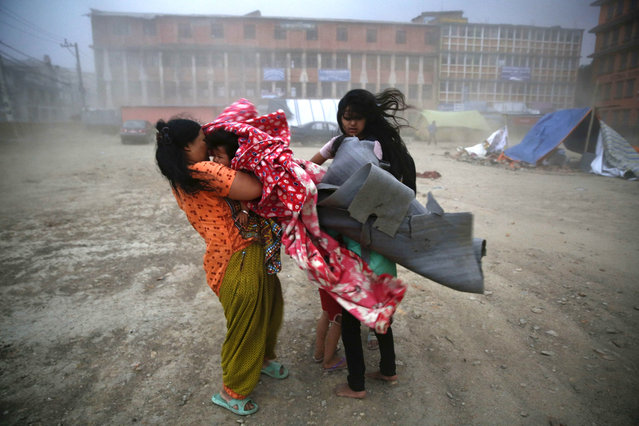
A storm whips through a tented area occupied by Nepalese earthquake survivors as a mother grabs her infant child and runs to find shelter in Kathmandu, Nepal 23 May 2015. Nepalese, who lost their homes in earthquake and fear aftershocks, have been living in temporary shelter in open ground which they had to flee because of the heavy rain and powerful wind. (Photo by Narendra Shrestha/EPA)

A storm whips through a tented area occupied by Nepalese earthquake survivors as a mother grabs her infant child and runs to find shelter in Kathmandu, Nepal 23 May 2015. Nepalese, who lost their homes in earthquake and fear aftershocks, have been living in temporary shelter in open ground which they had to flee because of the heavy rain and powerful wind. (Photo by Narendra Shrestha/EPA)
Details
25 May 2015 10:00:00
Rabbits are seen in a cage, which is placed by authority as a test of the living conditions near the site of last week's blasts at Binhai new district in Tianjin, China, August 19, 2015. (Photo by Reuters/Stringer)

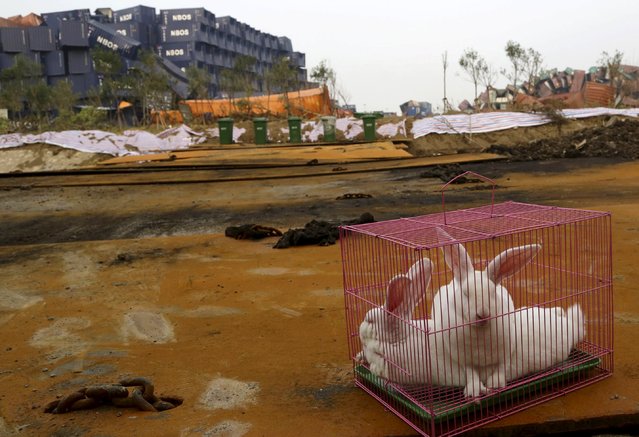
Rabbits are seen in a cage, which is placed by authority as a test of the living conditions near the site of last week's blasts at Binhai new district in Tianjin, China, August 19, 2015. According to local media, the animals were alive after being placed near the blasts site for two hours. Four new fires have broken out at the site where two huge blasts last week killed 116 people, Chinese state media reported Friday soon after officials said safety hazards were found at almost 70 percent of firms handling dangerous chemicals in Beijing. (Photo by Reuters/Stringer)
Details
22 Aug 2015 12:16:00
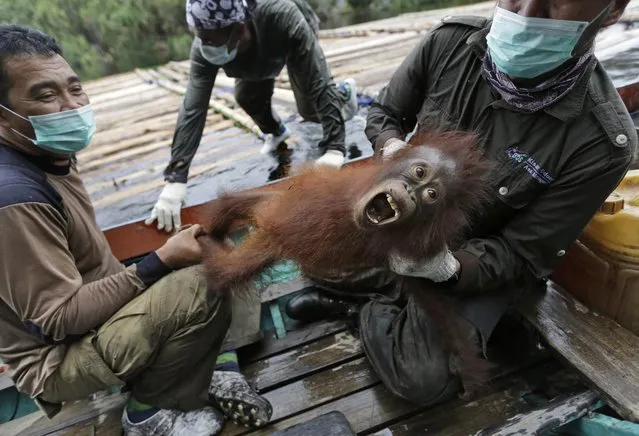
In this January 7, 2016, photo, conservationists of Borneo Orangutan Survival Foundation hold a baby orangutan rescued along with its mother during a rescue and release operation for orangutans trapped in a swath of jungle in Sungai Mangkutub, Central Kalimantan, Indonesia. Last year's forest fires drove orangutans closer to the river bank, where they had to live in an over-populated swath of forest as thin as 30 meters wide along the river. (Photo by Dita Alangkara/AP Photo)

In this January 7, 2016, photo, conservationists of Borneo Orangutan Survival Foundation hold a baby orangutan rescued along with its mother during a rescue and release operation for orangutans trapped in a swath of jungle in Sungai Mangkutub, Central Kalimantan, Indonesia. Last year's forest fires drove orangutans closer to the river bank, where they had to live in an over-populated swath of forest as thin as 30 meters wide along the river. (Photo by Dita Alangkara/AP Photo)
Details
25 Jan 2016 11:36:00
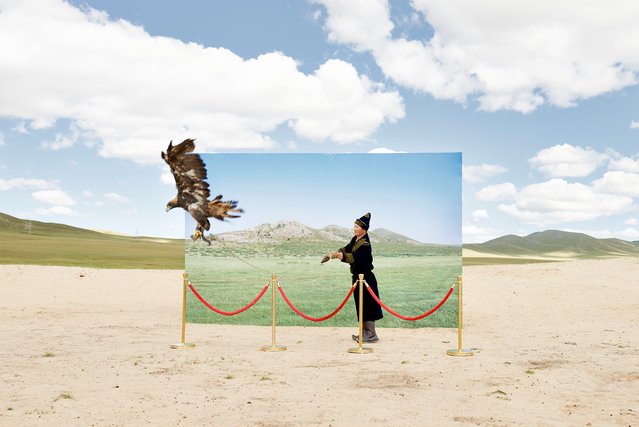
Up to 35% of Mongolians still live a nomadic life, depending on their land to survive. But environmental changes, particularly desertification, means this way of life is under threat. Korean photographer Daesung Lee’s Futuristic Archaeology images show billboard-size backdrops of lush steppe contrasting with actual scenery as former nomads enact scenes of hunting, herding and Mongolian wrestling. (Photo by Daesung Lee)

Up to 35% of Mongolians still live a nomadic life, depending on their land to survive. But environmental changes, particularly desertification, means this way of life is under threat. Korean photographer Daesung Lee’s Futuristic Archaeology images show billboard-size backdrops of lush steppe contrasting with actual scenery as former nomads enact scenes of hunting, herding and Mongolian wrestling. (Photo by Daesung Lee)
Details
24 Nov 2016 08:01:00
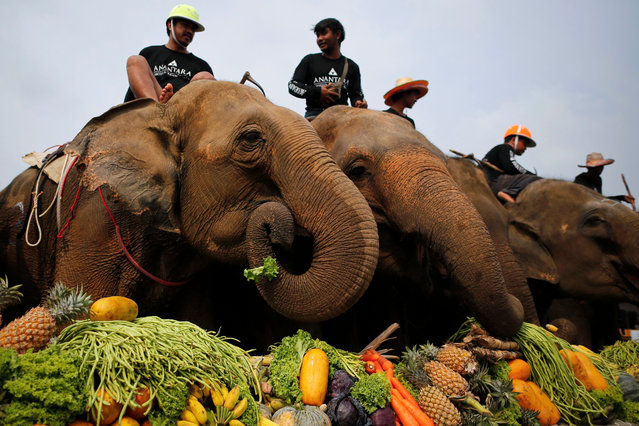
Elephants feast on fruits and vegetables during the elephant buffet prior to the start of the 2016 King's Cup Elephant Polo event in Bangkok, Thailand, 10 March 2016. The annual charity event, now in its 14th edition, runs until 13 March and will involve 18 elephants brought from tourist trekking camps in Pattaya as well as some unemployed in Surin. A total of 10 teams encompassing over 40 players will take part in the event directed at raising funds to improve the lives of elephants and elephant conservation. (Photo by Diego Azubel/EPA)

Elephants feast on fruits and vegetables during the elephant buffet prior to the start of the 2016 King's Cup Elephant Polo event in Bangkok, Thailand, 10 March 2016. The annual charity event, now in its 14th edition, runs until 13 March and will involve 18 elephants brought from tourist trekking camps in Pattaya as well as some unemployed in Surin. A total of 10 teams encompassing over 40 players will take part in the event directed at raising funds to improve the lives of elephants and elephant conservation. (Photo by Diego Azubel/EPA)
Details
11 Mar 2016 14:28:00