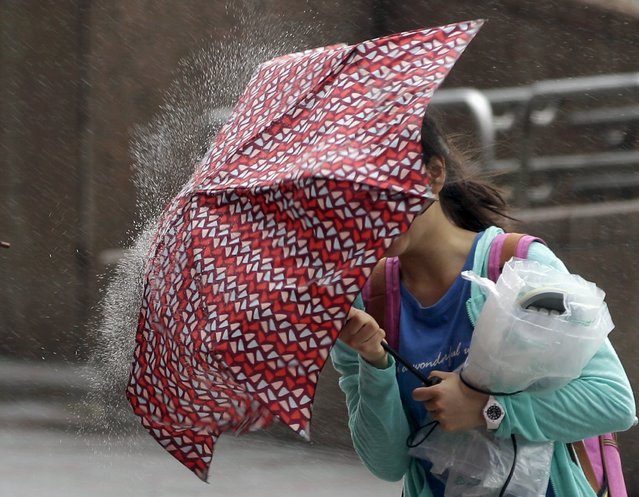
A woman holds her umbrella while walking against strong winds as Typhoon Chan-hom approaches Taiwan, in Taipei, July 10, 2015. (Photo by Pichi Chuang/Reuters)
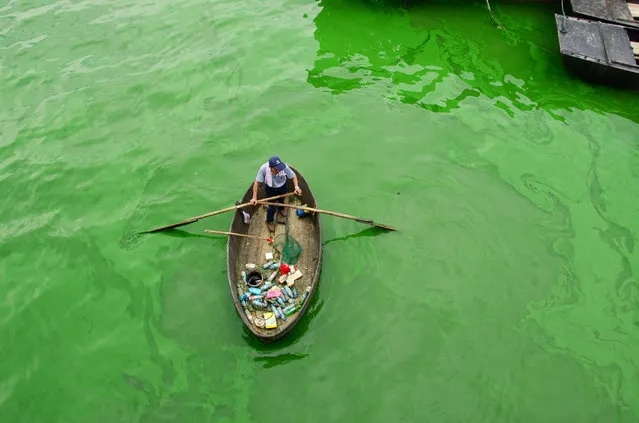
A fisherman boats in Chao Lake where thick cyanobacteria gather on the surface on August 5, 2015 in Chaohu, Anhui Province of China. As high temperature came in summar, part of water in Anhui Province's Chao Lake breeds large tracts of cyanobacteria which not only brought pollution to sense of smell, but also affected people's life. (Photo by ChinaFotoPress/ChinaFotoPress via Getty Images)
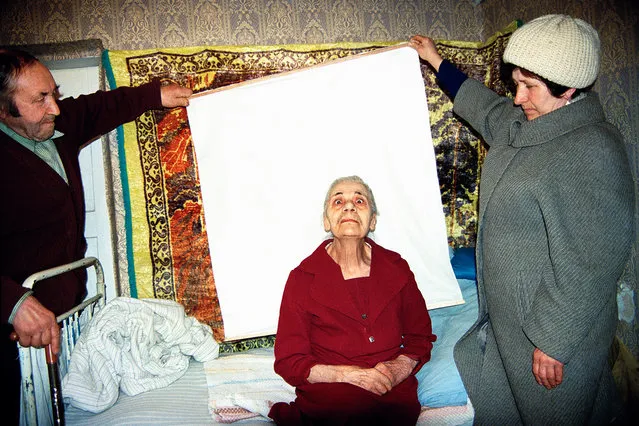
In 1994, after the fall of the Soviet Union, all Ukrainians had to get a new passport – and photographer Alexander Chekmenev was on hand to take their photos. The snatched extra shots he took are remarkable in their honesty and tenderness. (Photo by Alexander Chekmenev/The Guardian)
Locals dressed as “Perchten”, a traditional demonic creature in German and Austrian Alpine folklore, parade through the town center during the annual “Rauhnacht” gathering on January 5, 2017 in Waldkirchen, Germany. (Photo by Johannes Simon/Getty Images)
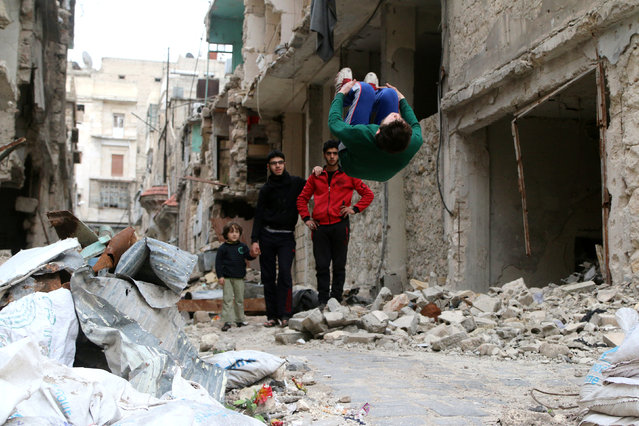
Gymnast Ahmad al-Sawas performs gymnastic moves near damaged buildings in the rebel-held Bustan al-Qasr neighbourhood of Aleppo, Syria March 26, 2016. As Syrian gymnast Ahmad al-Sawas watched his country fall apart, his Olympic dream collapsed too. The last national champion before the fighting began, he knew that supporting the anti-government side in the five-year-old civil war would prevent him from being selected for the Rio Games. (Photo by Abdalrhman Ismail/Reuters)
Tube passengers take a selfie next to a London underground roundel designed for the launching of the Night Tubes on display at Oxford Circus underground station in London, Britain, 19 August 2016. The long delayed Night Tubes service launched on 19 August. The 24-hour service will operate on Fridays and Saturdays. (Photo by Hannah Mckay/EPA)
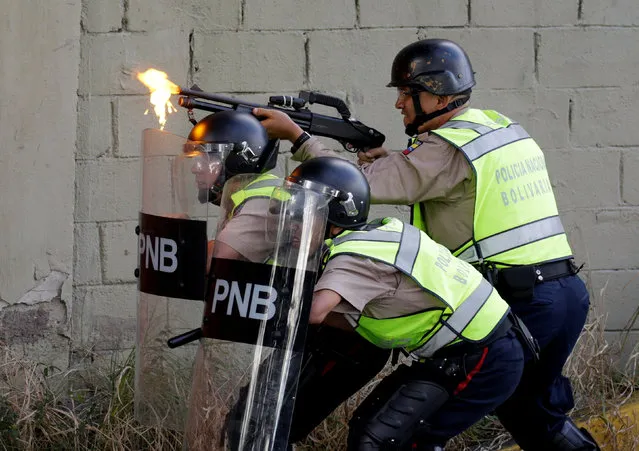
Riot police clash with protesters during a rally to demand a referendum to remove Venezuela's President Nicolas Maduro in Caracas, Venezuela, September 1, 2016. (Photo by Marco Bello/Reuters)
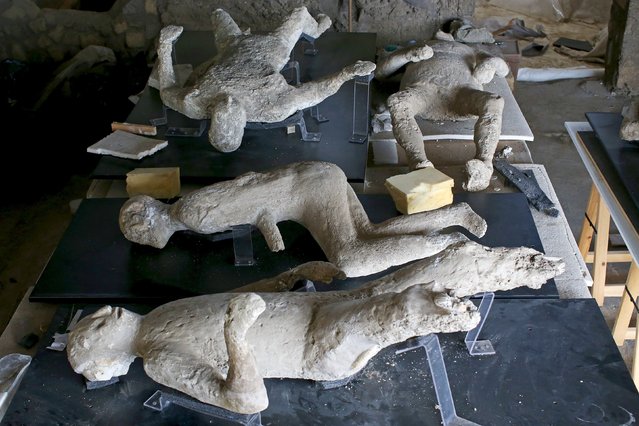
Plaster cast moulds of victims of the Mount Vesuvius eruption lie on a display table in a laboratory at Pompeii October 13, 2015. An expert team made up of archaeologists, radiologists, orthodontists and anthropologists began on September 2015 to use CAT scan technology (computerised axial tomography) to peer inside the plaster cast moulds of Pompeii's victims, in a study that has added more detail to previous findings. A 16-layer scan had to be used in order to penetrate the hardened plaster but the results showed up impressive skeletal remains and near perfect teeth. (Photo by Alessandro Bianchi/Reuters)