Loading...
Done
18-year-old Palestinian Mohammed Uleywa, who was shot in the foot about 2 years ago by Israeli soldiers and lost one of his feet in the hospital where he was taken, is seen in Gaza City, Gaza on December 13, 2020. Palestinian youth Mohammed Uleywa, who became disabled after lost one foot during the “Great March of Return” demonstrations on the border of the blockaded Gaza Strip, showed his skills in parkour on concrete blocks despite his disability. (Photo by Mustafa Hassona/Anadolu Agency via Getty Images)

18-year-old Palestinian Mohammed Uleywa, who was shot in the foot about 2 years ago by Israeli soldiers and lost one of his feet in the hospital where he was taken, is seen in Gaza City, Gaza on December 13, 2020. Palestinian youth Mohammed Uleywa, who became disabled after lost one foot during the “Great March of Return” demonstrations on the border of the blockaded Gaza Strip, showed his skills in parkour on concrete blocks despite his disability. (Photo by Mustafa Hassona/Anadolu Agency via Getty Images)
Details
26 Dec 2020 00:05:00
Rooftops of solar powered houses are pictured in Ota, 80 km northwest of Tokyo in this October 28, 2008 file photo. One by one, Japan is turning off the lights at the giant oil-fired power plants that propelled it to the ranks of the world's top industrialised nations. With nuclear power in the doldrums after the Fukushima disaster, it's solar energy that is becoming the alternative. (Photo by Yuriko Nakao/Reuters)

Rooftops of solar powered houses are pictured in Ota, 80 km northwest of Tokyo in this October 28, 2008 file photo. One by one, Japan is turning off the lights at the giant oil-fired power plants that propelled it to the ranks of the world's top industrialised nations. With nuclear power in the doldrums after the Fukushima disaster, it's solar energy that is becoming the alternative. Solar power is set to become profitable in Japan as early as this quarter, according to the Japan Renewable Energy Foundation (JREF), freeing it from the need for government subsidies and making it the last of the G7 economies where the technology has become economically viable. (Photo by Yuriko Nakao/Reuters)
Details
24 Nov 2015 08:04:00


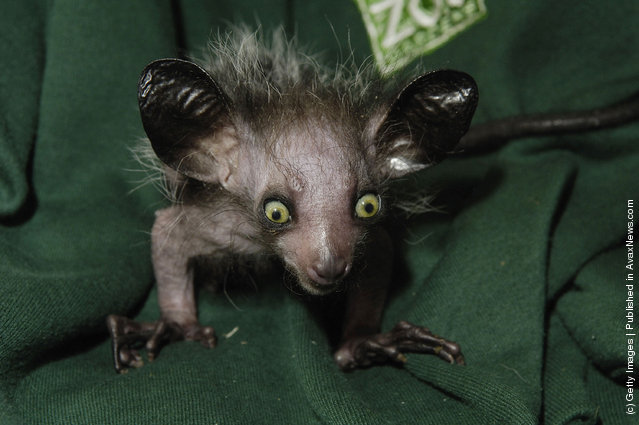
“The aye-aye (Daubentonia madagascariensis) is a lemur, a strepsirrhine primate native to Madagascar that combines rodent-like teeth and a special thin middle finger to fill the same ecological niche as a woodpecker. It is the world's largest nocturnal primate, and is characterized by its unusual method of finding food; it taps on trees to find grubs, then gnaws holes in the wood and inserts its narrow middle finger to pull the grubs out. The only other animal species known to find food in this way is the striped possum. From an ecological point of view the aye-aye fills the niche of a woodpecker as it is capable of penetrating wood to extract the invertebrates within”. – Wikipedia

Photo: In this handout image from Bristol Zoo is seen the first captive bred aye-aye in the UK named “Kintana” (meaning star in Malagasy) April 15, 2005 at Bristol Zoo Gardens, England. The zoo announced today only the second baby aye-aye to be hand-reared in the world (the first was in Jersey Zoo) and has now made his first public appearance since his birth on 11 February 2005. (Photo by Rob Cousins/Bristol Zoo via Getty Images)
Details
13 Apr 2011 13:33:00
The Bajau people of Malaysia live their lives completely at sea, living in wooden huts and spending their days fishing. Sailing over crystal clear waters, the Bajau people of Malaysia live their lives almost entirely at sea. (Photo by Ng Choo Kia/Hotspot Media/SIPA Press)

The Bajau people of Malaysia live their lives completely at sea, living in wooden huts and spending their days fishing. Sailing over crystal clear waters, the Bajau people of Malaysia live their lives almost entirely at sea. Photographer Ng Choo Kia joined the Bajau people on their pirogues, which are long narrow canoes made from single tree trunks, and documented their daily life in a series of pictures. (Photo by Ng Choo Kia/Hotspot Media/SIPA Press)
Details
05 May 2015 10:49:00
A woman poses next to two mailboxes along a street in Taipei on August 11, 2015 that were reportedly bent by strong winds brought by Typhoon Soudelor over the weekend. The two iron mailboxes have become an unlikely attraction, drawing thousands of snap-happy visitors and have even become a backdrop to a wedding photo shoot. (Photo by Benjamin Yeh/AFP Photo)

A woman poses next to two mailboxes along a street in Taipei on August 11, 2015 that were reportedly bent by strong winds brought by Typhoon Soudelor over the weekend. The two iron mailboxes have become an unlikely attraction, drawing thousands of snap-happy visitors and have even become a backdrop to a wedding photo shoot. The typhoon, which hit in the early hours of August 8 and was billed as the most powerful typhoon this year, uprooted trees, brought down electricity poles, knocking out power to a record 4.3 million households, while leaving eight dead and four missing. (Photo by Benjamin Yeh/AFP Photo)
Details
12 Aug 2015 13:44:00
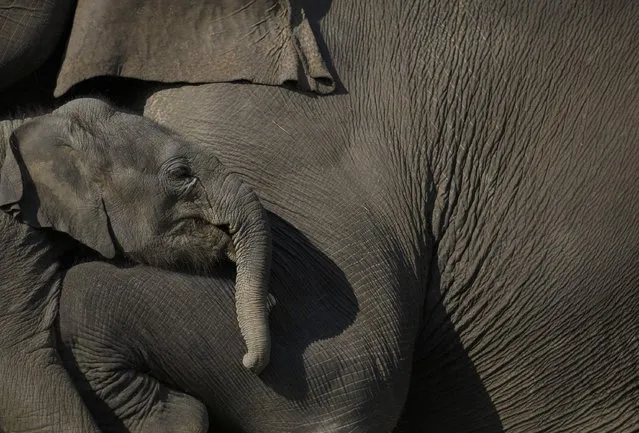
A one and a half months old baby elephant stands close to its mother at Chitwan National Park in Chitwan, south of Kathmandu December 30, 2014. (Photo by Navesh Chitrakar/Reuters)

A one and a half months old baby elephant stands close to its mother at Chitwan National Park in Chitwan, south of Kathmandu December 30, 2014. (Photo by Navesh Chitrakar/Reuters)
Details
01 Jan 2015 13:45:00
Members of Krewe Delusion, one of the the first parades of the Mardi Gras festivities, through the French Quarter of New Orleans January 31, 2015. (Photo by Lee Celano/Reuters)

Members of Krewe Delusion, one of the the first parades of the Mardi Gras festivities, through the French Quarter of New Orleans January 31, 2015. (Photo by Lee Celano/Reuters)
Details
02 Feb 2015 11:18:00
Pink Champagne Fox Miko

Meet this Miko, a 4-month fox color "pink champagne". Fox this color were first bred on the Canadian farm, one hundred years ago. They are so rare species that currently exist in the world only two such individuals: one lives in Ontario, and the other is Miko. Such foxes bred in captivity and contain only as pets in Canada.
Details
21 Mar 2014 12:49:00