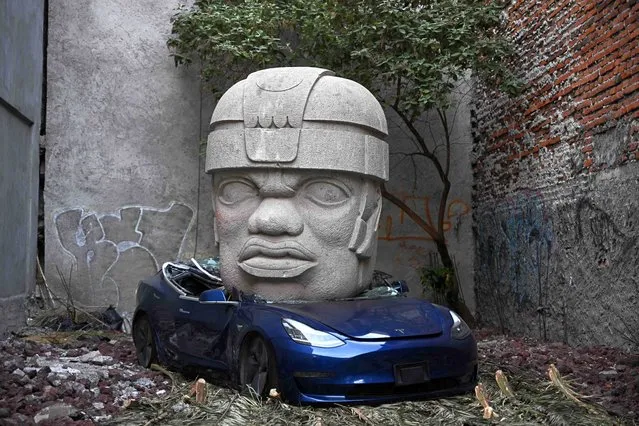
An artwork by artist Chavis Marmol, a Tesla 3 car crushed by a nine-ton Olmec-inspired head, is pictured in Mexico City on March 13, 2024. (Photo by Carl de Souza/AFP Photo)
Women take a picture atop a destroyed Russian tank during an exhibition displaying destroyed Russian military vehicles, amid Russia's invasion, in central Kyiv, Ukraine on March 21, 2023. (Photo by Gleb Garanich/Reuters)
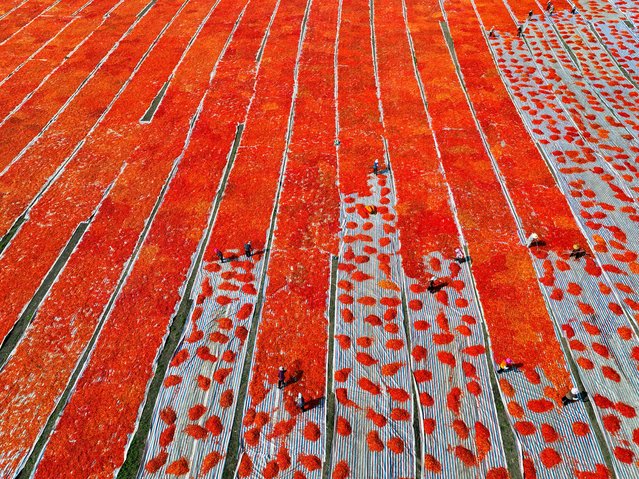
Aerial view of villagers drying chili peppers at a rural cooperative on August 21, 2024 in Bozhou, Anhui Province of China. (Photo by Yang Zhongqin/VCG via Getty Images)
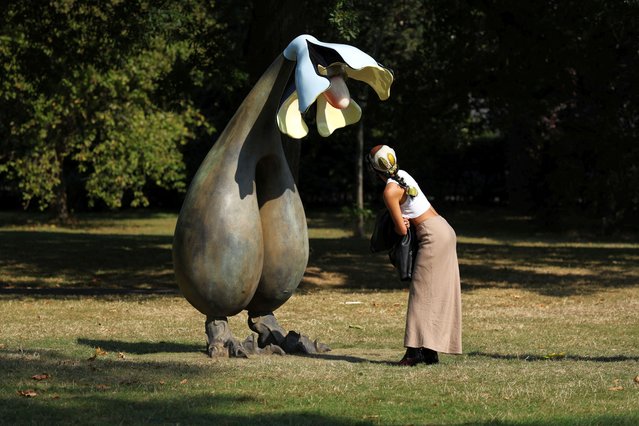
A person looks at Theresa Chromati's “steadfast, step into me (allow silence to create the sounds you desire most)”, which is part of Frieze Sculpture, in Regent's Park, in London, Britain on September 18, 2024. (Photo by Mina Kim/Reuters)
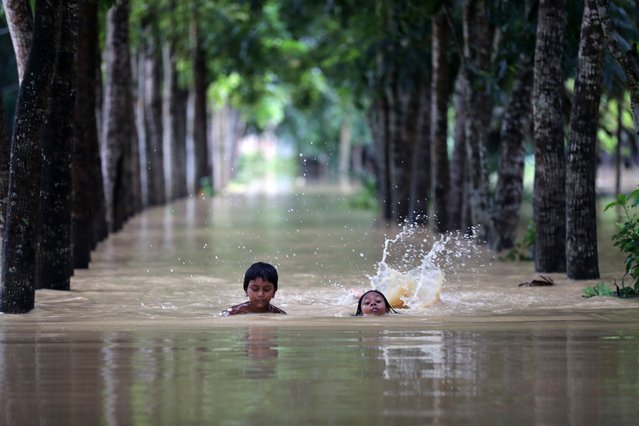
Two children swim on the flood water after a widespread flash flood at Nalitabari sub district in Sherpur district, Bangladesh, 08 October 2024. According to Bangladesh Water Development Board (BWDB) officials, at least 50,000 people remain stranded in five sub districts in Sherpur despite flood conditions improving. (Photo by EPA/EFE/Stringer)
Philip Colbert poses in front of his artwork at The Gallery Hosu on March 31, 2025 in Seoul, South Korea. (Photo by Chung Sung-Jun/Getty Images for Philip Colbert Studio)
British artist Nnena Kalu's presentation during a press preview for the 2025 Turner Prize at Cartwright Hall Art Gallery in Bradford, Britain, 23 September 2025. The Turner Prize is awarded to a British artist for an outstanding exhibition or presentation during the previous year. The shortlisted artists are Nnena Kalu, Rene Matic, Mohammed Sami, and Zadie Xa. The 2025 Turner Prize is held at Cartwright Hall in recognition of Bradford's status as UK City of Culture 2025. (Photo by Adam Vaughan/EPA)
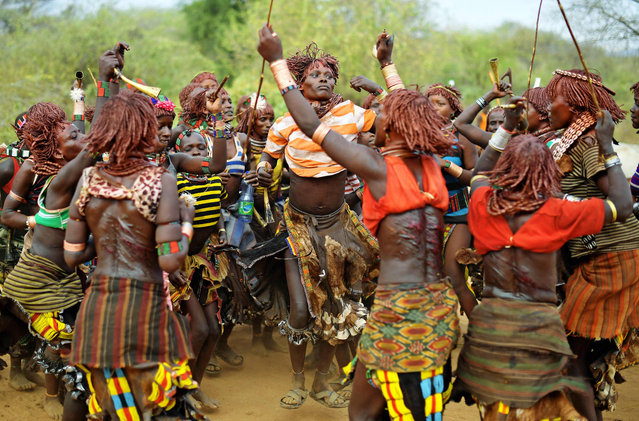
Hamar women dance before a bull jumping ceremony in Ethiopia's southern Omo Valley region near Turmi on September 19, 2016. The Hamar are a Nilotic ethnic group in Ethiopia. The construction of the Gibe III dam, the third largest hydroelectric plant in Africa, and large areas of very “thirsty” cotton and sugar plantations and factories along the Omo river are impacting heavily on the lives of tribes living in the Omo Valley who depend on the river for their survival and way of life. (Photo by Carl De Souza/AFP Photo)