Loading...
Done
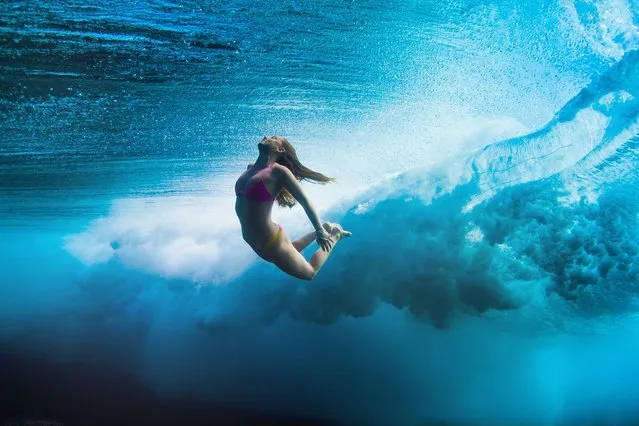
A surfer comes free from her surfboard. (Photo by Sarah Lee/Caters News)

Underwater photographer Sarah Lee uses a technique known as “duck diving” to capture these stunning photos of surfers in Hawaii. Surfers “duck dive” under the water to avoid incoming waves so they can get further out to sea. Photo: A surfer comes free from her surfboard. (Photo by Sarah Lee/Caters News)
Details
24 Jun 2013 12:37:00
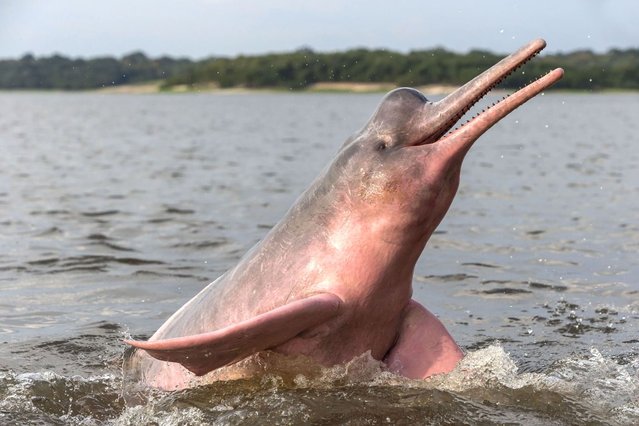
A pink dolphin shows off for the camera in Brazil. (Photo by Michel Watson)

Tourist Michel Watson found this pink dolphin making a splash in Brazil. The unusual creature, which hides deep in the Rio Negro river, was spotted leaping out of the Amazonian water brandishing its bizarre bright bubblegum color. Weighing in at nearly 300 pounds, the curious animal, known as an Amazon Pink River Dolphin, looked unusually agile as it rose above the waves. (Photo by Michel Watson)
Details
26 Jun 2013 05:10:00
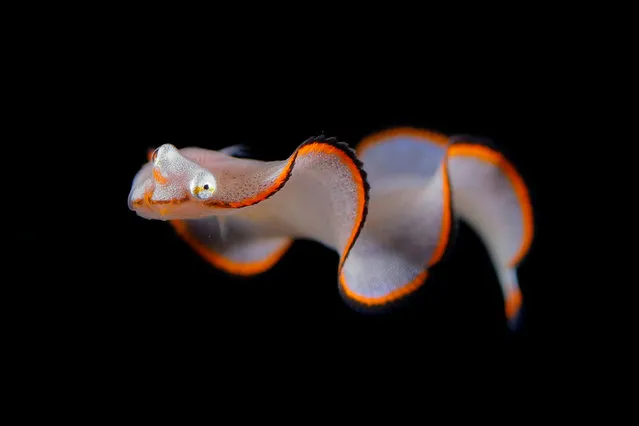
Batesian mimicry by a Soleichthys fish larva. (Photo by Ryo Minemizu/The Guardian)

Ryo Minemizu, one of Japan’s emerging stars in the field of marine life photography and the 2017 winner of the Nikkei National Geographic photography prize, captures the beauty and complexity of plankton that drift in our planet’s oceans and other bodies of water in meticulous detail. Here: Batesian mimicry by a Soleichthys fish larva. (Photo by Ryo Minemizu/The Guardian)
Details
21 Aug 2018 00:05:00
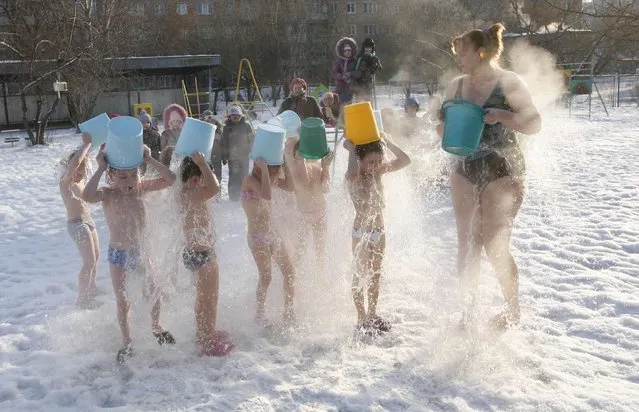
Children pour cold water on themselves under the control of fitness coach Margarita Filimonova (R) at local kindergarten number 317, with the air temperature at about minus 23 degrees Celsius (minus 9.4 degrees Fahrenheit), in Russia's Siberian city of Krasnoyarsk, February 5, 2013. (Photo by Ilya Naymushin/Reuters)

Children pour cold water on themselves under the control of fitness coach Margarita Filimonova (R) at local kindergarten number 317, with the air temperature at about minus 23 degrees Celsius (minus 9.4 degrees Fahrenheit), in Russia's Siberian city of Krasnoyarsk, February 5, 2013. (Photo by Ilya Naymushin/Reuters)

P.S. All pictures are presented in high resolution. To see Hi-Res images – just TWICE click on any picture. In other words, click small picture – opens the BIG picture. Click BIG picture – opens VERY BIG picture (if available; this principle works anywhere on the site AvaxNews).
Details
17 Feb 2013 15:40:00
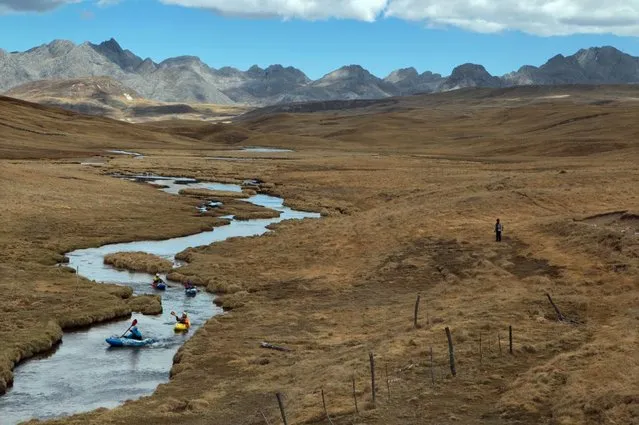
August 19, 2012 – Alpamarca, Peru – Amazon Express white water members Juan Antonio De Ugarte, of Peru, Rafael Ortiz, of Mexico, West Hansen, of the U.S., and Tino Specht, of the U.S., paddle down the Rio Gashan after leaving Lago Acucocha. Lago Acucocha is possibly the dry season source of the Amazon River. (Photo by Erich Schlegel/zReportage via ZUMA Press)

“The Amazon river has a newly discovered source. Completed last year and led by West Hansen and documented by award-winning freelance photographer Erich Schlegel, this is the first expedition to paddle from the furthest source of the earth's largest river to the ocean”. – zReportage. Photo: August 19, 2012 – Alpamarca, Peru – Amazon Express white water members Juan Antonio De Ugarte, of Peru, Rafael Ortiz, of Mexico, West Hansen, of the U.S., and Tino Specht, of the U.S., paddle down the Rio Gashan after leaving Lago Acucocha. Lago Acucocha is possibly the dry season source of the Amazon River. (Photo by Erich Schlegel/zReportage via ZUMA Press)
Details
29 Jul 2013 10:47:00
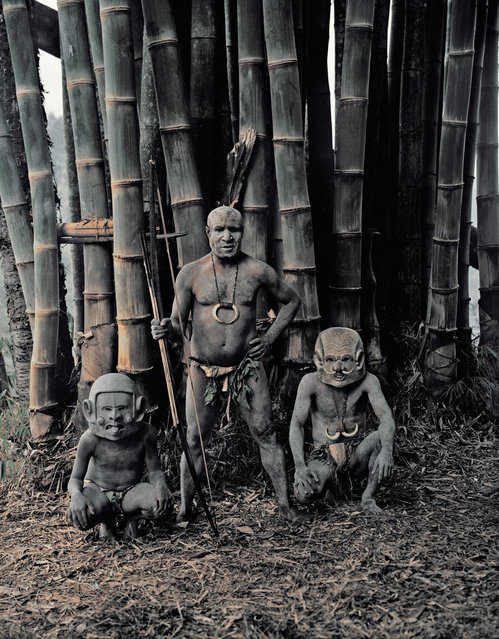
“Asaro from the Eastern Highlands”. The mudmen could not cover their faces with mud because the people of Papua New Guinea thought that the mud from the Asaro river was poisonous. So instead of covering their faces with this alleged poison, they made masks from pebbles that they heated and water from the waterfall, with unusual designs such as long or very short ears either going down to the chin or sticking up at the top, long joined eyebrows attached to the top of the ears, horns and sideways mouths. (Jimmy Nelson)

“Asaro from the Eastern Highlands”. The mudmen could not cover their faces with mud because the people of Papua New Guinea thought that the mud from the Asaro river was poisonous. So instead of covering their faces with this alleged poison, they made masks from pebbles that they heated and water from the waterfall, with unusual designs such as long or very short ears either going down to the chin or sticking up at the top, long joined eyebrows attached to the top of the ears, horns and sideways mouths. (Photo and caption by Jimmy Nelson)
Details
20 Oct 2013 08:54:00
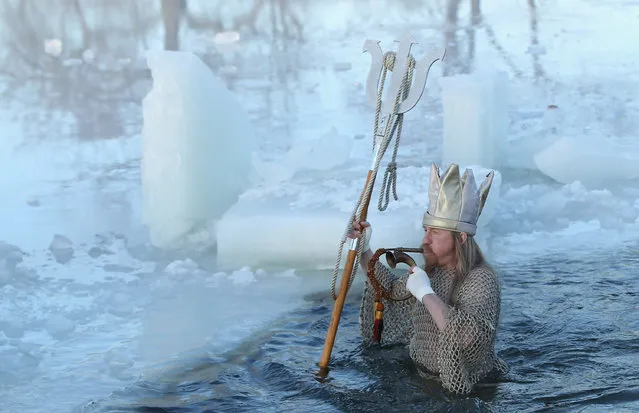
An ice swimming enthusiast dressed as Neptune takes to the frigid waters of Orankesee lake during the 27th annual "Winter Swimming in Berlin" on January 8, 2011 in Berlin, Germany. A local swimmers' group called the “Berlin Seals” invite ice swimmers from across Germany and abroad to the annual event. Members claim ice swimming is good for the body's blood circulation. (Photo by Sean Gallup)

An ice swimming enthusiast dressed as Neptune takes to the frigid waters of Orankesee lake during the 27th annual "Winter Swimming in Berlin" on January 8, 2011 in Berlin, Germany. A local swimmers' group called the “Berlin Seals” invite ice swimmers from across Germany and abroad to the annual event. Members claim ice swimming is good for the body's blood circulation. (Photo by Sean Gallup)
Details
16 Jun 2015 13:45:00
This aerial picture taken on August 16, 2020, shows the MV Wakashio bulk carrier that had run aground and broke into two parts near Blue Bay Marine Park, Mauritius. A ship that has leaked more than 1,000 tonnes of oil in pristine waters off the Mauritius coast has split into two, its Japanese operator said August 16, 2020. (Photo by AFP Photo/Stringer)

This aerial picture taken on August 16, 2020, shows the MV Wakashio bulk carrier that had run aground and broke into two parts near Blue Bay Marine Park, Mauritius. A ship that has leaked more than 1,000 tonnes of oil in pristine waters off the Mauritius coast has split into two, its Japanese operator said August 16, 2020. (Photo by AFP Photo/Stringer)
Details
08 Sep 2020 00:03:00