Loading...
Done
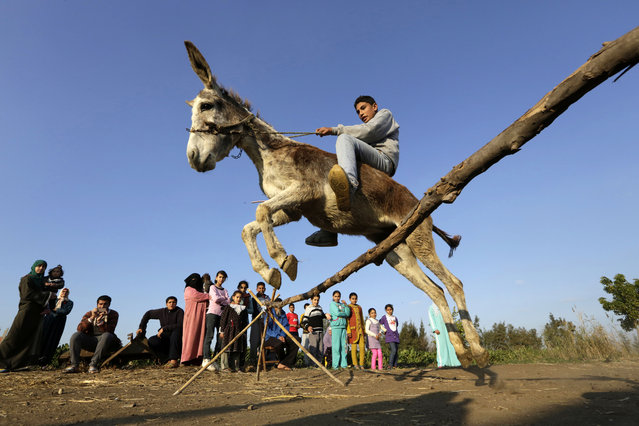
In this Friday, February 5, 2016 picture, Egyptian farmer Ahmed Ayman, 14, rides his trained donkey as he jumps over a barrier in the Nile Delta village of Al-Arid about 150 kilometers north of Cairo, Egypt. He discovered the donkey's talent after she jumped over a small irrigation canal. (Photo by Amr Nabil/AP Photo)

In this Friday, February 5, 2016 picture, Egyptian farmer Ahmed Ayman, 14, rides his trained donkey as he jumps over a barrier in the Nile Delta village of Al-Arid about 150 kilometers north of Cairo, Egypt. He discovered the donkey's talent after she jumped over a small irrigation canal. (Photo by Amr Nabil/AP Photo)
Details
11 Feb 2016 12:37:00
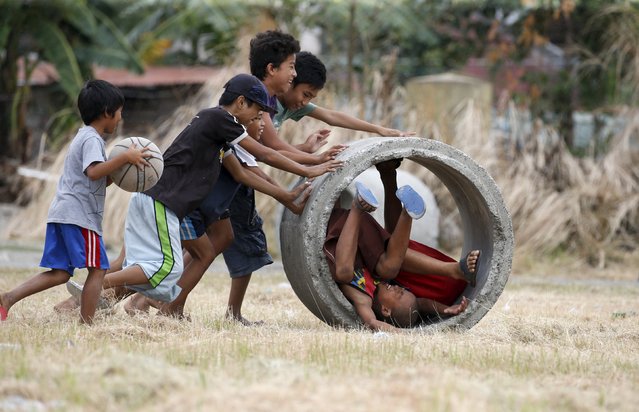
Boys play with a drainage culvert used for flood control in Las Pinas, Metro Manila February 28, 2016. (Photo by Erik De Castro/Reuters)

Boys play with a drainage culvert used for flood control in Las Pinas, Metro Manila February 28, 2016. (Photo by Erik De Castro/Reuters)
Details
13 Mar 2016 10:41:00
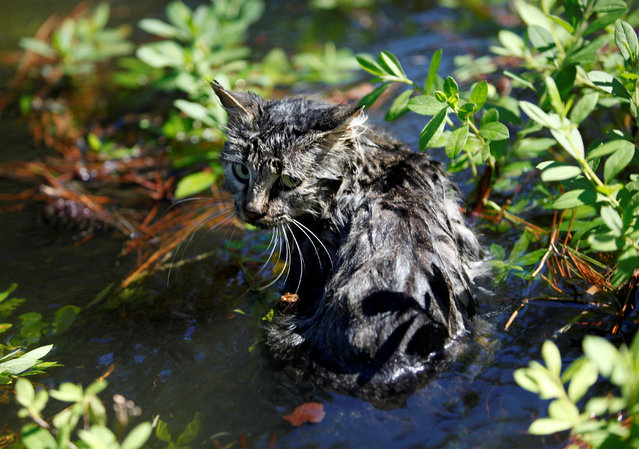
A cat sits in the flooding waters from Hurricane Matthew in downtown Nichols, South Carolina, October 10, 2016. (Photo by Randall Hill/Reuters)

A cat sits in the flooding waters from Hurricane Matthew in downtown Nichols, South Carolina, October 10, 2016. (Photo by Randall Hill/Reuters)
Details
14 Dec 2016 08:03:00
Ethnic Wa performer dressed as United Wa State Army (UWSA) soldiers perform a traditional dance in Mongmao, Wa territory in northeast Myanmar October 1, 2016. (Photo by Soe Zeya Tun/Reuters)

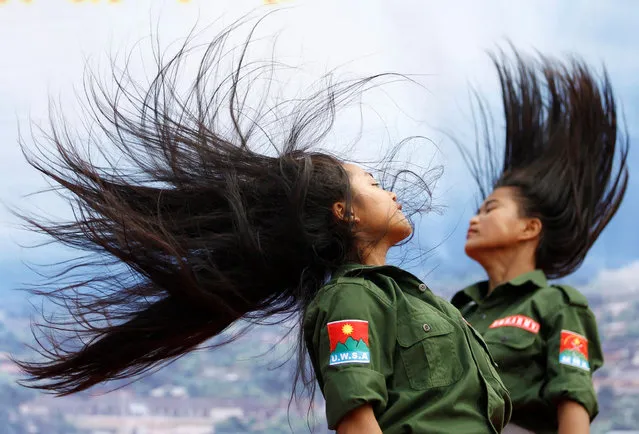
Ethnic Wa performer dressed as United Wa State Army (UWSA) soldiers perform a traditional dance in Mongmao, Wa territory in northeast Myanmar October 1, 2016. Wa State is an unrecognised state in Myanmar (Burma) and is currently subsumed under the official Wa Special Region 2 of northern Shan State. The Wa were once known as the “Wild Wa” by the British due to their practice of headhunting. (Photo by Soe Zeya Tun/Reuters)
Details
30 Dec 2016 10:18:00
Kawakanih Yawalapiti, 9, Upper Xingu region of Mato Grosso, Brazil, 2018: Kawakanih lives with her tribe, the Yawalapiti, in Xingu national park, a preserve in the Amazon basin of Brazil. The Yawalapiti collect seeds to preserve species unique to their ecosystem, which lies between the rain forest and savannah. Kawakanih’s diet is simple, consisting mainly of fish, cassava, porridge, fruit and nuts. “It takes five minutes to catch dinner”, says Kawakanih. “When you’re hungry, you just go to the river with your net”. (Photo by Gregg Segal/The Guardian)

Photographer Gregg Segal travelled the world to document children and the food they eat in a week. Partly inspired by the increasing problems of childhood obesity, he tracked traditional regional diets as yet unaffected by globalisation, and ironically, found that the healthiest diets were often eaten by the least well off. (Photo by Gregg Segal/The Guardian)
Details
03 Jul 2019 00:03:00
A woman takes a picture of a statue of a child wearing what appears to be a hazardous material suit in Fukushima, Japan on August 14, 2018. (Photo by Kwiyeon Ha/Reuters)

A woman takes a picture of a statue of a child wearing what appears to be a hazardous material suit in Fukushima, Japan on August 14, 2018. (Photo by Kwiyeon Ha/Reuters)
Details
15 Aug 2018 07:40:00
A couple shares a light moment in a Mass Transit Railway (MTR) subway train in Hong Kong, China on August 28, 2019. (Photo by Anushree Fadnavis/Reuters)

A couple shares a light moment in a Mass Transit Railway (MTR) subway train in Hong Kong, China on August 28, 2019. (Photo by Anushree Fadnavis/Reuters)
Details
01 Jan 2020 00:01:00
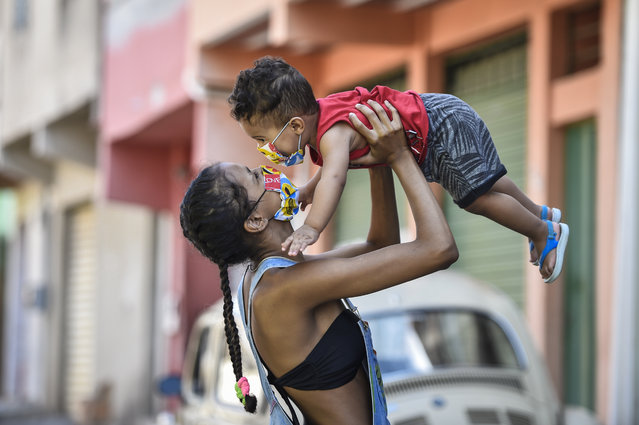
Carolaine Reis and her son Miguel Alves, residents of the Aglomerado da Serra favela, wear a protective mask against the spread of the new Coronavirus (COVID-19) made by the seamstresses of the Remexe Favelinha studio, in the Aglomerado da Serra favela, on April 13, 2020 in Belo Horizonte, Brazil. Facial masks follow the protocol and guidelines defined by the Ministry of Health. Around 6,000 masks have already been produced. The masks are being distributed to a part of the population and sold throughout the country, in the amount of 5 reais per unit. (Photo by Pedro Vilela/Getty Images)

Carolaine Reis and her son Miguel Alves, residents of the Aglomerado da Serra favela, wear a protective mask against the spread of the new Coronavirus (COVID-19) made by the seamstresses of the Remexe Favelinha studio, in the Aglomerado da Serra favela, on April 13, 2020 in Belo Horizonte, Brazil. Facial masks follow the protocol and guidelines defined by the Ministry of Health. Around 6,000 masks have already been produced. The masks are being distributed to a part of the population and sold throughout the country, in the amount of 5 reais per unit. (Photo by Pedro Vilela/Getty Images)
Details
16 Apr 2020 00:03:00