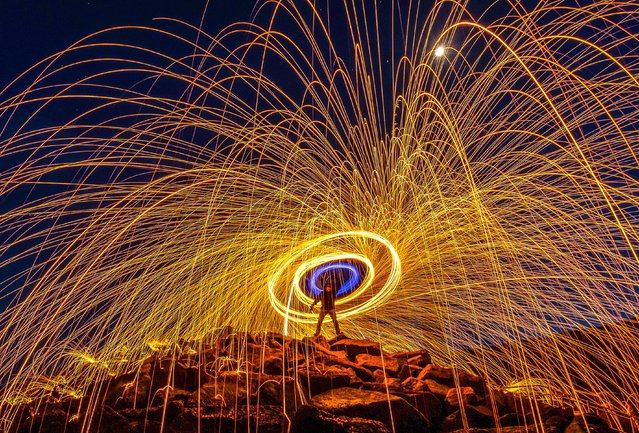
Light painting on the beach at Walton-on-the-Naze in Essex, United Kingdom on April 25, 2023 using burning steel wool spun around on a rope sending sparks flying. (Photo by Kevin Jay/Picture Exclusive)
Viking re-enactors from the Gullinkambi group pose for pictures as part of the Jorvik Viking Festival on February 21, 2025. 100s of Viking re-enactors will march through the streets of York tomorrow. (Photo by James Glossop/The Times & Sunday Times)
A member of the Unidos do Viradouro samba school performs during the last night of the Carnival parade at the Marques de Sapucai Sambadrome in Rio de Janeiro, Brazil, on February 13, 2024. (Photo by Pablo Porciuncula/AFP Photo)
On the second straight day of record-setting temperatures, Maddy Hacker is hoisted up by friend Jasmine Harper, both of McLean, Virgnia, as they attempt an acrobatic stunt in front of the U.S. Capitol in Washington, U.S., February 21, 2018. (Photo by Kevin Lamarque/Reuters)
Members of contemporary circus group perform inside the subway train, amid the energy crisis in Prague, Czech Republic on March 2, 2023. (Photo by David W. Cerny/Reuters)
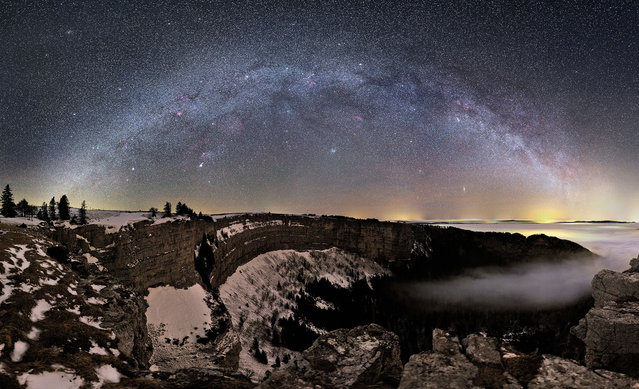
The Milky Way is the galaxy in which Earth is contained. This name derives from its appearance as a dim “milky” glowing band arching across the night sky, in which the naked eye cannot distinguish individual stars. The term “Milky Way” is a translation of the Classical Latin via lactea, from the Hellenistic Greek γαλαξίας κύκλος (pr. galaxías kýklos, “milky circle”). The Milky Way appears like a band because it is a disk-shaped structure being viewed from inside. The fact that this faint band of light is made up of stars was proven in 1610 when Galileo Galilei used his telescope to resolve it into individual stars. In the 1920s, observations by astronomer Edwin Hubble showed that the Milky Way is just one of many galaxies.