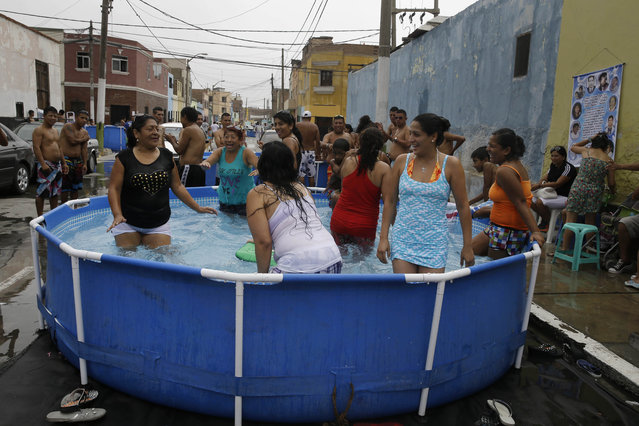
A group of women dance in a pool in Callao, Peru, Sunday, February 22, 2015. One of centers for the front-doorstep, pool-party phenomenon is Lima's port city of Callao. People hold parties in them and sometimes entire blocks chip in to buy a pool, which can be had in local department stores for a bit over $100. (Photo by Martin Mejia/AP Photo)
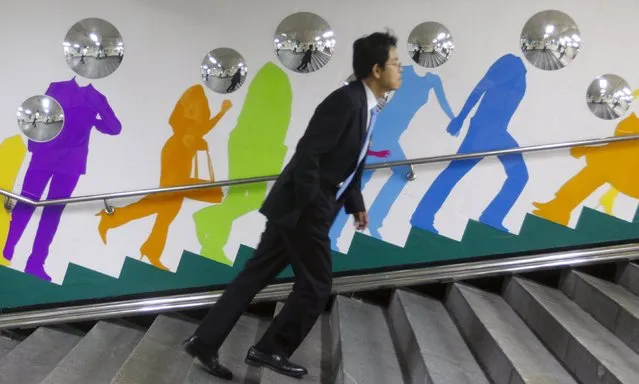
A man walks past an advertisement sign promoting a bank in Seoul in this September 3, 2009 file photo. South Korea is expected to release GDP dara this week. (Photo by Lee Jae-Won/Reuters)
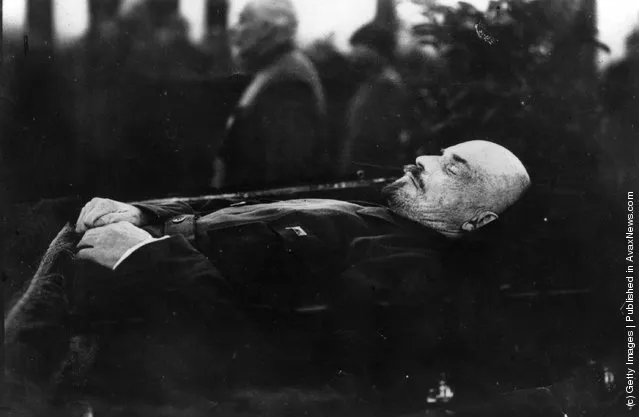
Photo: Vladimir Ilyich Lenin (1870 – 1924) lying in state in the Kremlin. (Photo by Hulton Archive/Getty Images). 1924
Important! For the same article in Russian language click here.
Something quite intriguing is happening within Russian-speaking internet during the last few – should you type a fully academic inquiry (at least, according to Russian academic requirements) in national search engines for "Lenin's mausoleum" – the first thing you get (even in top 10 searches) is website pages talking about black magic and occult. Website authors view this construction differently, but unconditionally agree on one thing: the mausoleum of the "leader of the world proletariat” – the essence of a magical artifact, a sort of “energy vampire”. It was built with a certain purpose: to drain the energy out of miserable Soviet citizens on one hand; and to poison the anthroposphere of one-sixth part of the earth with its vibes (the exact territory that was occupied by the former Soviet Union), depriving the Russian people of will to resist on the other hand. Complete nonsense? No doubt. Nevertheless, an intriguing one. Well, probably because some oddities do exist in mausoleum's history. These oddities are the thing we are going to discuss this time. First, let me refresh you memory on the subject.
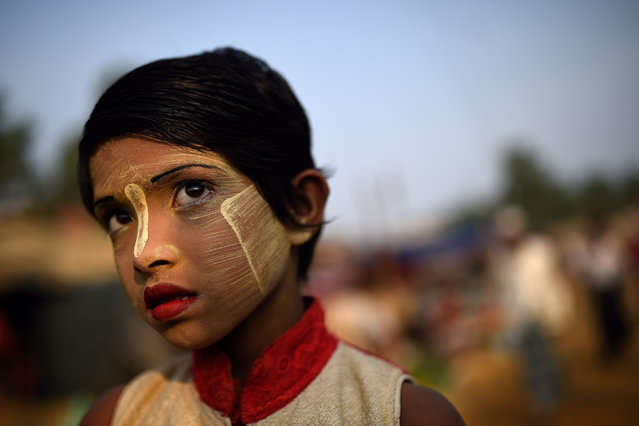
A Rohingya refugee girl named Rufia Begum, aged 9, poses for a photograph as she wears thanaka paste at Balukhali camp in Cox's Bazaar, Bangladesh, March 31, 2018. (Photo by Clodagh Kilcoyne/Reuters)
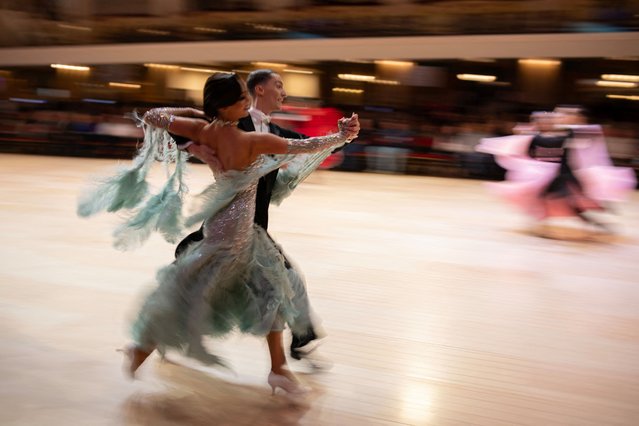
Ballroom dancers Andrei Toader and Mia Linnik-Holden compete in the “North of England Amateur Ballroom Dancing” competition at the 49th British National Dance Championships, in the Empress Ballroom of Blackpool's Winter Gardens, in Blackpool, north-west England, on November 21, 2024. The four-day British National Dance Championships have been taking place since 1975 with dancers competing in Ballroom and Latin dancing disciplines. (Photo by Oli Scarff/AFP Photo)
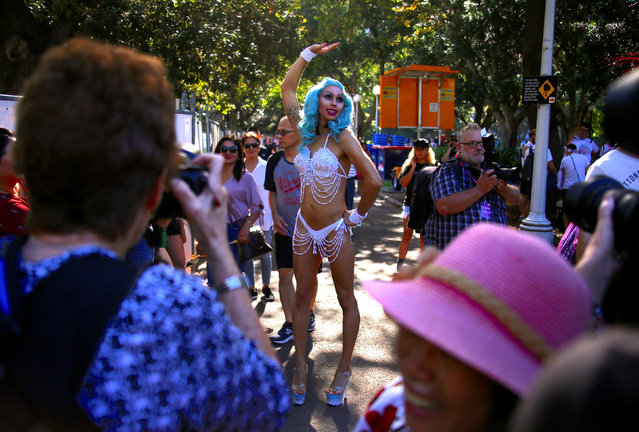
A participant wearing a costume poses for members of the public before the 40th anniversary of the Sydney Gay and Lesbian Mardi Gras Parade in central Sydney, Australia, March 3, 2018. (Photo by David Gray/Reuters)