Loading...
Done


“Sektor gaza” (Russian: Сектор газа) was a Russian rock band formed on 5 December 1987 in the city of Voronezh, Russia. Despite only semi-officially existing (due to obscene lyrics), the group remains popular in Russia today. The group name was taken from an eponymous industrial district of Voronezh (itself named for high levels of environmental contamination). Their music style could be defined as Russian punk, integrated with elements of different musical genres such as rock, rap, and Russian folk. On 4 July 2000, group leader Yuri “Hoy” Klinskih complained of strong pains in his stomach and the left side of his chest. He suffered heart failure shortly thereafter. Klinskikh died in Voronezh (Russia)at the age of 35. He is buried in the Levoberezhniy Cemetery. The group ceased to exist.

About the music video: The First Chechen War, also known as the War in Chechnya, was a conflict between the Russian Federation and the Chechen Republic of Ichkeria, fought from December 1994 to August 1996. After the initial campaign of 1994 – 1995, culminating in the devastating Battle of Grozny, Russian federal forces attempted to seize control of the mountainous area of Chechnya but were set back by Chechen guerrilla warfare and raids on the flatlands in spite of Russia's overwhelming manpower, weaponry, and air support...
Details
24 May 2012 14:38:00
New Yorkers Celebrate At West Indian Day Parade

“The Labor Day Parade (or West Indian Carnival), is an annual celebration held on American Labor Day (the first Monday in September), in Crown Heights, Brooklyn, New York. Ms. Jessie Waddell and some of her West Indian friends started the Carnival in Harlem in the 1920s by staging costume parties in large enclosed places like the Savoy, Renaissance and Audubon Ballrooms due to the cold wintry weather of February. This is the usual time for the pre-Lenten celebrations held in most countries around the world. However, because of the very nature of Carnival, and the need to parade in costume to music, indoor confinement did not work well. The earliest known Carnival street parade was held on September 1, 1947. The Trinidad Carnival Pageant Committee was the founding force behind the parade, which was held in Harlem. The parade route was along Seventh Avenue, starting at 110th St.” – Wikipedia

Photo: A reveler looks on during the West Indian-American Day Parade September 5, 2011 in the Brooklyn borough of New York City. More than 2 million spectators were expected to attend the celebration of Caribbean culture. (Photo by Mario Tama/Getty Images)
Details
06 Sep 2011 11:18:00
Participants play in the mud as they plant rice samplings during National Paddy Day, also called Asar Pandra, that marks the commencement of rice crop planting in paddy fields as monsoon season arrives, in Dhading, Nepal, June 30, 2019. (Photo by Navesh Chitrakar/Reuters)

Participants play in the mud as they plant rice samplings during National Paddy Day, also called Asar Pandra, that marks the commencement of rice crop planting in paddy fields as monsoon season arrives, in Dhading, Nepal, June 30, 2019. (Photo by Navesh Chitrakar/Reuters)
Details
22 Aug 2019 00:01:00
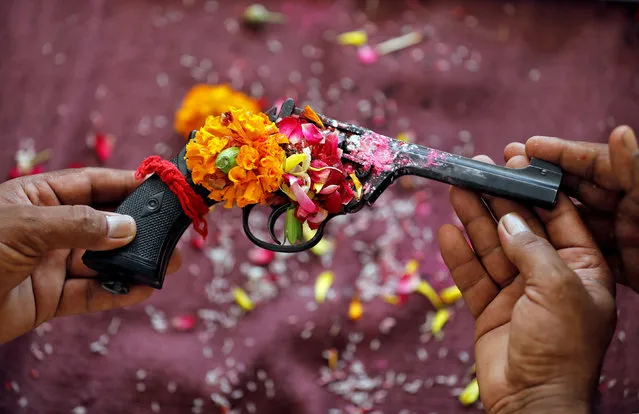
Police officers hold a revolver as they offer prayers to their weapons as part of a ritual at their headquarters on the occasion of Dussehra, or Vijaya Dashami, festival in Ahmedabad, India, October 8, 2019. (Photo by Amit Dave/Reuters)

Police officers hold a revolver as they offer prayers to their weapons as part of a ritual at their headquarters on the occasion of Dussehra, or Vijaya Dashami, festival in Ahmedabad, India, October 8, 2019. (Photo by Amit Dave/Reuters)
Details
17 Oct 2019 00:01:00
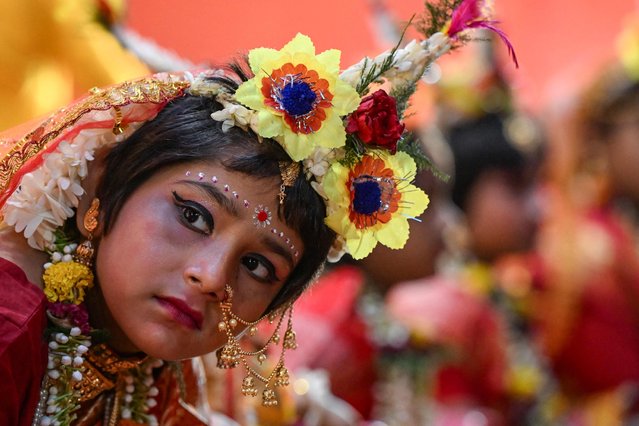
A young girl dressed as Hindu Goddess “Durga” sits near the deity's idol during the traditional “Kumari Puja” as a part of the Durga Puja festival in Kolkata on October 11, 2024. (Photo by Dibyangshu Sarkar/AFP Photo)

A young girl dressed as Hindu Goddess “Durga” sits near the deity's idol during the traditional “Kumari Puja” as a part of the Durga Puja festival in Kolkata on October 11, 2024. (Photo by Dibyangshu Sarkar/AFP Photo)
Details
26 Oct 2024 02:47:00
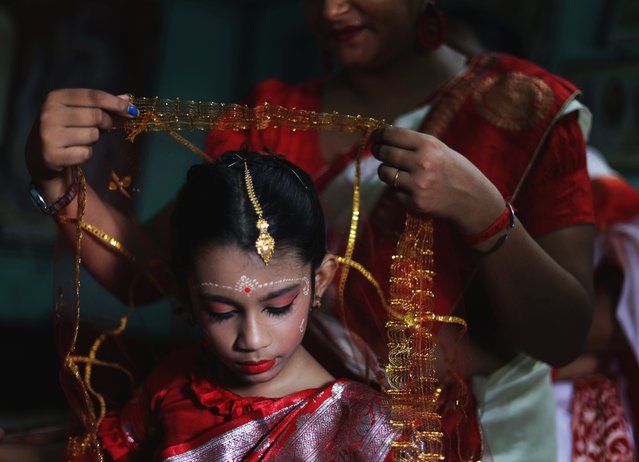
Indian girl, Amrita Bannerjee, gets dressed as the Goddess Durga, during Kumari Puja ritual as part of the Durga Puja festival at Shidaspur village, far north of Kolkata, India, 30 September 2025. During the Kumari Puja, devotees worship a girl aged between six and twelve, symbolizing the Kanya Kumari (virgin) form of the Goddess Durga Devi. Hindu devotees believe that Kanya is a living embodiment of the goddess Durga. (Photo by Piyal Adhikary/EPA)

Indian girl, Amrita Bannerjee, gets dressed as the Goddess Durga, during Kumari Puja ritual as part of the Durga Puja festival at Shidaspur village, far north of Kolkata, India, 30 September 2025. During the Kumari Puja, devotees worship a girl aged between six and twelve, symbolizing the Kanya Kumari (virgin) form of the Goddess Durga Devi. Hindu devotees believe that Kanya is a living embodiment of the goddess Durga. (Photo by Piyal Adhikary/EPA)
Details
31 Oct 2025 02:37:00
A leader “Rolli” of a yodel group “Schuppel” runs in the snow in front of a farmstead during the “Silvesterchlausen” in the early morning in Urnaesch in the Swiss canton Appenzell Ausserroden on January 13, 2017. The “Silvesterchlausen” is a tradition of the Swiss canton Appenzell, where colorfull characters organized in groups called “Schuppel”, chase out the old year and welcome the new one. They run all day long from farmstead to farmstead, gather together to sing a jodel and great the farmers. A “Schuppel” consists of some “Schelli” and two “Rolli”, sometimes with female dresses and nice scenes over the head, despite the dress all participants are males. The Silversterchlausen run twice a year, first for the new Silvester on December 31, and then again on January 13, for the old Silvester following the Julian calendar. (Photo by Michael Buholzer/AFP Photo)

A leader “Rolli” of a yodel group “Schuppel” runs in the snow in front of a farmstead during the “Silvesterchlausen” in the early morning in Urnaesch in the Swiss canton Appenzell Ausserroden on January 13, 2017. (Photo by Michael Buholzer/AFP Photo)
Details
14 Jan 2017 12:41:00
A reveller reacts amid a “flour war” during the “Ash Monday” celebrations, a traditional festivity marking the end of the carnival season and the start of the 40-day Lent period until the Orthodox Easter, in the port town of Galaxidi, Greece, on March 11, 2019. (Photo by Aris Messinis/AFP Photo)

A reveller reacts amid a “flour war” during the “Ash Monday” celebrations, a traditional festivity marking the end of the carnival season and the start of the 40-day Lent period until the Orthodox Easter, in the port town of Galaxidi, Greece, on March 11, 2019. (Photo by Aris Messinis/AFP Photo)
Details
13 Mar 2019 00:07:00