Loading...
Done
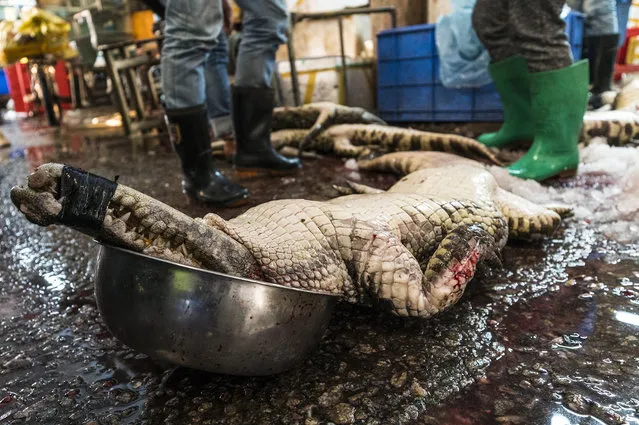
A dead crocodile is seen on Huangsha Seafood Market in Guangzhou, Guandong Province, China, 22 January 2018. Tsukiji Market of China or Huangsha Seafood Market is biggest one in Southern China and one of the biggest in China, as there are literally hundreds of different varieties of fish and seafood scattered throughout the market. Since the proximity of the fish market is so close to the Zhujiang River, it's quite easy for the large fishing vessels and fishermen to unload their fresh catch right at the market, which ensures that the fish and seafood remain fresh. Fish and other seafood are coming there from all around the globe. Seafood Market is full of different kinds of live fish, live shellfish, and live seafood on display in crystal clear tanks and it's common to see 5-star chefs, retailers and expats to source for fresh and high-quality seafood supplies for reasonable prices. While it is a wholesale fish market, since many Guangzhou restaurants and businesses come to purchase their seafood here, the public is welcome to come and even purchase. Many local Chinese have the vendors slice up fresh salmon fillets to take home or carry seafood into one of the nearby specialty restaurants, where they will cook if for them and serve it with vegetables and other side dishes of their choice. One of the biggest attractions for both, tourists and buyers, on market are crocodiles, which are brought there alive in wooden cases with taped jaws so they can?t accidentally bite. They are from crocodile farms from Guangdong, China and from Vietnam. Crocodile meat is popular in most Asian countries and it is consider as delicate one. Crocodiles weight from 10 to 25 kg and bigger ones are about 2 years old. They cost about 70 RMB (8.90 EURO) when bout as whole, or if you buy as parts most expensive and appreciated parts are paws 120 RMB (15.26 EURO) per kg, and tail 100 RMB (12.72 EURO) per kg. (Photo by Aleksandar Plavevski/EPA/EFE)

A dead crocodile is seen on Huangsha Seafood Market in Guangzhou, Guandong Province, China, 22 January 2018. Tsukiji Market of China or Huangsha Seafood Market is biggest one in Southern China and one of the biggest in China, as there are literally hundreds of different varieties of fish and seafood scattered throughout the market. (Photo by Aleksandar Plavevski/EPA/EFE)
Details
17 Apr 2020 00:05:00
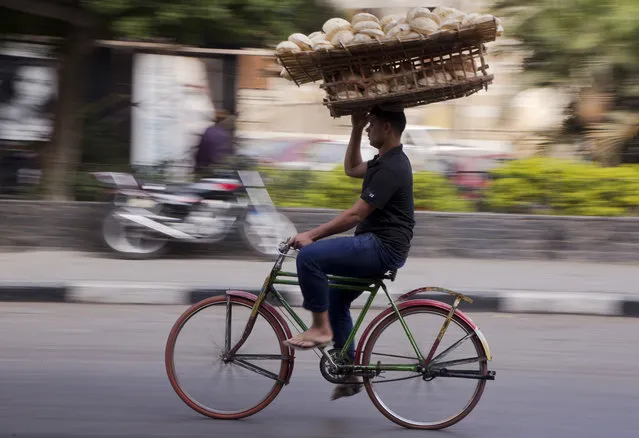
An Egyptian carries bread tray over his bicycle, in Cairo, Egypt, Saturday, November 19, 2016. Egypt is currently suffering an acute foreign currency shortage because of the decimation of its lucrative tourism industry, double digit rates of inflation and unemployment. (Photo by Amr Nabil/AP Photo)

An Egyptian carries bread tray over his bicycle, in Cairo, Egypt, Saturday, November 19, 2016. Egypt is currently suffering an acute foreign currency shortage because of the decimation of its lucrative tourism industry, double digit rates of inflation and unemployment. (Photo by Amr Nabil/AP Photo)
Details
08 Feb 2017 00:02:00
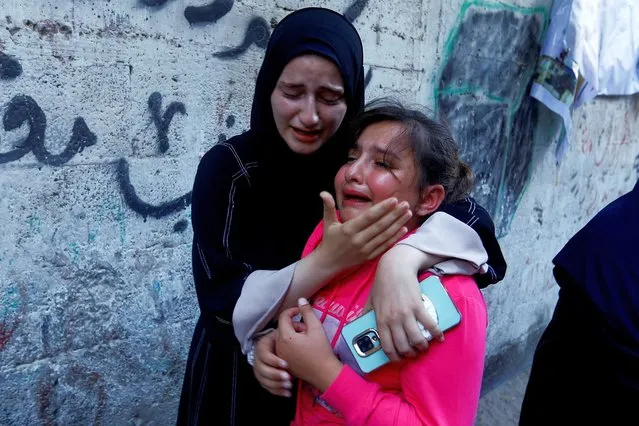
The daughter of Zakaria Abu Maamar, a member of Hamas' political office, is comforted as she cries during her father's funeral, after he was killed in an air strike, in Khan Younis, in southern Gaza Strip on October 10, 2023. (Photo by Ibraheem Abu Mustafa/Reuters)

The daughter of Zakaria Abu Maamar, a member of Hamas' political office, is comforted as she cries during her father's funeral, after he was killed in an air strike, in Khan Younis, in southern Gaza Strip on October 10, 2023. (Photo by Ibraheem Abu Mustafa/Reuters)
Details
17 Oct 2023 00:47:00
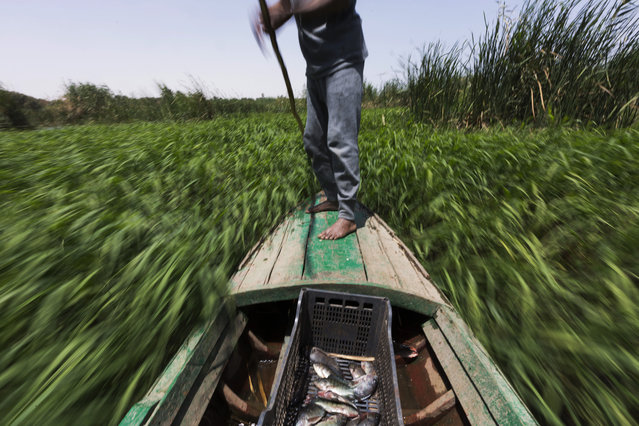
In this April 12, 2015 photo, Sayed Ahmed Abdoh poles his boat to check his fish traps in the Nile River, near Abu al-Nasr village, about 770 kilometers (480 miles) south of Cairo, Egypt. Abdoh caught some 20 fish this day and gave them to his friend, Salama Osman, a migrant worker in a Cairo apartment building, to celebrate his biannual return to their village. (Photo by Hiro Komae/AP Photo)

In this April 12, 2015 photo, Sayed Ahmed Abdoh poles his boat to check his fish traps in the Nile River, near Abu al-Nasr village, about 770 kilometers (480 miles) south of Cairo, Egypt. Abdoh caught some 20 fish this day and gave them to his friend, Salama Osman, a migrant worker in a Cairo apartment building, to celebrate his biannual return to their village. (Photo by Hiro Komae/AP Photo)
Details
06 May 2015 13:11:00
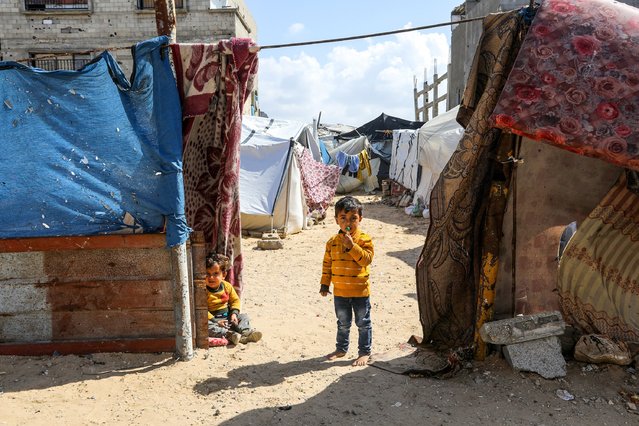
Palestinians living in the rubble of destroyed houses or in makeshift tents in the city of Khan Yunis, which suffered great destruction during the 15-month-long attacks of the Israeli army, continue their daily life despite all the negativities on February 16, 2025 in Khan Yunis, Gaza. (Photo by Abed Rahim Khatib/Anadolu via Getty Images)

Palestinians living in the rubble of destroyed houses or in makeshift tents in the city of Khan Yunis, which suffered great destruction during the 15-month-long attacks of the Israeli army, continue their daily life despite all the negativities on February 16, 2025 in Khan Yunis, Gaza. (Photo by Abed Rahim Khatib/Anadolu via Getty Images)
Details
08 Mar 2025 04:02:00
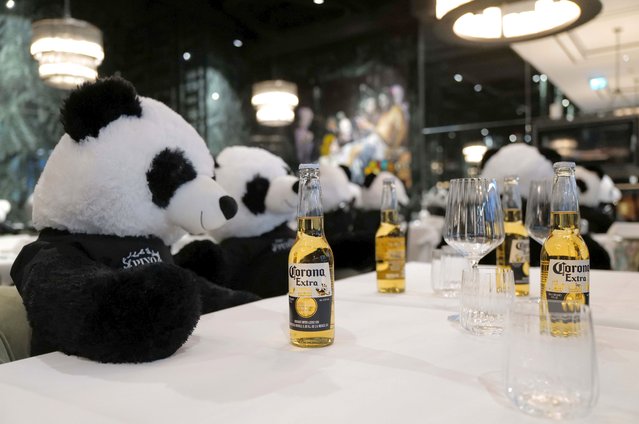
Fluffy toy panda bears as part of the art installation “Panda mie” by Italian restaurant owner Giuseppe “Pino” Fichera sit over beers at his restaurant “Pino's” to raise awareness of the COVID-19 lockdown's business impact on gastronomy in Frankfurt, Germany, November 24, 2020. (Photo by Kai Pfaffenbach/Reuters)

Fluffy toy panda bears as part of the art installation “Panda mie” by Italian restaurant owner Giuseppe “Pino” Fichera sit over beers at his restaurant “Pino's” to raise awareness of the COVID-19 lockdown's business impact on gastronomy in Frankfurt, Germany, November 24, 2020. (Photo by Kai Pfaffenbach/Reuters)
Details
26 Nov 2020 00:07:00
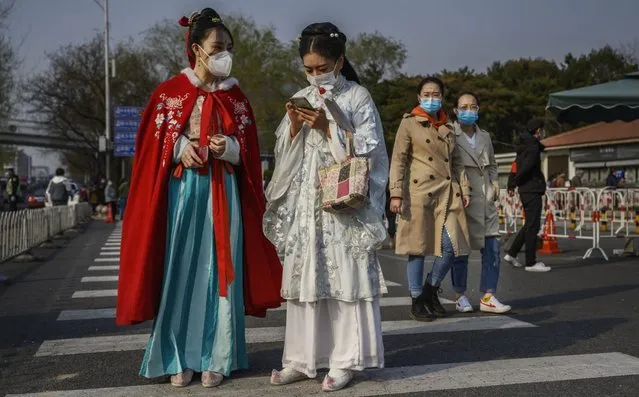
Chinese women wear protective masks as they are dressed in traditional clothing from the Qing Dynasty era outside a park on March 29, 2020 in Beijing, China. A limited section of the iconic tourist site was re-opened to the public this week allowing a smaller number of visitors to reserve tickets online in advance and to enter after passing health screening. With the pandemic hitting hard across the world, China recorded its first day with no new domestic cases of the coronavirus last week, since the government imposed sweeping measures to keep the disease from spreading. For two months, millions of people across China have been restricted in how they move from their homes, while other cities have been locked down in ways that appeared severe at the time but are now being replicated in other countries trying to contain the virus. Officials believe the worst appears to be over in China, though there are concerns of another wave of infections as the government attempts to reboot the worlds second largest economy. In Beijing, it is mandatory to wear masks outdoors, retail stores operate on reduced hours, restaurants employ social distancing among patrons, and tourist attractions at risk of drawing large crowds remain closed. Monitoring and enforcement of virus-related measures and the quarantine of anyone arriving to Beijing is carried out by neighborhood committees and a network of Communist Party volunteers who wear red arm bands. A primary concern for Chinese authorities remains the arrival of flights from Europe and elsewhere, given the exposure of passengers in regions now regarded as hotbeds for transmission. Since January, China has recorded more than 81,000 cases of COVID-19 and at least 3200 deaths, mostly in and around the city of Wuhan, in central Hubei province, where the outbreak first started. (Photo by Kevin Frayer/Getty Images)

Chinese women wear protective masks as they are dressed in traditional clothing from the Qing Dynasty era outside a park on March 29, 2020 in Beijing, China. A limited section of the iconic tourist site was re-opened to the public this week allowing a smaller number of visitors to reserve tickets online in advance and to enter after passing health screening. (Photo by Kevin Frayer/Getty Images)
Details
01 Apr 2020 00:05:00
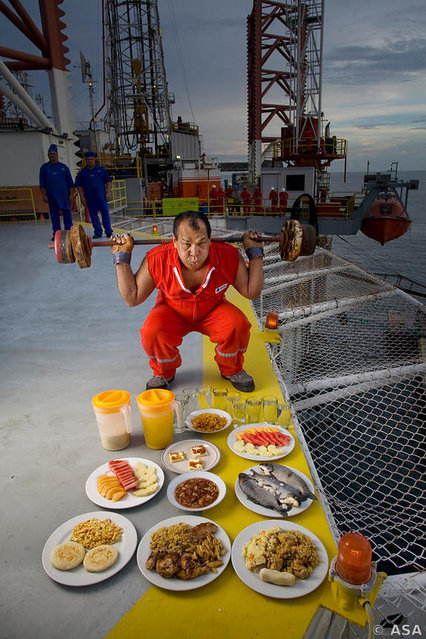
What the World Eats By Peter Menzel And Faith D'Aluisio Part 1

A stunning photographic collection featuring portraits of people from 30 countries and the food they eat in one day. In this fascinating study of people and their diets, 80 profiles are organized by the total number of calories each person puts away in a day. Featuring a Japanese sumo wrestler, a Massai herdswoman, world-renowned Spanish chef Ferran Adria, an American competitive eater, and more, these compulsively readable personal stories also include demographic particulars, including age, activity level, height, and weight. Essays from Harvard primatologist Richard Wrangham, journalist Michael Pollan, and others discuss the implications of our modern diets for our health and for the planet. This compelling blend of photography and investigative reportage expands our understanding of the complex relationships among individuals, culture, and food.
Details
23 Apr 2014 14:34:00