Loading...
Done
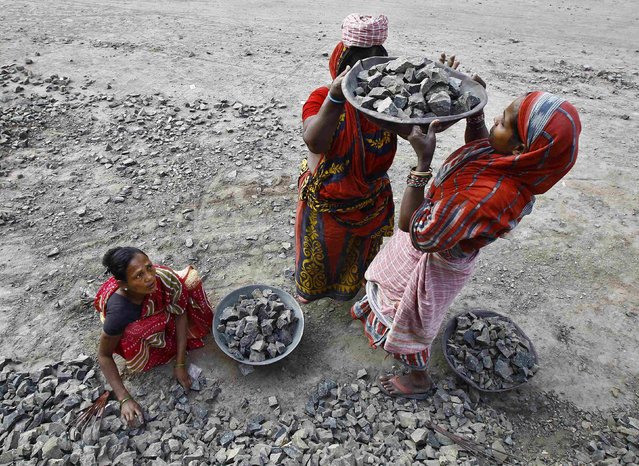
Women labourers work at the construction site of a road in Kolkata January 8, 2015. Across towns and cities in India, it is not uncommon to see women cleaning building sites, carrying bricks and or shoveling gravel - helping construct the infrastructure necessary for the country's economic and social development. (Photo by Rupak De Chowdhuri/Reuters)

Women labourers work at the construction site of a road in Kolkata January 8, 2015. Across towns and cities in India, it is not uncommon to see women cleaning building sites, carrying bricks and or shoveling gravel – helping construct the infrastructure necessary for the country's economic and social development. They help build roads, railway tracks, airports, and offices. They lay pipes for clean water supplies, cables for telecommunications, and dig the drains for sewage systems. But although women make up at least 20 percent of India's 40 million construction workers, they are less recognized than male workers with lower pay and often prone to safety hazards and sexual harassment. They are often unaware of their rights or scared to complain, say activists now trying to campaign for better treatment of women in the construction industry. (Photo by Rupak De Chowdhuri/Reuters)
Details
15 Jan 2015 13:47:00
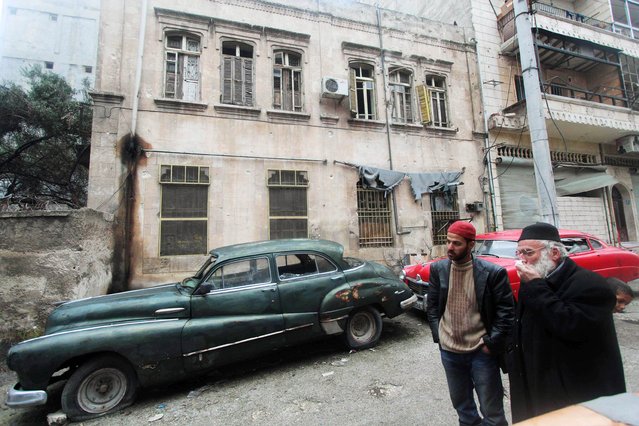
Mohamed Badr al-Din (R) stands in front of his vintage cars along a street where he keeps them, in the al-Shaar neighborhood of Aleppo January 31, 2015. The 66-year-old collector nicknamed Abu Omar inherited the hobby from his father and has a large collection of vintage cars, some of which he says belonged to former Syrian officials and were used in several movies and shows. (Photo by Abdalrhman Ismail/Reuters)

Mohamed Badr al-Din (R) stands in front of his vintage cars along a street where he keeps them, in the al-Shaar neighborhood of Aleppo January 31, 2015. The 66-year-old collector nicknamed Abu Omar inherited the hobby from his father and has a large collection of vintage cars, some of which he says belonged to former Syrian officials and were used in several movies and shows. Before the unrest, Abu Omar planned to open a museum to display his cars, which are guarded from pedestrians by a turkey that he owns. He hopes that the turmoil in the country will end so that he can pursue his hobby and repair his cars, which are heavily damaged from shelling. (Photo by Abdalrhman Ismail/Reuters)
Details
01 Feb 2015 10:34:00
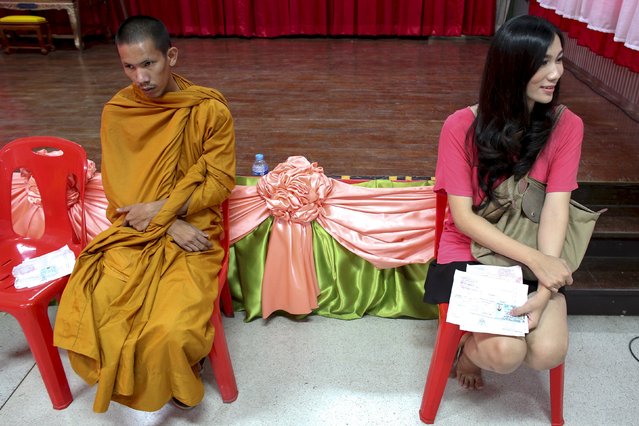
Nopparat (R), a 24-year-old transgender, and a Buddhist monk (L) wait to speak to officers during an army draft held at a school in Bang Na in Bangkok April 3, 2015. Thai men over 21 must serve in the army. Those who volunteer serve six months, but others choose the annual lottery, which goes on for 10 days in recruitment centres around Thailand. Only those not considered physically capable of service, the mentally ill and those who have significantly altered their physical appearance, such as transgenders, are exempt. Picture taken April 3, 2015. (Photo by Athit Perawongmetha/Reuters)

Nopparat (R), a 24-year-old transgender, and a Buddhist monk (L) wait to speak to officers during an army draft held at a school in Bang Na in Bangkok April 3, 2015. Thai men over 21 must serve in the army. Those who volunteer serve six months, but others choose the annual lottery, which goes on for 10 days in recruitment centres around Thailand. Only those not considered physically capable of service, the mentally ill and those who have significantly altered their physical appearance, such as transgenders, are exempt. Picture taken April 3, 2015. (Photo by Athit Perawongmetha/Reuters)
Details
06 Apr 2015 09:54:00
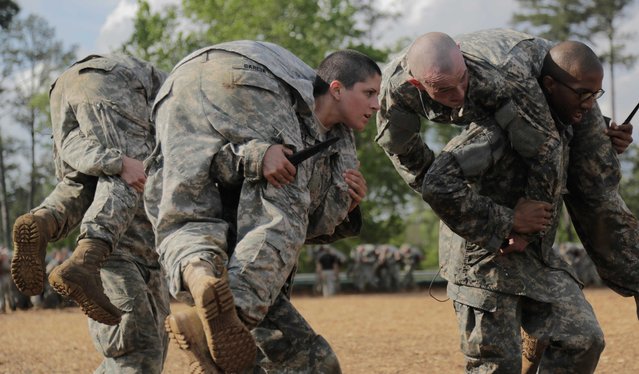
Then U.S. Army First Lieutenant Kirsten Griest (C) and fellow soldiers participate in combatives training during the Ranger Course on Fort Benning, Georgia, in this handout photograph taken on April 20, 2015 and obtained on August 20, 2015. When Griest and another woman completed the daunting U.S. Army Ranger school this week they helped end questions about whether women can serve as combat leaders, as the Pentagon is poised to open new roles, including elite Navy SEALs, to women in coming months. (Photo by Spc. Nikayla Shodeen/Reuters/U.S. Army)

Then U.S. Army First Lieutenant Kirsten Griest (C) and fellow soldiers participate in combatives training during the Ranger Course on Fort Benning, Georgia, in this handout photograph taken on April 20, 2015 and obtained on August 20, 2015. When Griest and another woman completed the daunting U.S. Army Ranger school this week they helped end questions about whether women can serve as combat leaders, as the Pentagon is poised to open new roles, including elite Navy SEALs, to women in coming months. The feat by Griest and First Lieutenant Shaye Haver followed a re-evaluation of the role of women after their frontline involvement in Iraq and Afghanistan and the end of a rule barring them from combat roles in 2013. (Photo by Spc. Nikayla Shodeen/Reuters/U.S. Army)
Details
21 Aug 2015 13:03:00
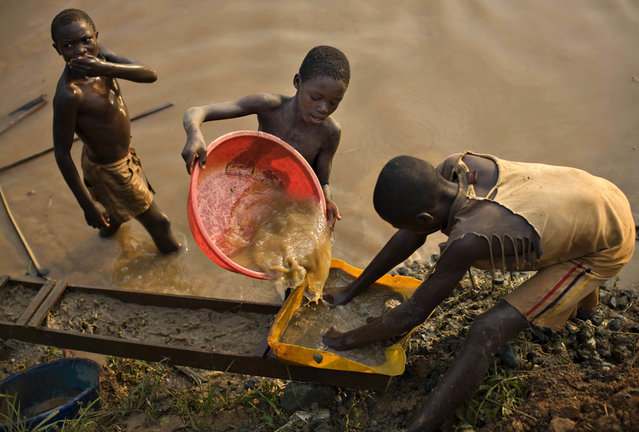
Boys pan for gold on a riverside at Iga Barriere, 25 km (15 miles) from Bunia, in the resource-rich Ituri region of eastern Congo February 16, 2009. Ituri is one of many areas of the country to have experienced bitter ethnic conflict between rival tribes in recent years. Massacres have left tens of thousands dead. It is this fighting that led U.S. authorities to take the unprecedented step of naming Congo in section 1502 of the Dodd-Frank financial regulation act, which says U.S.-listed companies that source gold, tungsten, tantalum and tin from Congo or its neighbours must assure the U.S. stock exchange regulator that their business is not helping fund conflict. (Photo by Finbarr O'Reilly/Reuters)

Boys pan for gold on a riverside at Iga Barriere, 25 km (15 miles) from Bunia, in the resource-rich Ituri region of eastern Congo February 16, 2009. Ituri is one of many areas of the country to have experienced bitter ethnic conflict between rival tribes in recent years. Massacres have left tens of thousands dead. It is this fighting that led U.S. authorities to take the unprecedented step of naming Congo in section 1502 of the Dodd-Frank financial regulation act, which says U.S.-listed companies that source gold, tungsten, tantalum and tin from Congo or its neighbours must assure the U.S. stock exchange regulator that their business is not helping fund conflict. (Photo by Finbarr O'Reilly/Reuters)
Details
12 Nov 2016 10:24:00
Wrestler known as Gio Malkriado (top) fights with a fluorescent tube with wrestler Ciclope during an extreme wrestling fight at a temporary wrestling ring inside a car wash in Tulancingo Hidalgo, Mexico October 8, 2016. When the time comes for the so-called Extreme Star Fight, six wrestlers climb into the ring. Once the fighting begins, anything goes. They bash each other with chairs and long neon lights, causing small explosions and scattering tiny pieces of glass everywhere. The fighters, about half of whom wear masks, even use plastic knives and forks to hurt their opponents. Quickly, blood begins to stain the faces of the combatants and the crowd goes wild, shouting even louder. The screaming and yelling goes on for some time as fans swear at the fighters who ignore them. (Photo by Carlos Jasso/Reuters)

Wrestler known as Gio Malkriado (top) fights with a fluorescent tube with wrestler Ciclope during an extreme wrestling fight at a temporary wrestling ring inside a car wash in Tulancingo Hidalgo, Mexico October 8, 2016. When the time comes for the so-called Extreme Star Fight, six wrestlers climb into the ring. Once the fighting begins, anything goes. They bash each other with chairs and long neon lights, causing small explosions and scattering tiny pieces of glass everywhere. (Photo by Carlos Jasso/Reuters)
Details
20 Nov 2016 11:13:00
A monarch butterfly rests on the ground at the Sierra Chincua butterfly sanctuary on a mountain in Angangeo, Michoacan November 24, 2016. Angangueo is a town and municipality located in far eastern Michoacán state in central Mexico noted for its history of mining and its location in the Monarch Butterfly Biosphere Reserve. The Monarch Butterfly Biosphere Reserve is a World Heritage Site containing most of the over-wintering sites of the eastern population of the monarch butterfly. The reserve is located in the Trans-Mexican Volcanic Belt pine-oak forests ecoregion on the border of Michoacán and State of Mexico, 100 km (62 miles), northwest of Mexico City. Millions of butterflies arrive in the reserve annually. Butterflies only inhabit a fraction of the 56,000 hectares of the reserve from October–March. (Photo by Carlos Jasso/Reuters)

A monarch butterfly rests on the ground at the Sierra Chincua butterfly sanctuary on a mountain in Angangeo, Michoacan November 24, 2016. Angangueo is a town and municipality located in far eastern Michoacán state in central Mexico noted for its history of mining and its location in the Monarch Butterfly Biosphere Reserve. The Monarch Butterfly Biosphere Reserve is a World Heritage Site containing most of the over-wintering sites of the eastern population of the monarch butterfly. (Photo by Carlos Jasso/Reuters)
Details
26 Nov 2016 10:20:00
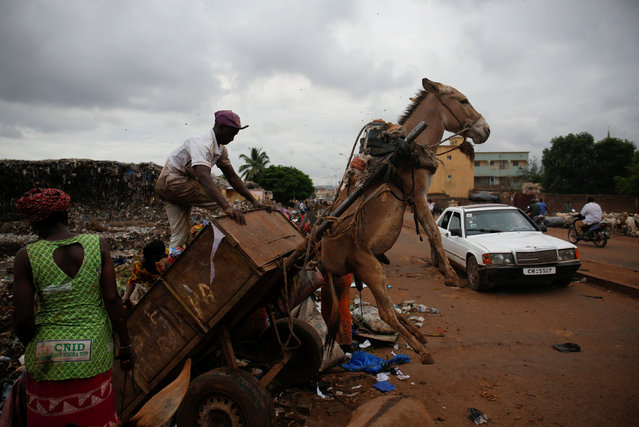
A waste picker unloads garbage at a waste transfer station in Bamako, Mali, August 19, 2018. In the Malian capital of Bamako, donkey carts driven by young men like 19-year-old Arouna Diabate play a vital role battling the fast-growing city's waste problem. Every morning before dawn, Diabate hitches his donkey to a cart and sets off on his rounds, going door-to-door to collect household garbage which he delivers to a local waste transfer station for a monthly salary of around $35. “I won't be picking up trash with a donkey cart for the rest of my life, but for now people appreciate us because we help clean up the homes of Bamako”, Diabate said. (Photo by Luc Gnago/Reuters)

A waste picker unloads garbage at a waste transfer station in Bamako, Mali, August 19, 2018. In the Malian capital of Bamako, donkey carts driven by young men like 19-year-old Arouna Diabate play a vital role battling the fast-growing city's waste problem. Every morning before dawn, Diabate hitches his donkey to a cart and sets off on his rounds, going door-to-door to collect household garbage which he delivers to a local waste transfer station for a monthly salary of around $35. “I won't be picking up trash with a donkey cart for the rest of my life, but for now people appreciate us because we help clean up the homes of Bamako”, Diabate said. (Photo by Luc Gnago/Reuters)
Details
18 Sep 2018 00:01:00