Loading...
Done
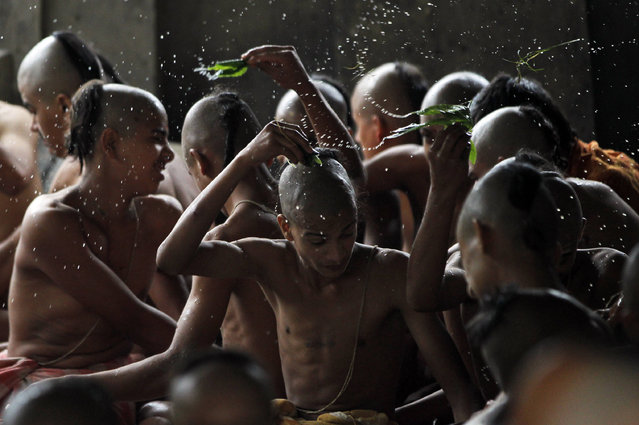
Nepalese Hindu priests perform rituals during Janai Purnima festival at Pashupatinath temple in Kathmandu, Nepal, Thursday, August 18, 2016. During this festival Hindus take holy baths and perform annual change of the Janai, a sacred cotton string worn around their chest or tied on the wrist, in the belief that it will protect and purify them. (Photo by Niranjan Shrestha/AP Photo)

Nepalese Hindu priests perform rituals during Janai Purnima festival at Pashupatinath temple in Kathmandu, Nepal, Thursday, August 18, 2016. During this festival Hindus take holy baths and perform annual change of the Janai, a sacred cotton string worn around their chest or tied on the wrist, in the belief that it will protect and purify them. (Photo by Niranjan Shrestha/AP Photo)
Details
19 Aug 2016 11:48:00
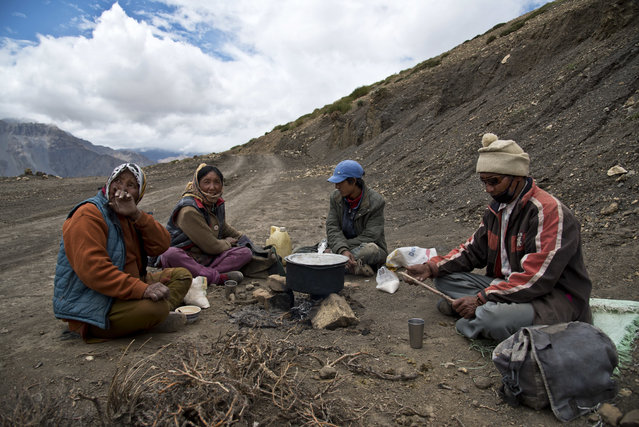
In this August 17, 2016, photo, from left to right, Chhering Chodom, 60, Tashi Yangzom, 50, Lobsang Chhering, 27, and Dorje Tandup, 58, drink milk tea on the side of the road. For centuries, the sleepy valley nestled in the Indian Himalayas remained a hidden Buddhist enclave forbidden to outsiders. Enduring the harsh year-round conditions of the high mountain desert, the people of Spiti Valley lived by a simple communal code – share the Earth's bounty, be hospitable to neighbors, and eschew greed and temptation at all turns. That's all starting to change, for better or worse. Since India began allowing its own citizens as well as outsiders to visit the valley in the early 1990s, tourism and trade have boomed. And the marks of modernization, such as solar panels, asphalt roads and concrete buildings, have begun to appear around some of the villages that dot the remote landscape at altitudes above 4,000 meters (13,000 feet). (Photo by Thomas Cytrynowicz/AP Photo)

In this August 17, 2016, photo, from left to right, Chhering Chodom, 60, Tashi Yangzom, 50, Lobsang Chhering, 27, and Dorje Tandup, 58, drink milk tea on the side of the road. For centuries, the sleepy valley nestled in the Indian Himalayas remained a hidden Buddhist enclave forbidden to outsiders. Enduring the harsh year-round conditions of the high mountain desert, the people of Spiti Valley lived by a simple communal code – share the Earth's bounty, be hospitable to neighbors, and eschew greed and temptation at all turns. That's all starting to change, for better or worse. (Photo by Thomas Cytrynowicz/AP Photo)
Details
15 Sep 2016 09:22:00
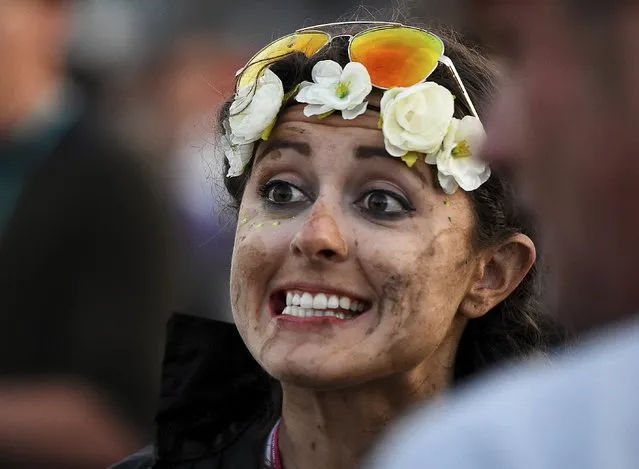
A reveller, covered in mud, chats with friends during the Glastonbury Festival at Worthy Farm in Somerset, Britain, June 26, 2015. (Photo by Dylan Martinez/Reuters)

A reveller, covered in mud, chats with friends during the Glastonbury Festival at Worthy Farm in Somerset, Britain, June 26, 2015. The outdoor festival runs from 24 to 29 June. (Photo by Dylan Martinez/Reuters)
Details
27 Jun 2015 13:41:00
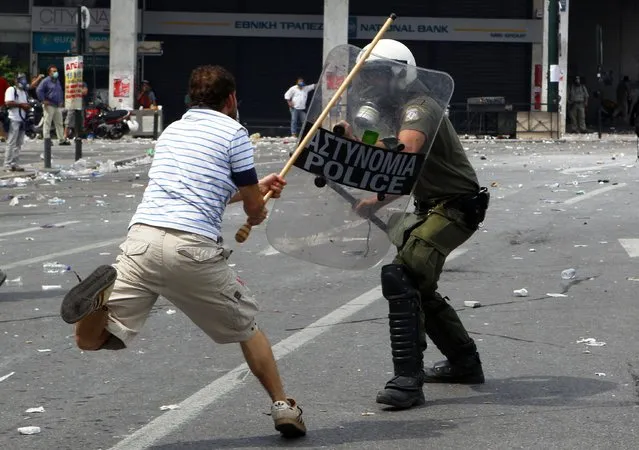
A protester clashes with a police officer in Athens' central Syntagma (Constitution) Square in this June 15, 2011 file photo. Greece triggered the regional financial crisis in 2009 when a far higher budget deficit than previously calculated emerged. (Photo by Yannis Behrakis/Reuters)

A protester clashes with a police officer in Athens' central Syntagma (Constitution) Square in this June 15, 2011 file photo. Greece triggered the regional financial crisis in 2009 when a far higher budget deficit than previously calculated emerged. The collapse of talks with creditors in Paris last November set off a month-long sequence of events leading to elections this week and proving Greece is still the region's weak link. The vote is expected to be won by Syriza, a far-left party opposed to the bailout, worrying investors and creditors alike. (Photo by Yannis Behrakis/Reuters)
Details
22 Jan 2015 13:44:00
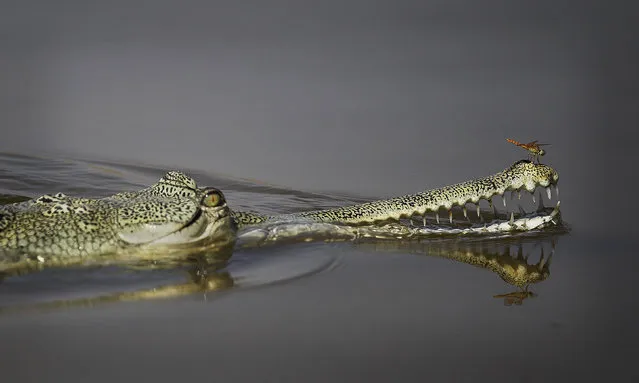
In this photo taken Wednesday, April 30, 2014, a dragonfly sits on the nose of a Gharial, rare crocodile-like creatures, in the River Chambal near Bhopepura village in the northern Indian state of Uttar Pradesh. The narrow 250-mile stretch of the Chambal is a place of crocodiles and jackals, of river dolphins and the occasional wolf. Hundreds of species of birds, storks, geese, babblers, larks, falcons and so many more, nest along the river. (Photo by Altaf Qadri/AP Photo)

In this photo taken Wednesday, April 30, 2014, a dragonfly sits on the nose of a Gharial, rare crocodile-like creatures, in the River Chambal near Bhopepura village in the northern Indian state of Uttar Pradesh. The narrow 250-mile stretch of the Chambal is a place of crocodiles and jackals, of river dolphins and the occasional wolf. Hundreds of species of birds, storks, geese, babblers, larks, falcons and so many more, nest along the river. Endangered birds lay small speckled eggs in tiny pits they dig in the sandbars. Gharials, rare crocodile-like creatures that look like they swaggered out of the Mesozoic Era, are commonplace here and nowhere else. (Photo by Altaf Qadri/AP Photo)
Details
23 Feb 2015 12:55:00
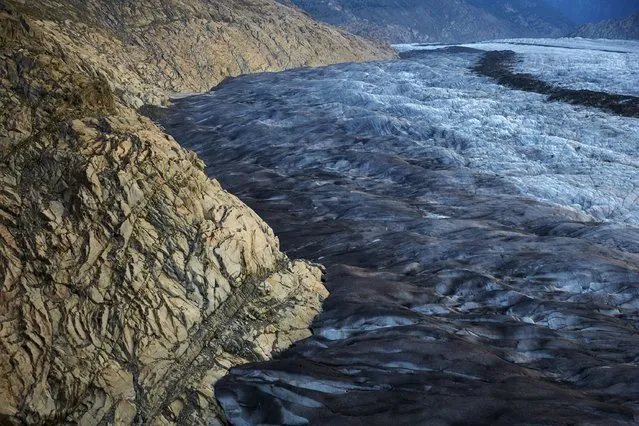
The Aletsch Glacier is pictured at dusk in Fiesch, Switzerland, August 11, 2015. (Photo by Denis Balibouse/Reuters)

The Aletsch Glacier is pictured at dusk in Fiesch, Switzerland, August 11, 2015. One of Europe's biggest glaciers, the Great Aletsch coils 23 km (14 miles) through the Swiss Alps – and yet this mighty river of ice could almost vanish in the lifetimes of people born today because of climate change. The glacier, 900 metres (2,950 feet) thick at one point, has retreated about 3 km (1.9 miles) since 1870 and that pace is quickening. (Photo by Denis Balibouse/Reuters)
Details
18 Oct 2015 08:05:00
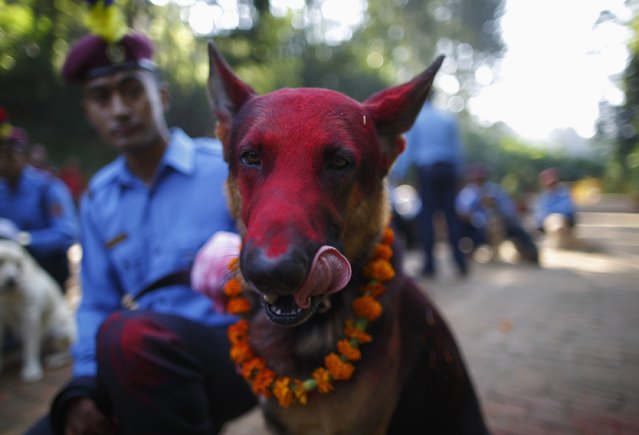
A police dog licks its face after receiving food during the dog festival, as part of celebrations of Tihar at Nepal Police Academy in Kathmandu October 22, 2014. Hindus all over Nepal are celebrating the Tihar festival, also called Diwali, during which they worship cows, which are considered a maternal figure, and other animals. (Photo by Navesh Chitrakar/Reuters)

A police dog licks its face after receiving food during the dog festival, as part of celebrations of Tihar at Nepal Police Academy in Kathmandu October 22, 2014. Hindus all over Nepal are celebrating the Tihar festival, also called Diwali, during which they worship cows, which are considered a maternal figure, and other animals. Also known as the festival of lights, devotees also worship the goddess of wealth Laxmi by illuminating and decorating their homes using garlands, oil lamps, candles and colourful light bulbs. (Photo by Navesh Chitrakar/Reuters)
Details
23 Oct 2014 11:57:00
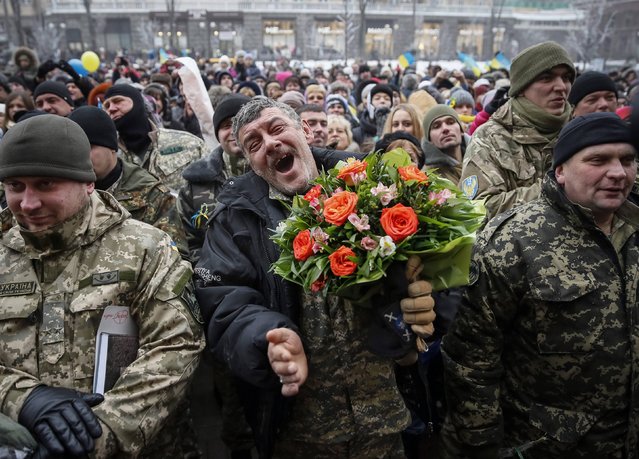
Servicemen of “Kiev 12” military defence battalion react as they take part in a welcoming ceremony in central Ukrainian capital Kiev December 6, 2014. Servicemen of the battalion returned to Kiev after taking part in fighting in eastern Ukraine. (Photo by Gleb Garanich/Reuters)

Servicemen of “Kiev 12” military defence battalion react as they take part in a welcoming ceremony in central Ukrainian capital Kiev December 6, 2014. Servicemen of the battalion returned to Kiev after taking part in fighting in eastern Ukraine. (Photo by Gleb Garanich/Reuters)
Details
07 Dec 2014 11:15:00