Loading...
Done
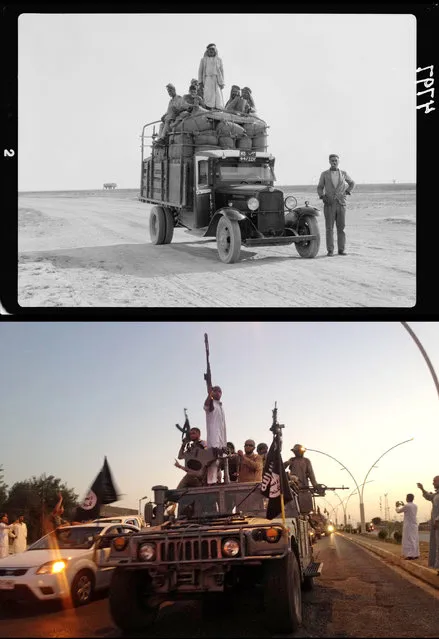
This combination of two photographs shows a 1932 image of men on a lorry on the road to Mosul, northern Iraq, from the Library of Congress, top, and fighters from the Islamic State group parading in a commandeered Iraqi security forces armored vehicle down a main road in Mosul on Monday, June 23, 2014. (Photo by AP Photo)


Iraq's second largest city, Mosul, is locked under the rule of extremists from the Islamic State group trying to purge it of everything they see as contradicting their stark vision of Islam. A trove of photographs now housed at the Library of Congress offers a glimpse of a different Mosul – before wars, insurgency, sectarian strife and now radicals' rule. The scenes were taken in the autumn of 1932 by staff from the American Colony Photo Department during a visit to Iraq at the end of the British mandate. (Photo by AP Photo)
Details
21 Sep 2014 11:13:00
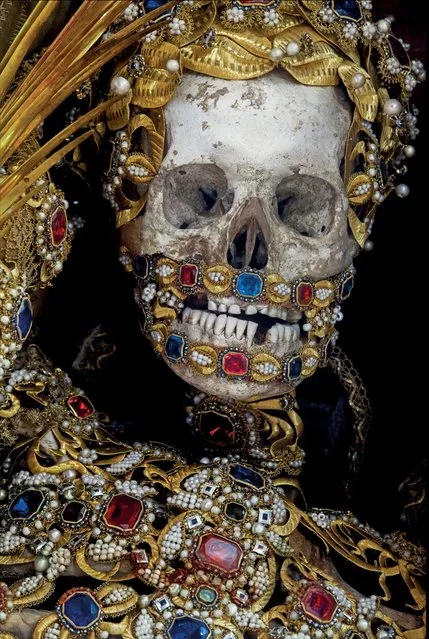
Albertus in the church of St George in Burgrain, Germany. Incredibly, some of the skeletons, which took up to five years to decorate, were even found hidden away in lock-ups and containers. (Photo by Paul Koudounaris/BNPS)

A relic hunter dubbed “Indiana Bones” has lifted the lid on a macabre collection of 400-year-old jewel-encrusted skeletons unearthed in churches across Europe. Art historian Paul Koudounaris has hunted down and photographed dozens of gruesome skeletons in some of the world's most secretive religious establishments. Photo: Albertus in the church of St George in Burgrain, Germany. Incredibly, some of the skeletons, which took up to five years to decorate, were even found hidden away in lock-ups and containers. (Photo by Paul Koudounaris/BNPS)
Details
08 Sep 2013 07:20:00
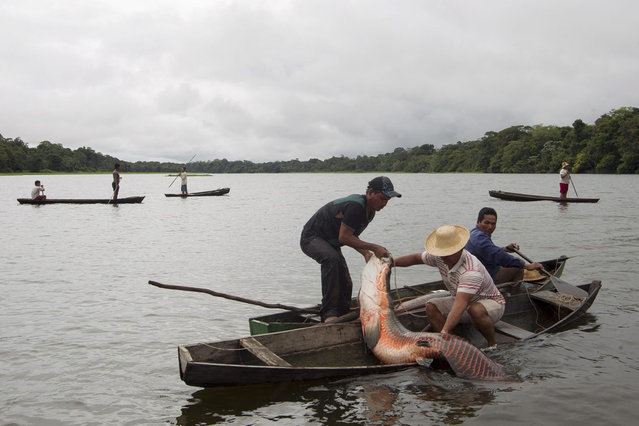
Villagers from the Porto Novo community load into their canoes arapaima or pirarucu, the largest freshwater fish species in South America and one of the largest in the world, while fishing in Poco Fundo lake along a branch of the Solimoes river, one of the main tributaries of the Amazon, in the Mamiraua nature reserve near Fonte Boa about 600 km (373 miles) west of Manaus, November 26, 2013. (Photo by Bruno Kelly/Reuters)

Villagers from the Porto Novo community load into their canoes arapaima or pirarucu, the largest freshwater fish species in South America and one of the largest in the world, while fishing in Poco Fundo lake along a branch of the Solimoes river, one of the main tributaries of the Amazon, in the Mamiraua nature reserve near Fonte Boa about 600 km (373 miles) west of Manaus, November 26, 2013. Catching the arapaima, a fish that is sought after for its meat and is considered by biologists to be a living fossil, is only allowed once a year by Brazil's environmental protection agency. The minimum size allowed for a fisherman to keep an arapaima is 1.5 meters (4.9 feet). (Photo by Bruno Kelly/Reuters)
Details
17 Dec 2013 08:03:00
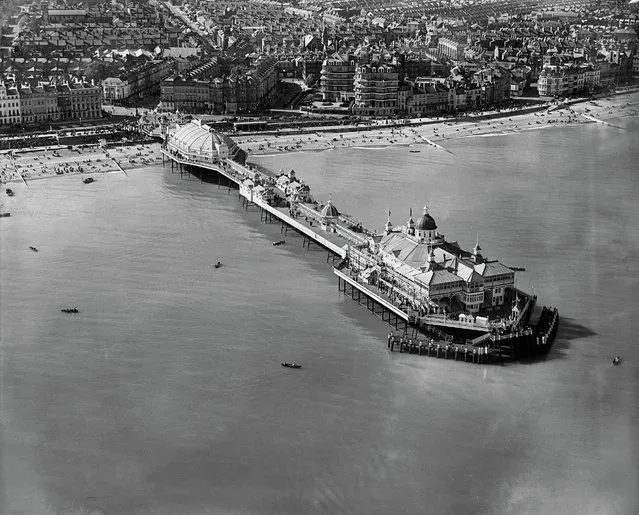
While the lido was described as bringing “modernism to the masses” on the British coast it was just the latest example of a trend that had been developing since Victorian times – transforming seaside towns into resorts for leisure and entertainment. In the latter half of the nineteenth century, the fashion was for local authorities to build great piers stretching from the promenade out into the sea

While the lido was described as bringing “modernism to the masses” on the British coast it was just the latest example of a trend that had been developing since Victorian times – transforming seaside towns into resorts for leisure and entertainment. In the latter half of the nineteenth century, the fashion was for local authorities to build great piers stretching from the promenade out into the sea. The Eastbourne Pier, pictured here in May 1931, was erected between 1866 and 1870 to an ingenious design by Eugenius Birch, which saw the structure sitting on special cups allowing the supporting struts to “move” in bad weather. Arranged on the pier's 1,000-foot length were kiosks, a theatre, a ballroom and a camera obscura. 1931. (Photo by Aerofilms Collection via “A History of Britain From Above”)
Details
25 Feb 2014 12:59:00
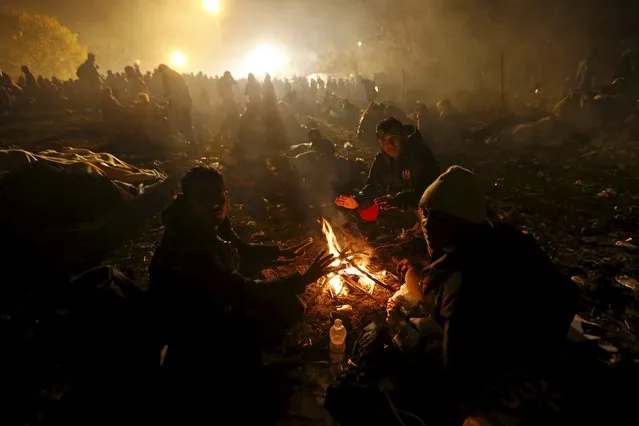
Migrants wait to cross the Slovenia-Austria border in Sentilj, Slovenia, October 27, 2015. The first five border guards – all German – of 400 promised to Slovenia by fellow EU countries are expected to arrive on Wednesday to help channel a huge flow of migrants through the tiny Alpine state, its government said. (Photo by Srdjan Zivulovic/Reuters)

Migrants wait to cross the Slovenia-Austria border in Sentilj, Slovenia, October 27, 2015. The first five border guards – all German – of 400 promised to Slovenia by fellow EU countries are expected to arrive on Wednesday to help channel a huge flow of migrants through the tiny Alpine state, its government said. Interior Ministry state secretary Bostjan Sefic also said 100-120 customs police would join Slovenian soldiers, regular police and private security firms in dealing with an influx that has strapped the country's limited resources. (Photo by Srdjan Zivulovic/Reuters)
Details
30 Oct 2015 08:03:00
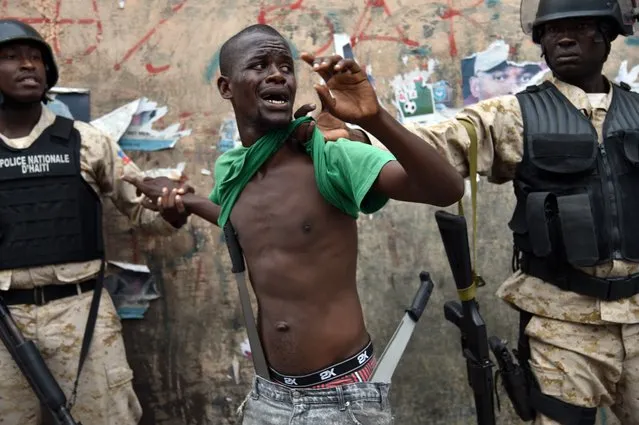
Haitian policemen arrest a demonstrator with machetes at the end of a march, in Port-au-Prince, on November 26, 2015. Supporters of Fanmi Lavalas and Petit Dessalines political parties marched to protest against the results given by the Provisional Electoral Council (CEP), against the Haitian President Michel Martelly, and against the candidate of the ruling party Jovenel Moise. (Photo by Hector Retamal/AFP Photo)

Haitian policemen arrest a demonstrator with machetes at the end of a march, in Port-au-Prince, on November 26, 2015. Supporters of Fanmi Lavalas and Petit Dessalines political parties marched to protest against the results given by the Provisional Electoral Council (CEP), against the Haitian President Michel Martelly, and against the candidate of the ruling party Jovenel Moise. Provisional Electoral Council (CEP) confirmed this week that Haiti's presidential election will go to a runoff on December 27, between ruling party candidate Jovenel Moise and Jude Celestin, close to former president Rene Preval. (Photo by Hector Retamal/AFP Photo)
Details
29 Nov 2015 08:04:00
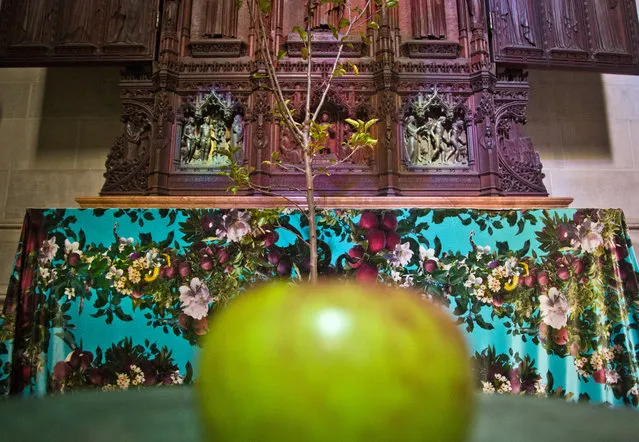
"Temptation", part of an installation from the artist-duo David Burns and Austin Young, appears among the works of 30 artists in the multimedia exhibition "The Value of Food: Sustaining a Green Planet" at the Cathedral of St. John the Divine, Wednesday, October 7, 2015, in New York.  (Photo by Bebeto Matthews/AP Photo)

"Temptation", part of an installation from the artist-duo David Burns and Austin Young, appears among the works of 30 artists in the multimedia exhibition "The Value of Food: Sustaining a Green Planet" at the Cathedral of St. John the Divine, Wednesday, October 7, 2015, in New York. The exhibition, installed in the cathedral's seven chapels and 14 bays, explores food accessibility, sustainability and other food-related issues and runs through April 3, 2016. (Photo by Bebeto Matthews/AP Photo)
Details
16 Oct 2015 08:01:00
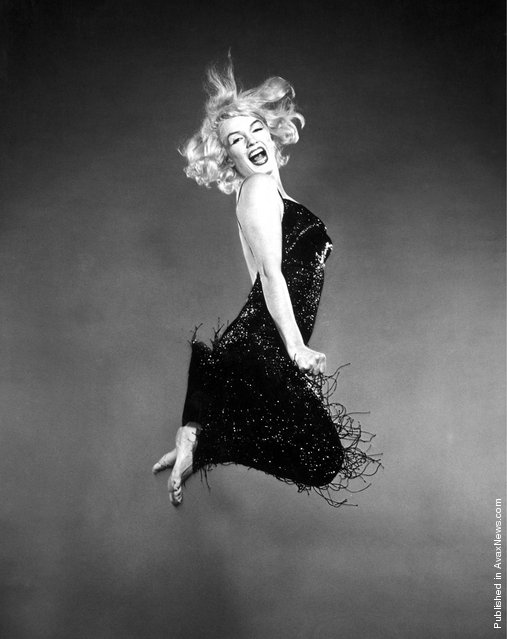
Marilyn Monroe, 'Jumpology', 1959. Photo by Philippe Halsman

“Philippe Halsman (2 May 1906 Riga, Russian Empire – 25 June 1979 New York City) was a Latvian-born American portrait photographer. Many celebrities photographed by Halsman include Alfred Hitchcock, Judy Garland, Winston Churchill, Marilyn Monroe, Dorothy Dandridge, and Pablo Picasso. Many of those photographs appeared on the cover of Life. In such photos, he utilizes a variety of his rules of photography. For example, in one of his photos of Winston Churchill, the omission of his face makes Halsman's photo even more powerful at making Churchill more human”. – Wikipedia

Photo: Marilyn Monroe, “Jumpology”, 1959. Photo by Philippe Halsman
Details
12 Apr 2012 13:18:00