2016 Rio Olympics, Rugby, Women's Semifinals Britain vs New Zealand, Deodoro Stadium, Rio de Janeiro, Brazil on August 8, 2016. Portia Woodman (NZL) of New Zealand tackles Claire Allan (GBR) of United Kingdom. (Photo by Phil Noble/Reuters)
Air France airplane from Air France-KLM Group arriving at Princess Juliana International Airport, Sint Maarten, Dutch Carebbean Island on February 12, 2023, taken from Sunset Beach Bar at Maho Beach, Sint Maarten, known for the beach being very close to the runway. (Photo by Rex Features/Shutterstock)
Robots of the Zurich Federal Institute of Technology play a football game during the International Telecommunication Union (ITU) AI for Good Global Summit in Geneva on May 30, 2024. (Photo by Fabrice Coffrini/AFP Photo)
Ukrainian soldiers Anastasia and Vyacheslav embrace prior to their wedding ceremony in a city park in Kyiv, Ukraine, Thursday, April 7, 2022. (Photo by Efrem Lukatsky/AP Photo)
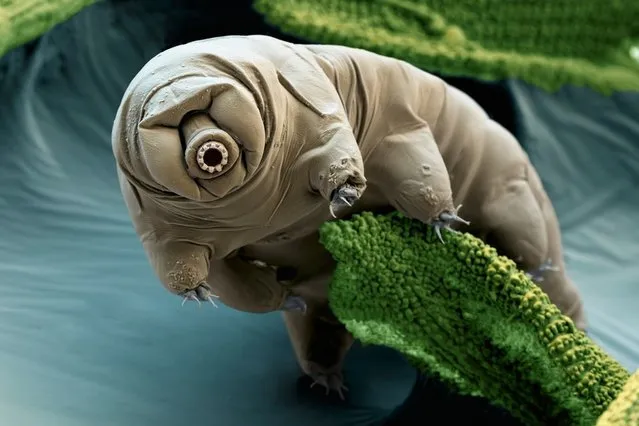
“Tardigrades (commonly known as waterbears or moss piglets) are small, water-dwelling, segmented animals with eight legs. Tardigrades were first discovered in 1773 by Johann August Ephraim Goeze, who called them kleiner Wasserbär, meaning “little water bear” in German. The name Tardigrada means “slow walker” and was given by Lazzaro Spallanzani in 1777. The name water bear comes from the way they walk, reminiscent of a bear's gait. The biggest adults may reach a body length of 1.5 millimetres (0.059 in), the smallest below 0.1 mm. Freshly hatched tardigrades may be smaller than 0.05 mm”. – Wikipedia. Photo: Tardigrades. (Photo by SPL/East News)
A girl jumps from a tomb, a day before the nationwide cemetery closure during All Saints' Day amid the coronavirus disease (COVID-19), at a flooded cemetery in Masantol, Pampanga, Philippines, October 28, 2021. (Photo by Lisa Marie David/Reuters)