A model displays a collection by graduates of the British Higher School of Art & Design during the Fashion Week at Zaryadye Park near Red Square in Moscow, Russia, Friday, June 24, 2022. (Photo by Alexander Zemlianichenko/AP Photo)
Alex Sun, left, Peter Simplicio and Matt Connelly jump through a hole in the ice into Lake Andrews on the Bates College campus, Friday, February 9, 2024, in Lewiston, Maine. The annual Bates College Puddle jump started 50 years ago as a Winter Carnival tradition. (Photo by Andree Kehn/AP Photo)
A veterinarian kisses an 8-month-old cat, wearing a prosthetic two-wheel device, at a veterinary hospital in Chongqing municipality, March 16, 2015. The cat's rear legs lost the abilty to walk after falling from the ninth to fifth floor of a building last November, its since undergone four major surgeries which included removing parts of its organs, local media reported. (Photo by Reuters/China Daily)
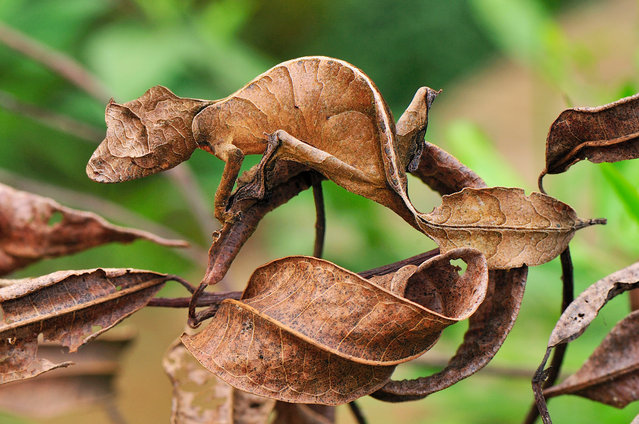
Is it a leaf? Is it tree bark? No, it’s the Satanic leaf-tailed gecko. Cleverly disguised as a rotting leaf, Madagascar’s camouflage king has red eyes, pointy horns and a taste for night hunting: it’s nature’s most devilish deceiver. The twisted body and veiny skin echo the detail of a dry leaf, which ensures the gecko blends in with its forest home. The mottled tail appears to have sections missing, as though it has withered over time. This mini-monster epitomises survival of the fittest, having adapted gradually to become today’s extraordinary leaf impersonator. (Photo by Thomas Marent/ARDEA)
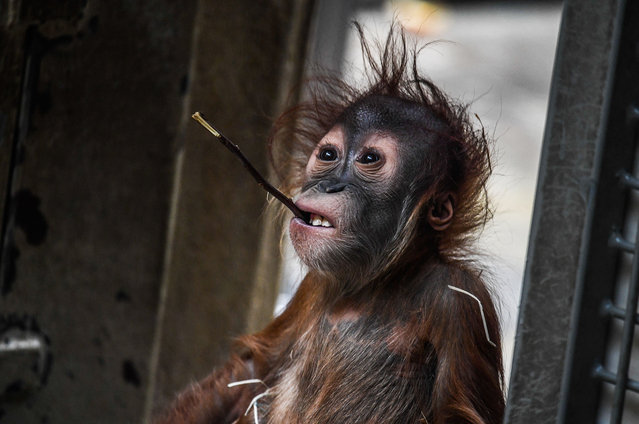
Almost two years old male baby orang-utan Dalai looks on in the zoo in Dresden, Germany, 30 March 2017. Dalai was born to mother Daisy in June 2016. (Photo by Filip Singer/EPA)
Midnight at the Palace, at Big Yin at Gilded Balloon Patter House during Edinburgh fringe 2025 in the first decade of August 2025. (Photo by Damian Robertson/The Guardian)
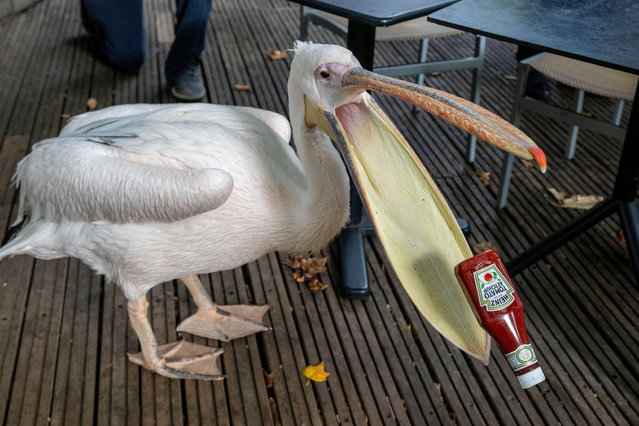
A pelican investigates a fallen ketchup bottle outside a cafe in St James’s Park in London, England on October 9, 2025. The species has lived there for hundreds of years and remain a popular sight for visitors. Introduced in 1664 as a gift from the Russian ambassador, about 40 pelicans have since made the park their home. The bottle was safely retrieved from the pelican. (Photo by Stephen Chung/Alamy Live News)