Loading...
Done
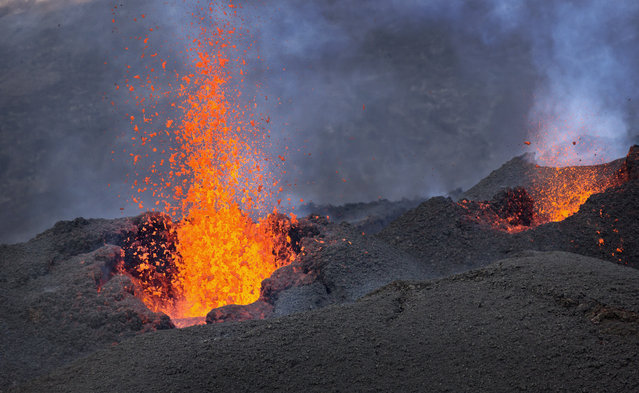
Lava erupts from the Piton de la Fournaise “Peak of the Furnace” volcano, on the southeastern corner of the Indian Ocean island of Reunion Saturday, August 1, 2015. Spewing red-hot lava, one of the most active volcanoes in the world is currently erupting on this Indian Ocean island, where the world's attention has been focused since a wing fragment believed to be from the missing Malaysian jet was discovered washed up on a beach. (Photo by Ben Curtis/AP Photo)

Lava erupts from the Piton de la Fournaise “Peak of the Furnace” volcano, on the southeastern corner of the Indian Ocean island of Reunion Saturday, August 1, 2015. Spewing red-hot lava, one of the most active volcanoes in the world is currently erupting on this Indian Ocean island, where the world's attention has been focused since a wing fragment believed to be from the missing Malaysian jet was discovered washed up on a beach. The lava fountains are shooting as high as 40 meters (44 yards) and are creating cones that are about 20 meters high after only one day of eruption, said Peltier. The volcano is in the Reunion National Park – a world heritage site. The volcano is not seen as dangerous because the lava flows down the east side of the mountain through an uninhabited area called the Grand Brule, or the Big Burned, toward the sea. The last times the volcano threatened the population was in 1977 and 1986. (Photo by Ben Curtis/AP Photo)
Details
03 Aug 2015 12:23:00
People look at a 1939 Alfa Romeo 8C 2900B Lungo Touring Spider displayed at Sotheby's in New York City, New York, U.S. July 21, 2016. The car, unveiled in a pre-publicity showing in New York on Thursday, is expected to sell for more than US$15 million – and could set a record for the most money ever paid for a pre-war auto at auction. “This is a personal favourite of mine, the 1939 Alfa Romeo is one of the grandest pre-war cars ever built”, said Ian Kelleher, managing director, RM Sotheby's US West Coast division. “You can achieve speeds in excess of 100 miles an hour in this car. (Photo by Brendan McDermid/Reuters)

People look at a 1939 Alfa Romeo 8C 2900B Lungo Touring Spider displayed at Sotheby's in New York City, New York, U.S. July 21, 2016. The car, unveiled in a pre-publicity showing in New York on Thursday, is expected to sell for more than US$15 million – and could set a record for the most money ever paid for a pre-war auto at auction. (Photo by Brendan McDermid/Reuters)
Details
22 Jul 2016 12:22:00
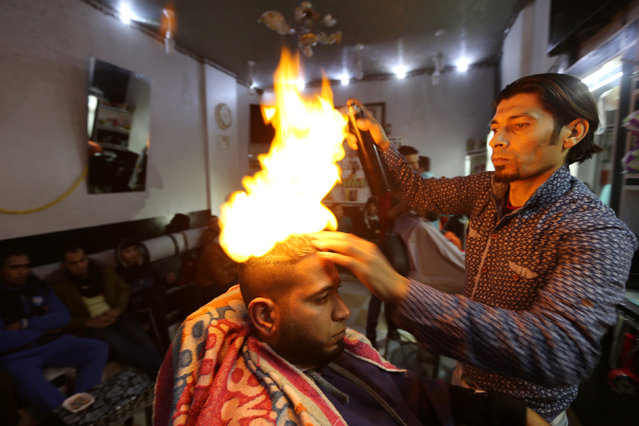
Palestinian barber Ramadan Odwan styles and straightens the hair of a customer with fire at his salon in Rafah, in the southern Gaza Strip February 2, 2017. In Ramadan Odwan's barbershop in Gaza, hair isn't just blow-dried, it's blowtorch-dried. “People have gone crazy about it, many people are curious to go through the experience and they are not afraid”, he told Reuters. “People here love adventures”. Odwan, 37, is not the first stylist in the world to use flame to straighten hair, but his craft is unique in the Gaza Strip. In his salon in the southern Gaza town of Rafah, Odwan applied what he described as a protective liquid coating to a customer's hair – he declined to disclose its contents – before aiming for the head and pressing the button on a small blowtorch. “I control how long I apply fire, I keep it on and off for 10 seconds or 15 seconds. It is completely safe and I have not encountered any accident since I started it two months ago”, Odwan added. Odwan charges 20 shekels ($5.20) for a haircut and fire-straightening. A barber for the past 18 years, he said part of the reason he uses the technique is to show that Palestinian barbers are as “professional as those out there around the world”. (Photo by Ibraheem Abu Mustafa/Reuters)

Palestinian barber Ramadan Odwan styles and straightens the hair of a customer with fire at his salon in Rafah, in the southern Gaza Strip February 2, 2017. In Ramadan Odwan's barbershop in Gaza, hair isn't just blow-dried, it's blowtorch-dried. “People have gone crazy about it, many people are curious to go through the experience and they are not afraid”, he told Reuters. “People here love adventures”. (Photo by Ibraheem Abu Mustafa/Reuters)
Details
11 Feb 2017 00:05:00
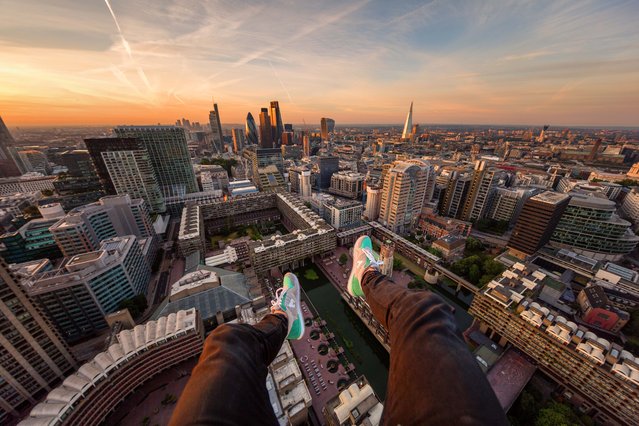
A daredevil photographer is determined to capture London in a whole new light – by scaling the city’s many rooftops. Jacob Riglin, from Richmond Upon Thames, photographs the nation's capital from above – hanging from scaffolding, dangling his legs over the edge of buildings and looking down from perilous heights. Such images have gained the photographer, 20, an incredible fan base on Instagram, which has seen his follower count rise to more than 150,000. (Photo by Jacob Riglin/Caters News)

A daredevil photographer is determined to capture London in a whole new light – by scaling the city’s many rooftops. Jacob Riglin, from Richmond Upon Thames, photographs the nation's capital from above – hanging from scaffolding, dangling his legs over the edge of buildings and looking down from perilous heights. Such images have gained the photographer, 20, an incredible fan base on Instagram, which has seen his follower count rise to more than 150,000. He said, “I had always been interested climbing and getting that adrenaline rush from feeling on top of the world”. Here: Jacob looking out to the London skyline. (Photo by Jacob Riglin/Caters News)
Details
17 Oct 2015 08:05:00
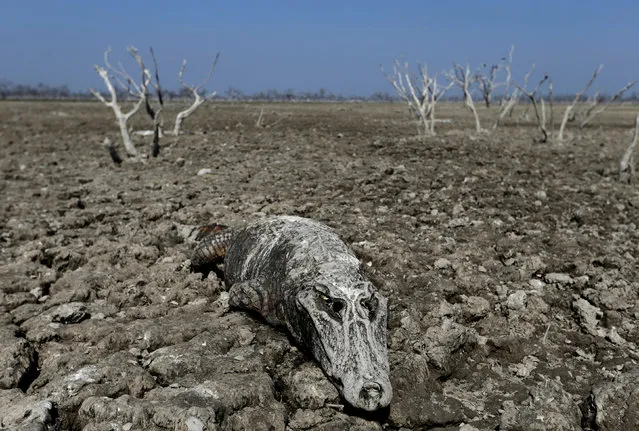
The carcass of a yacare caiman lies in the dried-up river bed of the Pilcomayo river in Boqueron, Paraguay, August 14, 2016. In Paraguay, alongside the Pilcomayo River, black vultures flew over a shrinking pond where a group of crocodilian reptiles known as yacare caimans sought refuge. Water from the river, which divides Paraguay and Argentina in the area of the Gran Chaco, was scarce. This is not an uncommon sight in the region of General Diaz, about 700 kilometres (435 miles) northwest of the country's capital Asuncion, where the Pilcomayo's waters form lakes and streams that give life to capybaras, birds and caimans. “The river's situation is critical. No water is forecast to enter the basin until December, as happens every year”, said Alcides Gonzalez, a resident of the area. (Photo by Jorge Adorno/Reuters)

The carcass of a yacare caiman lies in the dried-up river bed of the Pilcomayo river in Boqueron, Paraguay, August 14, 2016. In Paraguay, alongside the Pilcomayo River, black vultures flew over a shrinking pond where a group of crocodilian reptiles known as yacare caimans sought refuge. Water from the river, which divides Paraguay and Argentina in the area of the Gran Chaco, was scarce. This is not an uncommon sight in the region of General Diaz, about 700 kilometres (435 miles) northwest of the country's capital Asuncion, where the Pilcomayo's waters form lakes and streams that give life to capybaras, birds and caimans. (Photo by Jorge Adorno/Reuters)
Details
03 Nov 2016 12:40:00
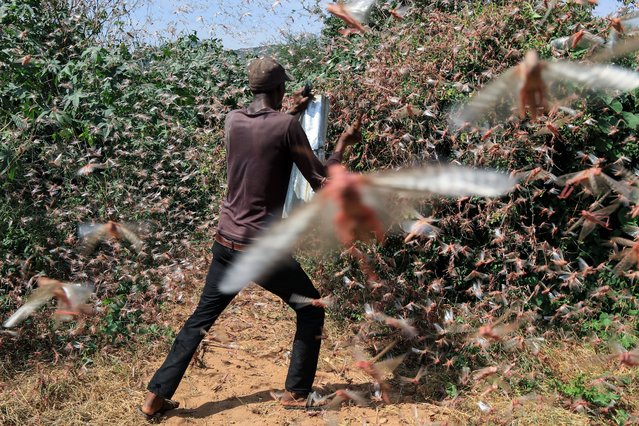
A man uses iron sheet to make noises, as a way of trying to disperse desert locusts that had invaded their farms during the second wave invasion in Kakongo village, in Nuu-Mwingi East, in Kitui, Kenya, 06 February 2021. The second wave invasion of the desert locusts in the country comes at a time where most famers are expecting to harvest their farm produce in the country. According to the United Nations Food and Agriculture Organization (FAO), on 04 February, warned numerous immature desert locust swarms persist in southern Ethiopia and Kenya. Some of the swarms are in community areas and therefore cannot be treated. In Kenya, immature swarms continue to spread westwards across northern and central counties where there are currently about 20 small swarms present, mostly about 50 hectares in size, it said. (Photo by Daniel Irungu/EPA/EFE)

A man uses iron sheet to make noises, as a way of trying to disperse desert locusts that had invaded their farms during the second wave invasion in Kakongo village, in Nuu-Mwingi East, in Kitui, Kenya, 06 February 2021. The second wave invasion of the desert locusts in the country comes at a time where most famers are expecting to harvest their farm produce in the country. (Photo by Daniel Irungu/EPA/EFE)
Details
25 Feb 2021 08:17:00
A girl stands with arms outstretched at North Narrabeen on January 27, 2024 in Sydney, Australia. Around 30 indigenous children from Brewarrina, Weilmoringle, and Goodooga in the far North West NSW travelled to Sydney to participate in the program. The initiative is part of the Bush to Beach programme, which now in its 19th year, gives indigenous children a unique opportunity to learn and explore Sydney's beach culture. The efforts are made possible entirely by volunteers, donations and sponsorship. Bush to Beach is a charity dedicated to inspiring hope, confidence, and self-esteem and promoting education for Aussie bush kids, a release by the charity said. This trip is a reward for school attendance and an opportunity for the kids to see that there is another world outside their community and help develop confidence and self-esteem, according to Bush to Beach co-founder Jack Cannons. (Photo by Jenny Evans/Getty Images)

A girl stands with arms outstretched at North Narrabeen on January 27, 2024 in Sydney, Australia. Around 30 indigenous children from Brewarrina, Weilmoringle, and Goodooga in the far North West NSW travelled to Sydney to participate in the program. The initiative is part of the Bush to Beach programme, which now in its 19th year, gives indigenous children a unique opportunity to learn and explore Sydney's beach culture. (Photo by Jenny Evans/Getty Images)
Details
10 Feb 2024 09:26:00
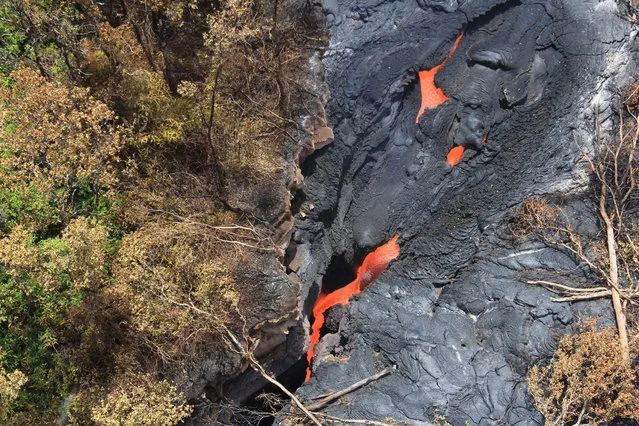
In this September 1, 2014 photo released by the U.S. Geological Survey, fluid lava streams from the June 27 lava flow from the Kilauea volcano in Pahoa, Hawaii. The June 27 lava flow is named for the date it began erupting from a new vent. The Hawaiian Volcano Observatory issued a warning Thursday, September 4, 2014 to a rural community in the path of a lava flow on Hawaii's Big Island, as the molten rock moved to within a mile of homes. (Photo by AP Photo/U.S. Geological Survey)

In this September 1, 2014 photo released by the U.S. Geological Survey, fluid lava streams from the June 27 lava flow from the Kilauea volcano in Pahoa, Hawaii. The June 27 lava flow is named for the date it began erupting from a new vent. The Hawaiian Volcano Observatory issued a warning Thursday, September 4, 2014 to a rural community in the path of a lava flow on Hawaii's Big Island, as the molten rock moved to within a mile of homes. Observatory scientists said lava from the Kilauea volcano could reach the Kaohe Homesteads in five to seven days if it continues advancing through cracks in the earth. (Photo by AP Photo/U.S. Geological Survey)
Details
07 Sep 2014 12:47:00