Loading...
Done
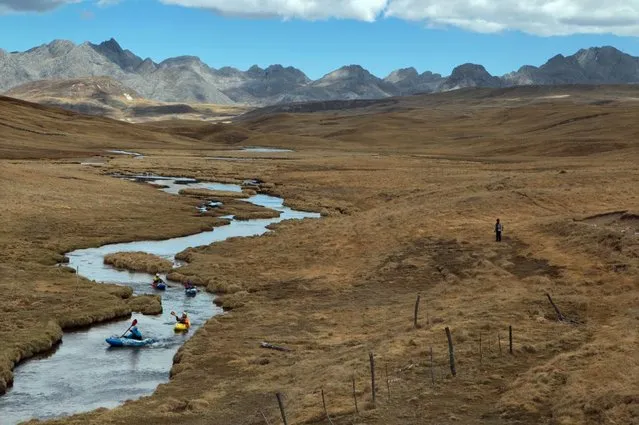
August 19, 2012 – Alpamarca, Peru – Amazon Express white water members Juan Antonio De Ugarte, of Peru, Rafael Ortiz, of Mexico, West Hansen, of the U.S., and Tino Specht, of the U.S., paddle down the Rio Gashan after leaving Lago Acucocha. Lago Acucocha is possibly the dry season source of the Amazon River. (Photo by Erich Schlegel/zReportage via ZUMA Press)

“The Amazon river has a newly discovered source. Completed last year and led by West Hansen and documented by award-winning freelance photographer Erich Schlegel, this is the first expedition to paddle from the furthest source of the earth's largest river to the ocean”. – zReportage. Photo: August 19, 2012 – Alpamarca, Peru – Amazon Express white water members Juan Antonio De Ugarte, of Peru, Rafael Ortiz, of Mexico, West Hansen, of the U.S., and Tino Specht, of the U.S., paddle down the Rio Gashan after leaving Lago Acucocha. Lago Acucocha is possibly the dry season source of the Amazon River. (Photo by Erich Schlegel/zReportage via ZUMA Press)
Details
29 Jul 2013 10:47:00
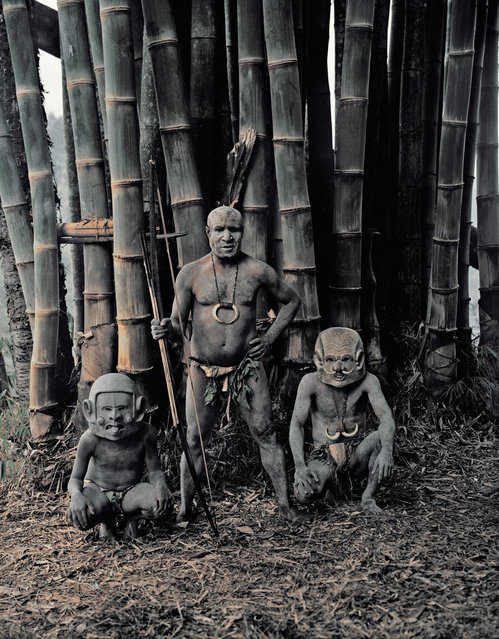
“Asaro from the Eastern Highlands”. The mudmen could not cover their faces with mud because the people of Papua New Guinea thought that the mud from the Asaro river was poisonous. So instead of covering their faces with this alleged poison, they made masks from pebbles that they heated and water from the waterfall, with unusual designs such as long or very short ears either going down to the chin or sticking up at the top, long joined eyebrows attached to the top of the ears, horns and sideways mouths. (Jimmy Nelson)

“Asaro from the Eastern Highlands”. The mudmen could not cover their faces with mud because the people of Papua New Guinea thought that the mud from the Asaro river was poisonous. So instead of covering their faces with this alleged poison, they made masks from pebbles that they heated and water from the waterfall, with unusual designs such as long or very short ears either going down to the chin or sticking up at the top, long joined eyebrows attached to the top of the ears, horns and sideways mouths. (Photo and caption by Jimmy Nelson)
Details
20 Oct 2013 08:54:00
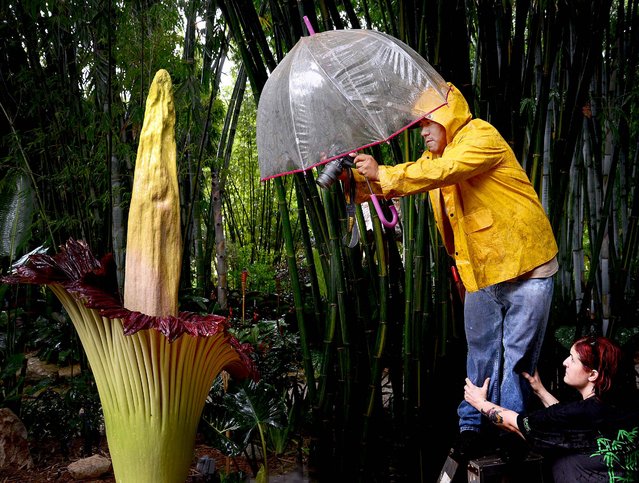
Mateo Santiago, Field Manager at Tropical Bamboo Nursery and Gardens, photographs rain water collecting in the corpse flower as Garden Manager Melanie Benson steadies a ladder. Santiago crinkled his nose up distastefully when he described its odor, which was at its worse Sunday night. “It smelled like a dead rat”. (Photo by Melanie Bell/Palm Beach Daily News)

Mateo Santiago, Field Manager at Tropical Bamboo Nursery and Gardens, photographs rain water collecting in the corpse flower as Garden Manager Melanie Benson steadies a ladder. Santiago crinkled his nose up distastefully when he described its odor, which was at its worse Sunday night. “It smelled like a dead rat”. (Photo by Melanie Bell/Palm Beach Daily News)
Details
23 Jul 2014 09:56:00
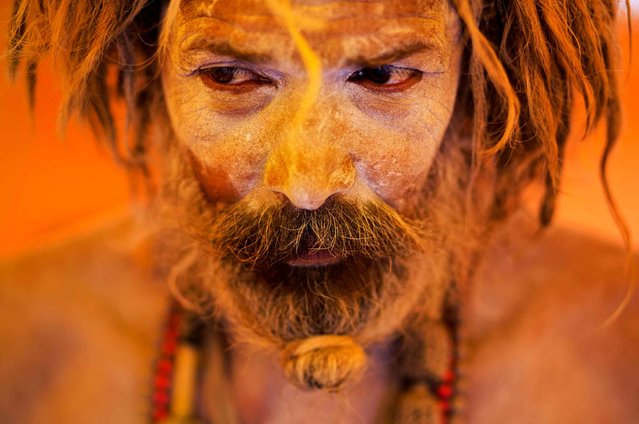
A Naga sadhu, or naked Hindu holy man, pauses inside a tent during Kumbh Mela, or Pitcher festival, at Trimbakeshwar, India, Thursday, August 27, 2015. Hindus believe taking a dip in the waters of a holy river during the festival will cleanse them of their sins. The festival is held four times every 12 years. (Photo by Bernat Armangue/AP Photo)

A Naga sadhu, or naked Hindu holy man, pauses inside a tent during Kumbh Mela, or Pitcher festival, at Trimbakeshwar, India, Thursday, August 27, 2015. Hindus believe taking a dip in the waters of a holy river during the festival will cleanse them of their sins. The festival is held four times every 12 years. (Photo by Bernat Armangue/AP Photo)
Details
27 Aug 2015 11:24:00
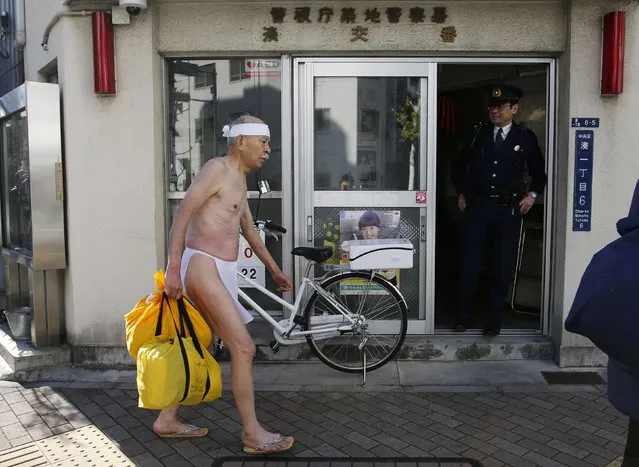
Eighty one-year-old Sakon Haba (L) wearing loin cloth walks past a police station after he bathed in ice-cold water at the Teppozu Inari shrine in Tokyo January 11, 2015. According to organizers, about 100 participants took part in the Shinto ceremony to purify their souls and wish for good health in the new year. (Photo by Toru Hanai/Reuters)

Eighty one-year-old Sakon Haba (L) wearing loin cloth walks past a police station after he bathed in ice-cold water at the Teppozu Inari shrine in Tokyo January 11, 2015. According to organizers, about 100 participants took part in the Shinto ceremony to purify their souls and wish for good health in the new year. (Photo by Toru Hanai/Reuters)
Details
17 Jan 2015 12:02:00
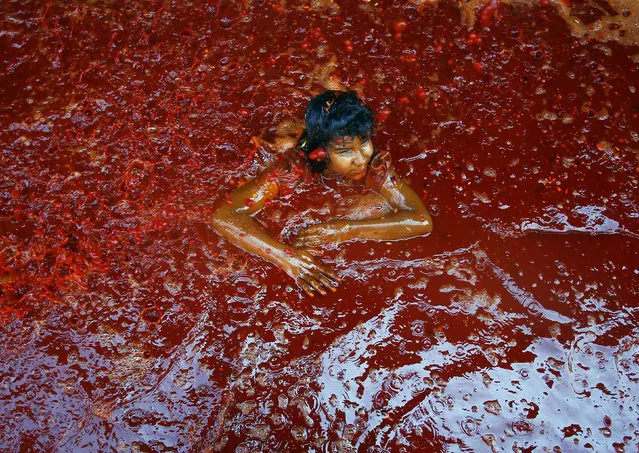
A child lies in a puddle of coloured water during “Huranga” at Dauji temple near the northern Indian city of Mathura, March 7, 2015. “Huranga” is a game played between men and women a day after Holi, the festival of colours, during which men drench women with liquid colours and women tear off the clothes of the men. (Photo by Anindito Mukherjee/Reuters)

A child lies in a puddle of coloured water during “Huranga” at Dauji temple near the northern Indian city of Mathura, March 7, 2015. “Huranga” is a game played between men and women a day after Holi, the festival of colours, during which men drench women with liquid colours and women tear off the clothes of the men. (Photo by Anindito Mukherjee/Reuters)
Details
14 Mar 2015 13:46:00
A folk performer (front R) with make-up and props takes part in a “Blood Shehuo” parade, during a performance in Linyi county, Shanxi province March 21, 2015. “Shehuo” is the common name of Chinese traditional activities consisting of folk performances in northern China. The "Blood Shehuo" performers use make-up and props to re-enact scenes of horror in classic Chinese novels like Water Margin. (Photo by Reuters/Stringer)

A folk performer (front R) with make-up and props takes part in a “Blood Shehuo” parade, during a performance in Linyi county, Shanxi province March 21, 2015. “Shehuo” is the common name of Chinese traditional activities consisting of folk performances in northern China. The “Blood Shehuo” performers use make-up and props to re-enact scenes of horror in classic Chinese novels like Water Margin. (Photo by Reuters/Stringer)
Details
23 Mar 2015 10:33:00
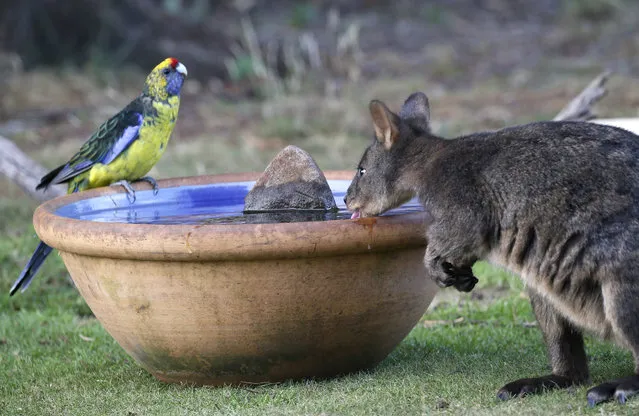
A green rosella and a wallaby, known as a Pademelon, eye off as they drink from a water bowl put out for thirsty wild animals at a back-yard in Kayena, in northern Tasmania, 01 February 2019. Australia recorded its hottest month on record in January; it was also the hottest and driest month on record for the Australian island state of Tasmania. (Photo by Barbara Walton/EPA/EFE)

A green rosella and a wallaby, known as a Pademelon, eye off as they drink from a water bowl put out for thirsty wild animals at a back-yard in Kayena, in northern Tasmania, 01 February 2019. Australia recorded its hottest month on record in January; it was also the hottest and driest month on record for the Australian island state of Tasmania. (Photo by Barbara Walton/EPA/EFE)
Details
03 Feb 2019 00:03:00