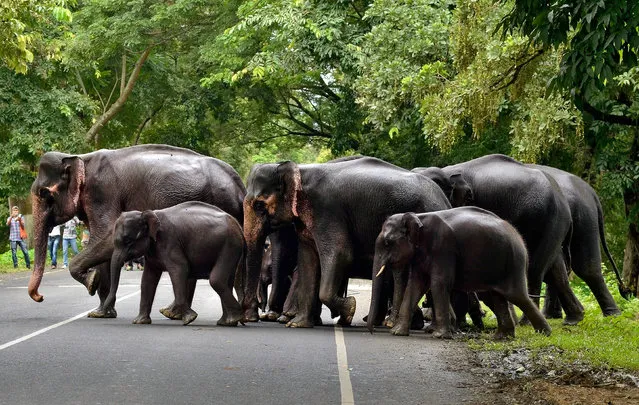
A herd of elephants cross a road that passes through the flooded Kaziranga National Park in the northeastern state of Assam, India, July 12, 2017. (Photo by Anuwar Hazarika/Reuters)
Fatima Rezai, 21, a female officer from the Afghan National Army (ANA) practices with a punch bag during an exercise session at at the Kabul Military Training Centre (KMTC) in Kabul, Afghanistan October 23, 2016. (Photo by Mohammad Ismail/Reuters)
A decorated human skull or “natitas”, sits on a blanket inside the Cementerio General chapel, during the Natitas Festival celebrations, in La Paz, Bolivia, Tuesday, November 8, 2016. The “natitas” are cared for and decorated by faithful who use them as amulets believing they serve as protection, the tradition marks the end of the Catholic All Saints holiday, but is not recognized by the Catholic church. (Photo by Juan Karita/AP Photo)
A passenger inter-island ferry Shuttle RoRo 5 is pictured after it was swept ashore at the height of Typhoon Nock-Ten in Mabini, Batangas in the Philippines December 26, 2016. (Photo by Erik De Castro/Reuters)
A “creuseur”, or digger, a plastic lantern on his head, readies to enter a copper and cobalt mine in Kawama, Democratic Republic of Congo on June 8, 2016. Cobalt is used in the batteries for electric cars and mobile phones. Working conditions are dangerous, often with no safety equipment or structural support for the tunnels. The diggers say they are paid on average US$2-3/day. (Photo by Michael Robinson Chavez/The Washington Post)
United States' defender Crystal Dunn (R) vies for the ball with Sweden's forward Sofia Jakobsson during the France 2019 Women's World Cup Group F football match between Sweden and USA, on June 20, 2019, at the Oceane Stadium in Le Havre, northwestern France. (Photo by Bernadett Szabo/Reuters)
Marchers kiss as they walk down 5th Avenue as they part in the 2019 World Pride NYC and Stonewall 50th LGBTQ Pride Parade in New York, U.S., June 30, 2019. (Photo by Lucas Jackson/Reuters)
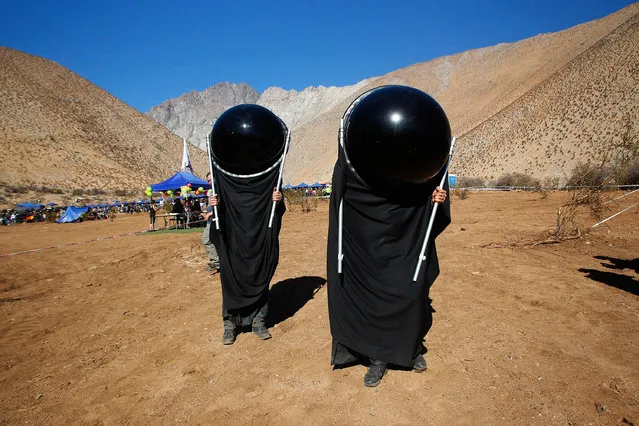
Chileans watch the sky with special suits prior to a total solar eclipse on July 2, 2019 in Paiguano, Chile. Around 25,0000 tourists arrived to Paiguano, a small town of around 1,000 inhabitants in the Elqui Valley, 650 km away Santiago. This is the only Earth's total solar eclipse of 2019 and the first one since 2017. From this point, the sun will fully disappear for around two minutes. It is best visible from a stripe in the South Pacific, Chile and Argentina. (Photo by Marcelo Hernandez/Getty Images)