Loading...
Done
A man carries his wife over an obstacle while competing in the Wife Carrying Championship to mark City Day in Krasnoyarsk, Siberia, Russia, June 25, 2016. (Photo by Ilya Naymushin/Reuters)

A man carries his wife over an obstacle while competing in the Wife Carrying Championship to mark City Day in Krasnoyarsk, Siberia, Russia, June 25, 2016. (Photo by Ilya Naymushin/Reuters)
Details
26 Jun 2016 13:11:00
A boy flies his kite in a cemetery in the Vila Operaria Favela of Rio de Janeiro, Brazil, July 9, 2016. (Photo by Nacho Doce/Reuters)

A boy flies his kite in a cemetery in the Vila Operaria Favela of Rio de Janeiro, Brazil, July 9, 2016. (Photo by Nacho Doce/Reuters)
Details
21 Jul 2016 13:56:00
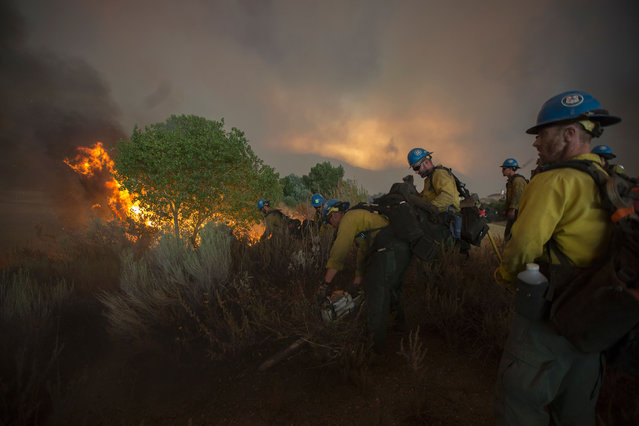
Firefighters of the Texas Canyon Hotshot crew fight the Sand Fire on July 23 2016 near Santa Clarita, California. Fueled by temperatures reaching about 108 degrees fahrenheit, the wildfire began yesterday has grown to 11,000 acres. (Photo by David McNew/AFP Photo)

Firefighters of the Texas Canyon Hotshot crew fight the Sand Fire on July 23 2016 near Santa Clarita, California. Fueled by temperatures reaching about 108 degrees fahrenheit, the wildfire began yesterday has grown to 11,000 acres. (Photo by David McNew/AFP Photo)
Details
25 Jul 2016 11:13:00
The six-months-old female koala cub holds on to the back of zoo keeper Lena at the zoo in Duisburg, Germany, 23 October 2015. The yet unnamed baby weighs 580 grams. (Photo by Roland Weihrauch/EPA)

The six-months-old female koala cub holds on to the back of zoo keeper Lena at the zoo in Duisburg, Germany, 23 October 2015. The yet unnamed baby weighs 580 grams. (Photo by Roland Weihrauch/EPA)
Details
26 Oct 2015 08:03:00
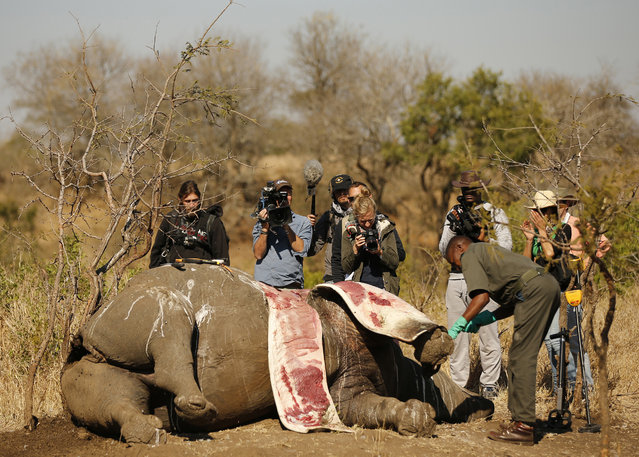
Members of the media film as a ranger performs a post mortem on the carcass of a rhino after it was killed for its horn by poachers at the Kruger national park in Mpumalanga province August 27, 2014. Rhino poachers in South Africa now risk giving themselves away when they shoot thanks to a high-tech, gunfire-detection system being piloted in the country's flagship Kruger National Park. (Photo by Siphiwe Sibeko/Reuters)

Members of the media film as a ranger performs a post mortem on the carcass of a rhino after it was killed for its horn by poachers at the Kruger national park in Mpumalanga province August 27, 2014. Rhino poachers in South Africa now risk giving themselves away when they shoot thanks to a high-tech, gunfire-detection system being piloted in the country's flagship Kruger National Park. The stakes are high, for rhinos are being slain in escalating numbers for their prized horns, alarming both conservationists and the government since wildlife in South Africa is an important tourist draw. (Photo by Siphiwe Sibeko/Reuters)
Details
07 Nov 2015 08:03:00
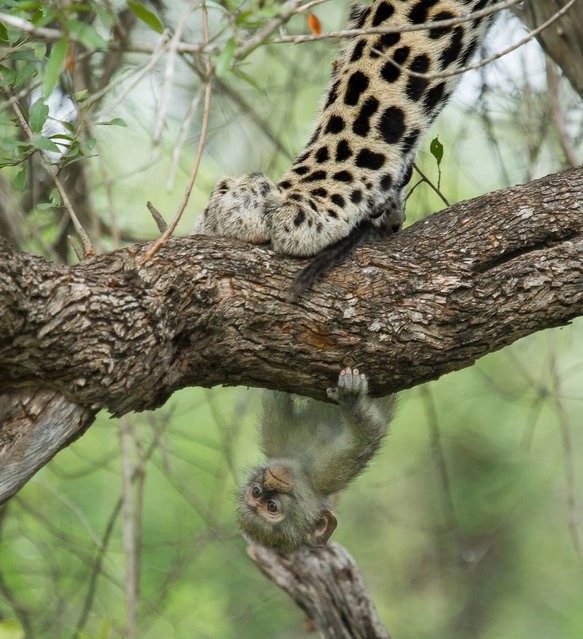
Chris Renshaw has recently been awarded the 2015 Africa Geographic “Photographer of the Year” award. Chris tells that his love “for anything wild and adventurous came from a deep rooted attachment to the African continent. This image shows that timing, a bit of anticipation, and luck allowed this incredible moment in time to be captured”. (Photo by Chris Renshaw)

Chris Renshaw has recently been awarded the 2015 Africa Geographic “Photographer of the Year” award. Chris tells that his love “for anything wild and adventurous came from a deep rooted attachment to the African continent. This image shows that timing, a bit of anticipation, and luck allowed this incredible moment in time to be captured”. (Photo by Chris Renshaw)
Details
19 Nov 2015 08:00:00
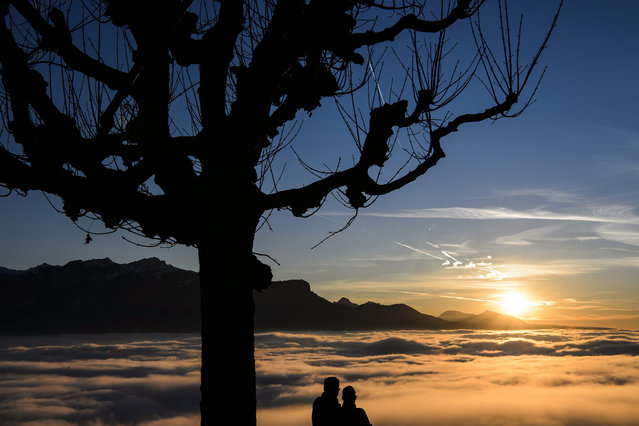
A couple watches the sunset over a sea of fog covering the Geneva Lake from Chardonne, Switzerland, 28 December 2015. (Photo by Jean-Christophe Bott/EPA)

A couple watches the sunset over a sea of fog covering the Geneva Lake from Chardonne, Switzerland, 28 December 2015. (Photo by Jean-Christophe Bott/EPA)
Details
30 Dec 2015 08:00:00
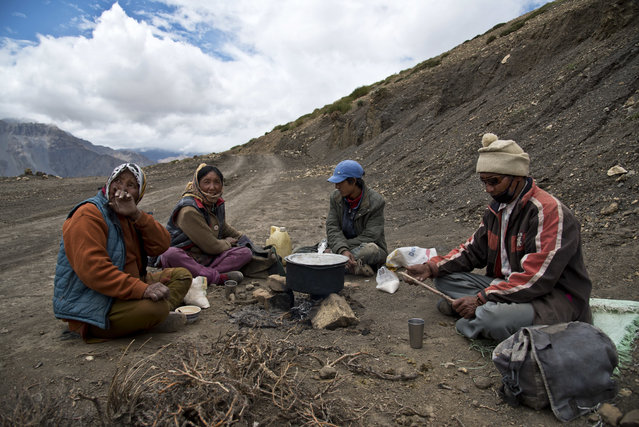
In this August 17, 2016, photo, from left to right, Chhering Chodom, 60, Tashi Yangzom, 50, Lobsang Chhering, 27, and Dorje Tandup, 58, drink milk tea on the side of the road. For centuries, the sleepy valley nestled in the Indian Himalayas remained a hidden Buddhist enclave forbidden to outsiders. Enduring the harsh year-round conditions of the high mountain desert, the people of Spiti Valley lived by a simple communal code – share the Earth's bounty, be hospitable to neighbors, and eschew greed and temptation at all turns. That's all starting to change, for better or worse. Since India began allowing its own citizens as well as outsiders to visit the valley in the early 1990s, tourism and trade have boomed. And the marks of modernization, such as solar panels, asphalt roads and concrete buildings, have begun to appear around some of the villages that dot the remote landscape at altitudes above 4,000 meters (13,000 feet). (Photo by Thomas Cytrynowicz/AP Photo)

In this August 17, 2016, photo, from left to right, Chhering Chodom, 60, Tashi Yangzom, 50, Lobsang Chhering, 27, and Dorje Tandup, 58, drink milk tea on the side of the road. For centuries, the sleepy valley nestled in the Indian Himalayas remained a hidden Buddhist enclave forbidden to outsiders. Enduring the harsh year-round conditions of the high mountain desert, the people of Spiti Valley lived by a simple communal code – share the Earth's bounty, be hospitable to neighbors, and eschew greed and temptation at all turns. That's all starting to change, for better or worse. (Photo by Thomas Cytrynowicz/AP Photo)

Details
15 Sep 2016 09:22:00