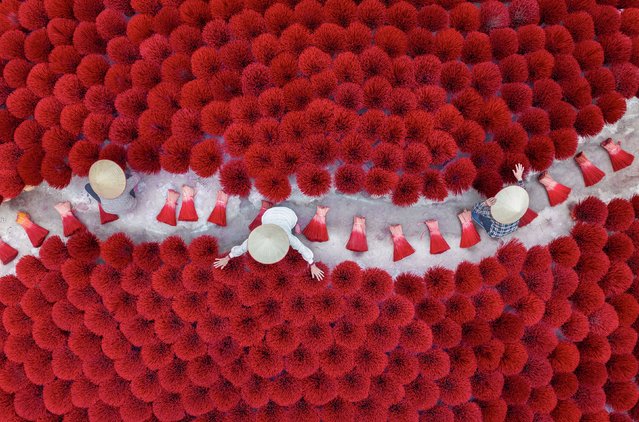
Workers lay out hundreds of bundles of dyed joss sticks to cure in the sun in Hanoi, Vietnam in the last decade of September 2024. They will next be coated with incense powder made from Canarium sap and charcoal. (Photo by Piyush Paul/Solent News)
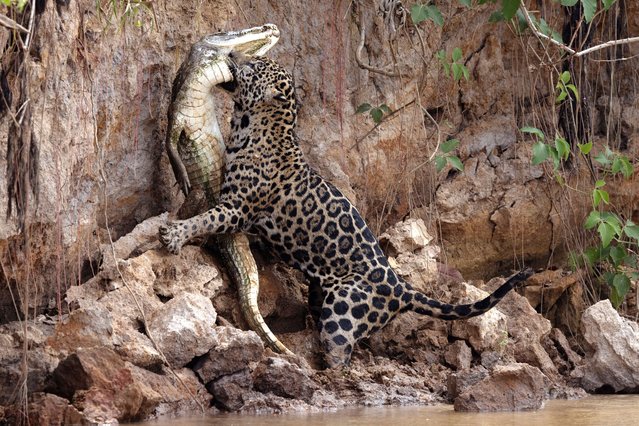
A female jaguar named Ti, by the NGO Jaguar ID, bites an alligator at Encontro das Aguas State Park, in the Pantanal, the largest wetland in the world, in Pocone, Mato Grosso, Brazil, on October 10, 2024. (Photo by Sergio Moraes/Reuters)
A folk artist gives a fire pot performance at the foot of Ulan Hada volcano group on November 16, 2024 in Ulanqab, Inner Mongolia Autonomous Region of China. A tourism festival themed on ice and snow opened in Ulanqab on November 16, which will last for five months. (Photo by Wang Zheng/VCG via Getty Images)
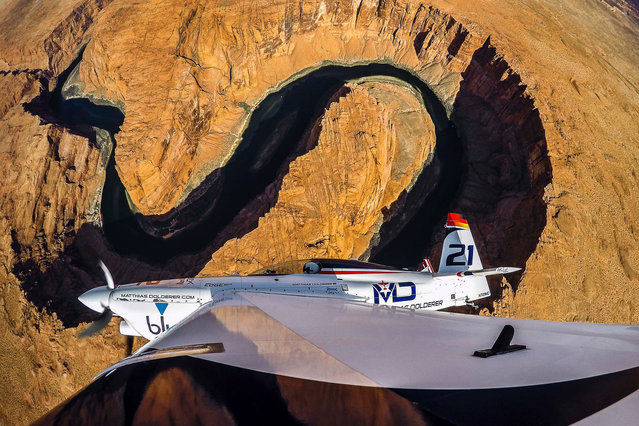
World Champion Matthias Dolderer of Germany flies over the Horseshoe Bend near Lake Powell in Page, United States during the transfer flight from Indianapolis to Las Vegas to prior the final stage of the Red Bull Air Race World Championship on October 12, 2016. (Photo by Predrag Vuckovic/AFP Photo)
High-wire artist Kane Petersen successfully walks a tightrope 300 metres above the ground at Eureka Skydeck on September 16, 2015 in Melbourne, Australia. The walk was the highest tightrope walk ever attempted in the Southern Hemisphere. The stunt is to mark the arrival of the film “The Walk” to Australian cinemas in October. The stunt saw Kane mimic the film's French high-wire artist Philippe Petit, who successfully walked between the twin towers of the World Trade Center in 1974. (Photo by Scott Barbour/Getty Images)
Yang Shiguang, 77, performs stunts at a park in Xi'an, Shaanxi province, September 3, 2013. Yang has been a member of a stunt performance club since 2007, after retiring from a research institution. (Photo by Reuters/China Daily)
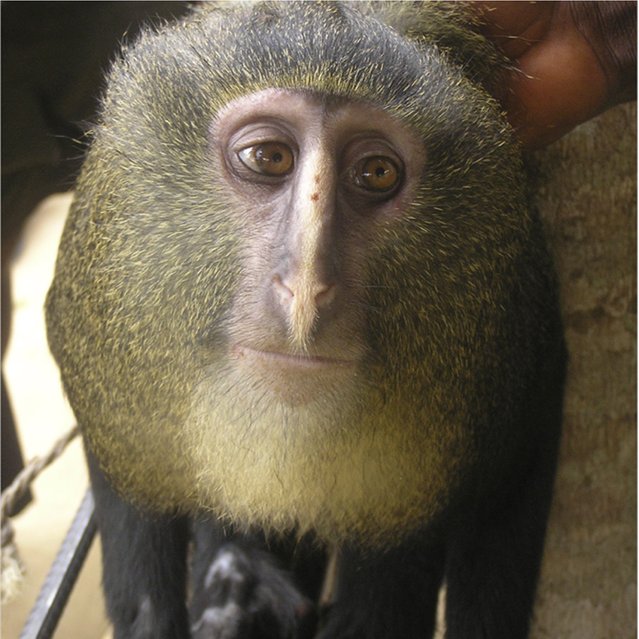
A new species of monkey found in the Democratic Republic of the Congo and identified as Lesula (Cercopithecus lomamiensis) is seen in this undated photograph from an article published September 12, 2012 in the science journal PLOS One. The monkey was first seen in 2007 by researchers John and Terese Hart of the Peabody Museum of Natural History at Yale Research Project. The finding of C. lomamiensis represents only the second new species of African monkey to be discovered in the past 28 years, according to the research article. (Photo by Hart J. A., Detwiler K. M., Gilbert C. C./Reuters)