Loading...
Done
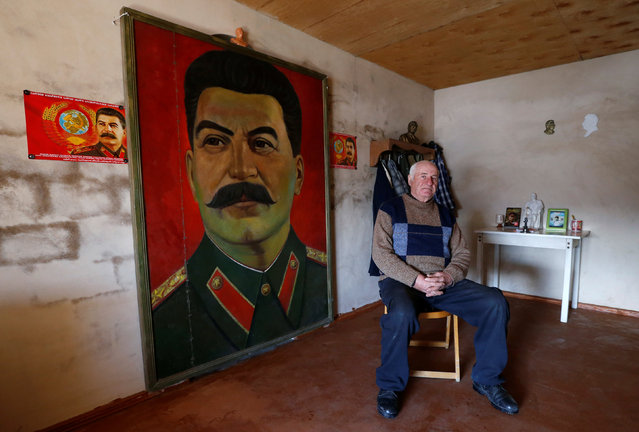
Retired builder Vasili Sidamonidze, 70, poses for a portrait at his home in Gori, Georgia, December 6, 2016. “Unfortunately, Stalin is not popular nowadays. Our people don't respect him. Only we, members of the (Communist) Party, respect him”, Sidamonidze said. “I always try to attend Stalin's birthday anniversaries in Gori. Unfortunately many people don't want to join us even if they live nearby. They look at us from their windows”. Stalin, who was born in Gori in 1878 and died in 1953, is largely reviled today in Georgia, which regained its independence during the 1991 collapse of the Soviet Union. Over the years, his memorials have been dismantled, most recently in 2010 when authorities removed a statue of the dictator from Gori's central square. But Stalin is still revered by a small group of mainly elderly supporters who stress his role in the industrialisation of the Soviet Union and in defeating Nazi Germany in World War Two. Each Dec. 21, a few dozen people mark his birthday by gathering outside a Gori museum dedicated to Stalin, where they make speeches and walk to the square where a 6-meter-high bronze statue of him once stood, calling for it to be reinstated. Opponents say it was a symbol of Moscow's still lingering shadow. In 2008, Russia fought a brief war with Georgia and recognised its breakaway regions of Abkhazia and South Ossetia as independent states. (Photo by David Mdzinarishvili/Reuters)

Retired builder Vasili Sidamonidze, 70, poses for a portrait at his home in Gori, Georgia, December 6, 2016. “Unfortunately, Stalin is not popular nowadays. Our people don't respect him. Only we, members of the (Communist) Party, respect him”, Sidamonidze said. “I always try to attend Stalin's birthday anniversaries in Gori. Unfortunately many people don't want to join us even if they live nearby. They look at us from their windows”. (Photo by David Mdzinarishvili/Reuters)
Details
17 Dec 2016 07:59:00
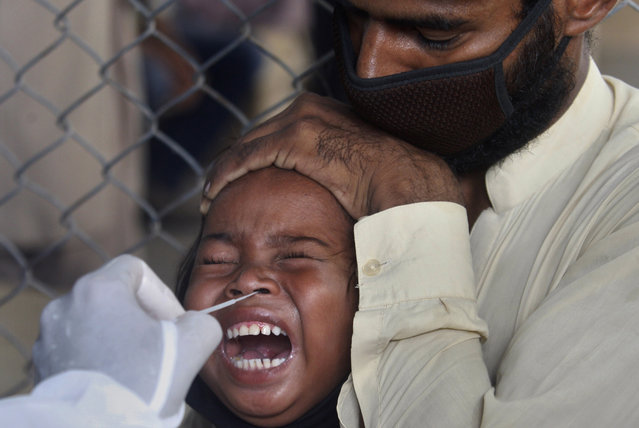
A girl reacts while getting a nasal swab sample at a testing and screening facility for the new coronavirus in a hospital in Karachi, Pakistan, Friday, July 17, 2020. (Photo by Fareed Khan/AP Photo)

A girl reacts while getting a nasal swab sample at a testing and screening facility for the new coronavirus in a hospital in Karachi, Pakistan, Friday, July 17, 2020. (Photo by Fareed Khan/AP Photo)
Details
19 Jul 2020 00:07:00
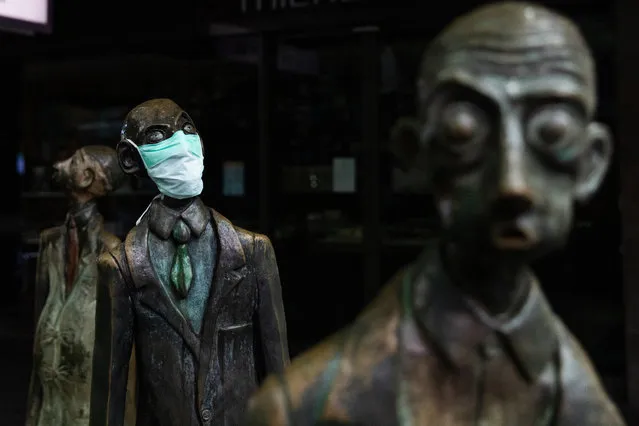
A face mask is placed on one of the 'Three business men who brought lunch' statues on Swanston street on March 29, 2020 in Melbourne, Australia. All international arrivals into Australia from midnight on Saturday will be placed into mandatory quarantine in hotels for 14 days as the Federal Government increases restrictions to stop the spread of COVID-19. All libraries, museums, galleries, beauty salons, tattoo parlours, shopping centre food courts, auctions, open houses, amusement parks, arcades, indoor and outdoor play centres, swimming pools are closed and indoor exercise activities are now banned. This is in addition to the closure of bars, pubs and nightclubs which came into effect on Monday. Restaurants and cafes are restricted to providing takeaway only. Weddings will now be restricted to five people including the couple while funerals are limited to 10 mourners. All Australians are now expected to stay at home except for essential outings such as work, grocery shopping and medical appointments. Exercising outdoors alone is still permitted. Australia now has more than 3,600 confirmed cases of COVID-19 while the death toll now stands at 16. (Photo by Asanka Ratnayake/Getty Images)

A face mask is placed on one of the 'Three business men who brought lunch' statues on Swanston street on March 29, 2020 in Melbourne, Australia. All international arrivals into Australia from midnight on Saturday will be placed into mandatory quarantine in hotels for 14 days as the Federal Government increases restrictions to stop the spread of COVID-19. (Photo by Asanka Ratnayake/Getty Images)
Details
31 Mar 2020 00:07:00
Syrian Tulin Hashemi waits for a job interview at a hotel in Vidigal slum in Rio de Janeiro, Brazil, September 22, 2015. Tulin, whose mother arrived two days ago, has been living in Brazil for two months. As she does not speak Portuguese, Tulin says it is difficult for her to find a job and therefore she is staying at the slum as it is one of the cheaper neighbourhoods to live in. (Photo by Pilar Olivares/Reuters)

Syrian Tulin Hashemi waits for a job interview at a hotel in Vidigal slum in Rio de Janeiro, Brazil, September 22, 2015. Tulin, whose mother arrived two days ago, has been living in Brazil for two months. As she does not speak Portuguese, Tulin says it is difficult for her to find a job and therefore she is staying at the slum as it is one of the cheaper neighbourhoods to live in. According to the National Committee for Refugees (CONARE), 2,077 people fleeing the Syrian civil war have settled in Brazil, whilst a quarter of the 8,400 refugees in the Latin American country come from Syria. (Photo by Pilar Olivares/Reuters)
Details
25 Sep 2015 08:05:00
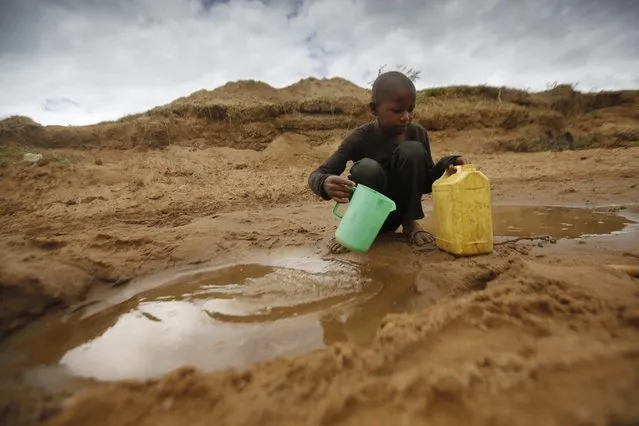
A young boy scoops water from a hand-dug well in the dry riverbed near Matinyani, in the semi-arid Kitui County in southeastern Kenya, 22 March 2015, the World Water Day. Residents of Kitui County and other arid and semi-arid areas of the country have been hard-hit by extremely poor rainfall this year while the government said in previous month that some 1.6 million people countrywide are facing acute starvation due to the drought and will need relief food over the next six months. (Photo by Dai Kurokawa/EPA)

A young boy scoops water from a hand-dug well in the dry riverbed near Matinyani, in the semi-arid Kitui County in southeastern Kenya, 22 March 2015, the World Water Day. Residents of Kitui County and other arid and semi-arid areas of the country have been hard-hit by extremely poor rainfall this year while the government said in previous month that some 1.6 million people countrywide are facing acute starvation due to the drought and will need relief food over the next six months. Residents of Matinyani say they haven't seen a drop of rain in nearly four months. Thousands of Kenyans in rural areas walk tens of kilometers just to fetch water to drink and to be used in their homes. According to an estimate by UNESCO (United Nations Educational, Scientific and Cultural Organization), 17 million people lack access to safe water in Kenya, where the drought is a perennial problem. (Photo by Dai Kurokawa/EPA)
Details
23 Mar 2015 11:01:00
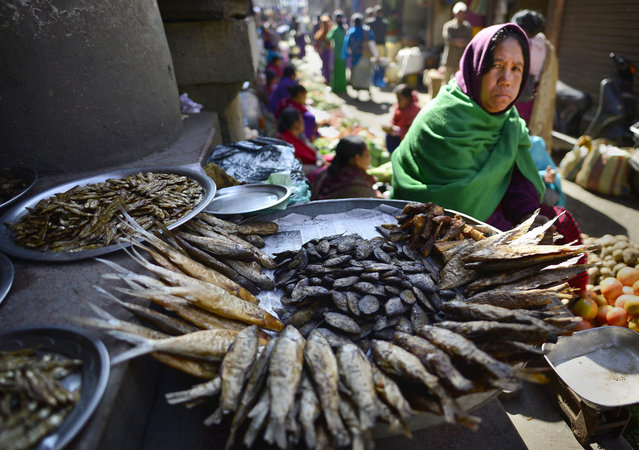
A Manipuri woman sells smoked and dry fish in Ima market - the world's largest all women market - in Imphal city, Manipur state, 06 January 2016. The 150-year-old Ima Keithel or 'Mothers's market' complex, which is run exclusively by women and was damaged in the 04 January 2016 earthquake, is returning back to normal. Nine deaths have been reported from in and around Imphal due to falling debris. (Photo by EPA/Stringer)

A Manipuri woman sells smoked and dry fish in Ima market - the world's largest all women market – in Imphal city, Manipur state, 06 January 2016. The 150-year-old Ima Keithel or “Mothers's market” complex, which is run exclusively by women and was damaged in the 04 January 2016 earthquake, is returning back to normal. Nine deaths have been reported from in and around Imphal due to falling debris. Imphal has a population of some 270,000 and people were jolted from their sleep and ran out of their homes in panic when the earth shook 04 January, reports say. (Photo by EPA/Stringer)
Details
08 Jan 2016 08:04:00
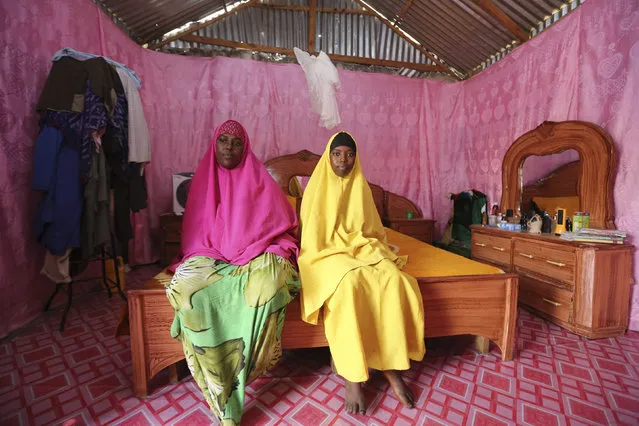
Saciido Sheik Yacquub, 34, poses for a picture with her daughter Faadumo Subeer Mohamed, 13, at their home in Hodan district IDP camp in Mogadishu February 11, 2014. Saciido, who runs a small business, wanted to be a business woman when she was a child. She studied until she was 20. She hopes that Faadumo will become a doctor. Faadumo will finish school in 2017 and hopes to be a doctor when she grows up. (Photo by Feisal Omar/Reuters)

“On March 8th activists celebrate International Women’s Day, which dates back to the early 20th century and has been observed by the United Nations since 1975. In the run-up to the event, Reuters photographers in countries around the globe took a series of portraits of women and their daughters. They asked each mother what her profession was, at what age she had finished education, and what she wanted her daughter to become when she grew up. They also asked each daughter at what age she would finish education and what she wanted to do in the future. The series of images offers an insight into the lives of women and girls around the world”. – Reuters. (Photo by Feisal Omar/Reuters)
Details
09 Mar 2014 04:33:00
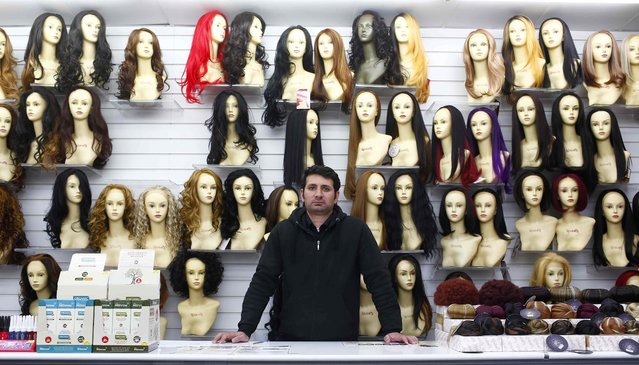
Kashir Mir, 34, poses for a photograph at his workplace, Juliet Wig Shop, in the London constituency of Brent Central, Britain, April 13, 2015. Mir, who was born in Pakistan, said: “I will vote but it's a secret. I also hope they can manage immigration better as I have been stopped and interviewed for hours returning from Pakistan. I'm an honest man, working here and paying my tax”. (Photo by Eddie Keogh/Reuters)

Kashir Mir, 34, poses for a photograph at his workplace, Juliet Wig Shop, in the London constituency of Brent Central, Britain, April 13, 2015. Mir, who was born in Pakistan, said: “I will vote but it's a secret. I also hope they can manage immigration better as I have been stopped and interviewed for hours returning from Pakistan. I'm an honest man, working here and paying my tax”. Brent, a northwest London neighbourhood that's home to Wembley football stadium, is among the most ethnically diverse areas in the United Kingdom. As the country approaches a closely fought election on May 7, Reuters photographer Eddie Keogh visited shopkeepers to get their views on the poll. (Photo by Eddie Keogh/Reuters)
Details
29 Apr 2015 06:30:00