Loading...
Done
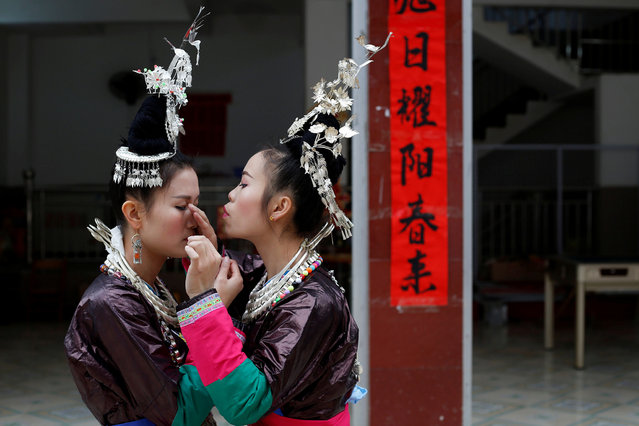
Ethnic “Kam” (also known as Dong) women get ready for a traditional wedding ritual known as the “steal the chicken at the drum tower” in a minority Dong village in southwestern Chinese city of Congjiang, Guizhou province, China January 29, 2017. The ceremony held in the ethnic Kam minority village of Gantuan in Guizhou province is based on a tradition dating back some 500 years that was revived and modified in the 1990s for villagers and tourists. (Photo by Tyrone Siu/Reuters)

Ethnic “Kam” (also known as Dong) women get ready for a traditional wedding ritual known as the “steal the chicken at the drum tower” in a minority Dong village in southwestern Chinese city of Congjiang, Guizhou province, China January 29, 2017. The ceremony held in the ethnic Kam minority village of Gantuan in Guizhou province is based on a tradition dating back some 500 years that was revived and modified in the 1990s for villagers and tourists. (Photo by Tyrone Siu/Reuters)
Details
03 Feb 2017 07:57:00
A visitor takes pictures with a smartphone of an artwork entitled “Blue Europe, 2015” by Chinese artist Liu Bolin, on display during the exhibition “Visible Invisible” at the Mudec Museum in Milan on May 14, 2019. Liu Bolin known as “the invisible man” for his photographic self-portraits, focused on a body-painting blending with the surrounding area. (Photo by Miguel Medina/AFP Photo)

A visitor takes pictures with a smartphone of an artwork entitled “Blue Europe, 2015” by Chinese artist Liu Bolin, on display during the exhibition “Visible Invisible” at the Mudec Museum in Milan on May 14, 2019. Liu Bolin known as “the invisible man” for his photographic self-portraits, focused on a body-painting blending with the surrounding area. (Photo by Miguel Medina/AFP Photo)
Details
16 May 2019 00:07:00
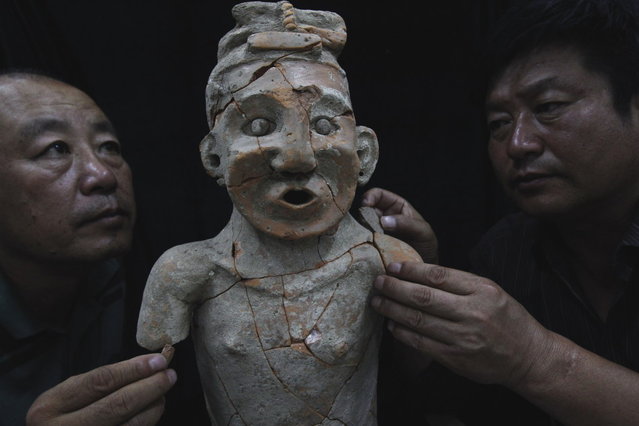
Archaeologists repair a pottery statue found in Aohan Banner, North China's Inner Mongolia autonomous region, July 3, 2012. (Photo by Xinhua)

On July 7, Chinese archaeologists from the Academy of Social Sciences announced that they have reconstituted a 5,300-year-old Mongolion pottery statue found at a relic site in North China, according to Xinhua news agency.
Details
08 Mar 2015 12:13:00
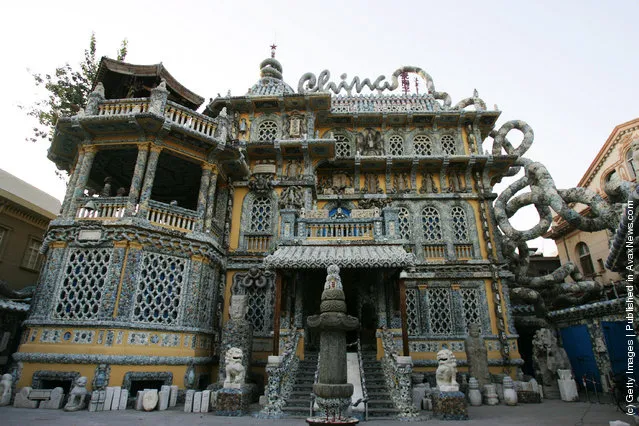
Porcelain House

Facade of the “Porcelain House”, built by Chinese collector Zhang Lianzhi, on November 1, 2008 in the Heping district of Tianjin, China. Over 400 million porcelain fragments, 5,000 ancient vases, 4,000 antique china dishes and bowls, over 20 tons of crystalline rocks and agate, 400 white marble stone carvings were incorporated in the five year refurbishment of the unique French styled house. (Photo by China Photos/Getty Images)
Details
08 Sep 2011 14:23:00
Watercolor Painting By Jack Tia Kee Woon

Jack Tia Kee Woon is an artist from Singapore. He is famous through his technique of watercolor painting in acrylic environment. His painting style is very light and radiant, where the watercolors add the transparence to the picture, while acrylic make the colors look very deep. One can see the influence of Chinese and Japanese culture on his art.
Details
26 May 2014 13:24:00
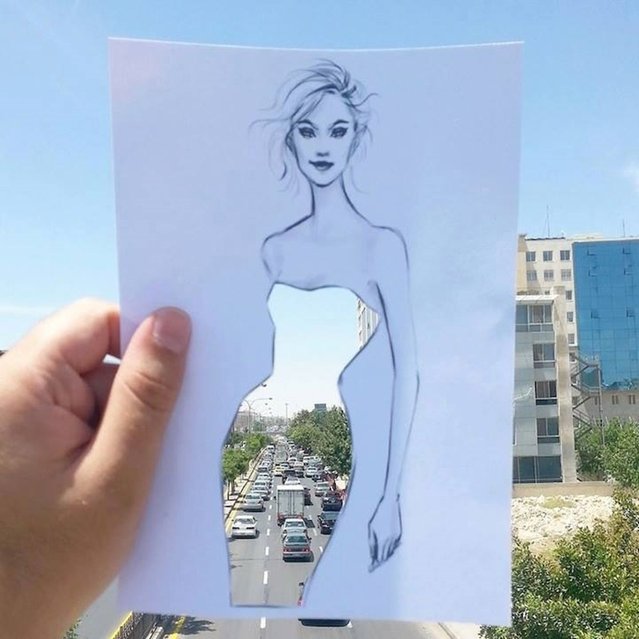
Fashion Illustrator Shamekh Bluwi

Shamekh Bluwi, an architect and fashion illustrator based in Amman, Jordan, creates beautiful paper cut-outs with women whose dresses become whatever you hold them up against. Besides being beautiful fashion drawings, they also seem like an excellent tool for coming up with inspiration for new fashion designs; simply hold up one of his drawings and see what sort of architectural lines, repeating patterns or images the women in his elegant cutouts would look good in.
Details
23 Jul 2015 10:30:00

Bulgarian Roma women from the close-knit Kalaidjii clan attend a so-called “bride fair” in a suburb of the city of Plovdiv April 13, 2015. (Photo by Stoyan Nenov/Reuters)

Bulgarian Roma women from the close-knit Kalaidjii clan attend a so-called “bride fair” in a suburb of the city of Plovdiv April 13, 2015. Each year Roma families from the close-knit Kalaidjii clan gather during what they call a “bride fair”, an event offering parents a chance to meet and to arrange marriages for their children. (Photo by Stoyan Nenov/Reuters)
Details
14 Apr 2015 10:59:00
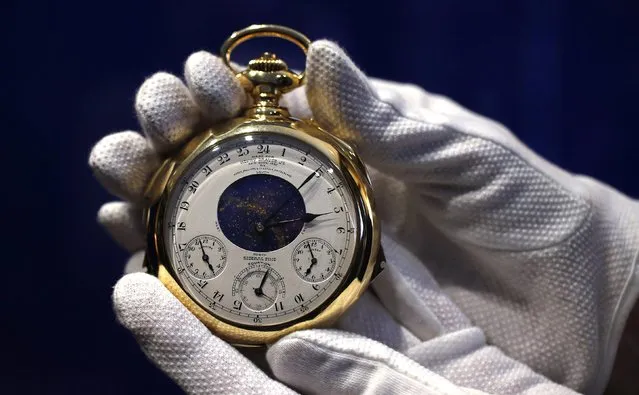
A staff member holds “The Henry Graves Supercomplication” handmade watch by Patek Philippe which was completed in 1932 at Sotheby's auction house in London October 21, 2014. (Photo by Suzanne Plunkett/Reuters)

What makes a watch the most valuable in the world? It’s supercomplicated – literally. In 1925 banker Henry Graves Jr. (considered the greatest watch collector of the 20th century) commissioned Patek Philippe to create a unique gold pocket watch. When Graves finally received it – eight years later – it was the most complex timepiece ever created by human hands... (Photo by Suzanne Plunkett/Reuters)
Details
21 Oct 2014 13:23:00