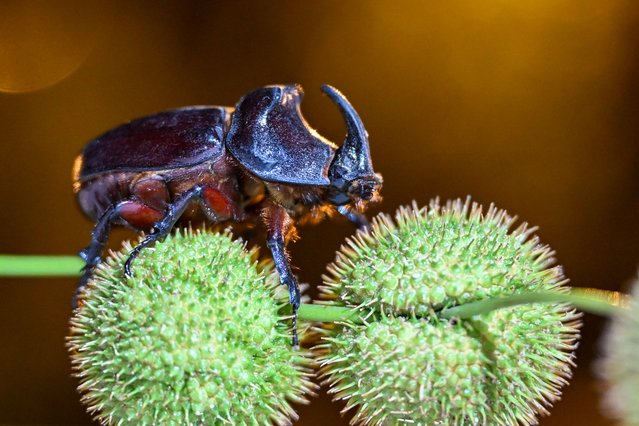
A “Rhino Beetle” (Oryctes nasicornis) is seen in Edremit, Van, Turkiye on August 2, 2024. Named “Rhino Beetle” due to the horn on its head, this beetle is commonly found in moist areas across Europe and Turkiye. (Photo by Ozkan Bilgin/Anadolu via Getty Images)
Nose to Nose; Human/Nature winner. “Doug Gimesy was documenting work at the Joey and Bat Sanctuary near Melbourne when he met a wombat (Vombatus ursinus) whose mother had been killed by a car. Gimesy watched as a young veterinary student bottle-fed the orphaned joey, then touched her nose to the joey’s in a tender moment of interspecies bonding”. (Photo by Doug Gimesy/BigPicture)
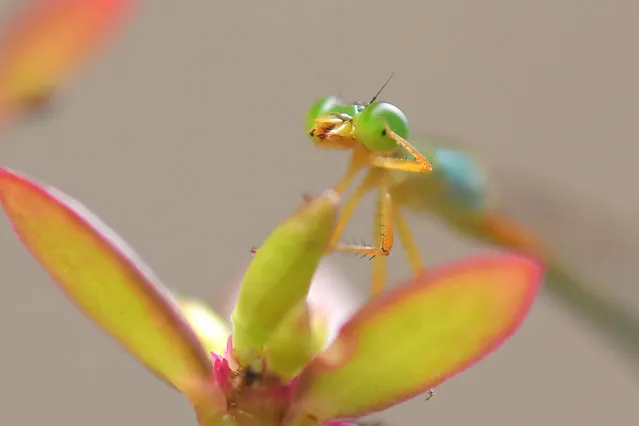
A damselfly sits on a leaf at a garden in Nagaon district in the northeastern state of Assam, India, on October 3 , 2023. (Photo by Anuwar Hazarika/NurPhoto/Rex Features/Shutterstock)
A dog with a cherry blossom-shaped pin, is seen in the cherry blossom festival in Seoul, South Korea, Sunday, April 9, 2017. (Photo by Lee Jin-man/AP Photo)
Japanese hairdresser Megumi Takeichi cuts patterns into the hair of a camel ahead of the Bikaner Camel Festival in Bikaner in the western Indian state of Rajasthan on January 10, 2019. (Photo by Dinesh Gupta/AFP Photo)
Merit: A Night at Deadvlei. The night before returning to Windhoek, we spent several hours at Deadveli. The moon was bright enough to illuminate the sand dunes in the distance, but the skies were still dark enough to clearly see the milky way and magellanic clouds. Deadveli means “dead marsh. The camelthorn trees are believed to be about 900 years old, but have not decomposed because the environment is so dry. (Photo and caption by Beth McCarley/National Geographic Traveler Photo Contest)