Loading...
Done
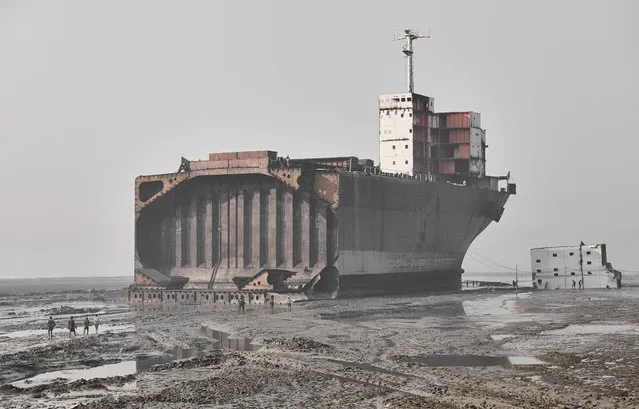
Anything not recycled in industry is sold on stalls along the neighbouring highway in Sitakunda Beach, Bangladesh, February 2012. (Photo by Jan Møller Hansen/Barcroft Images)

Anything not recycled in industry is sold on stalls along the neighbouring highway in Sitakunda Beach, Bangladesh, February 2012. A look inside Bangladesh’s ship breaking yards reveal the brutal conditions workers are subjected to everyday. (Photo by Jan Møller Hansen/Barcroft Images)
Details
27 Jan 2017 12:25:00
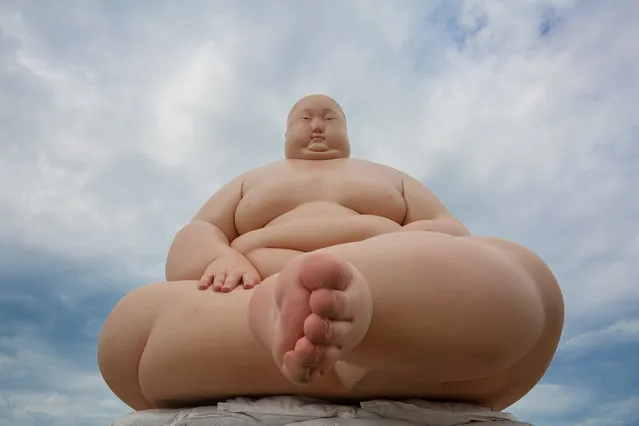
The Sculpture Bank (2017) by Chinese artist Mu Boyan is exhibited along the Bondi to Tamarama Coastal walk as part of the Sculpture by the Sea exhibition in Sydney, Australia, October 18, 2018. (Photo by Charlotte Curd/The Guardian)

The Sculpture Bank (2017) by Chinese artist Mu Boyan is exhibited along the Bondi to Tamarama Coastal walk as part of the Sculpture by the Sea exhibition in Sydney, Australia, October 18, 2018. (Photo by Charlotte Curd/The Guardian)
Details
23 Oct 2018 21:39:00
People watch as an acrobat rides his motorcycle around a circular track at an entertainment park set up outside a shrine in Rawalpindi, Pakistan, on June 19, 2013. (Photo by Muhammed Muheisen/Associated Press)

People watch as an acrobat rides his motorcycle around a circular track at an entertainment park set up outside a shrine in Rawalpindi, Pakistan, on June 19, 2013. (Photo by Muhammed Muheisen/Associated Press)
Details
22 Jun 2013 13:32:00
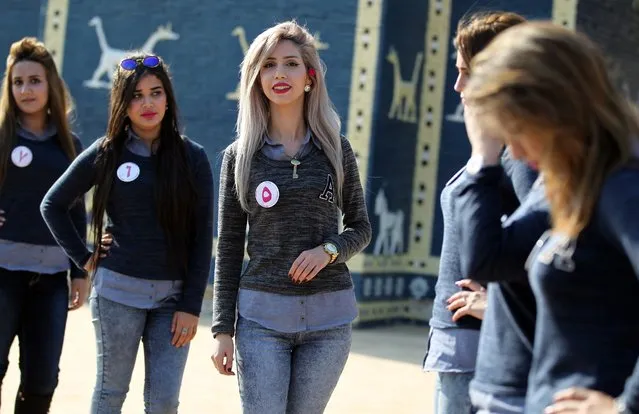
Some Iraqi candidates for Miss Iraq beauty contest pose in front of the Ishtar Gate at the ancient archaeological site of Babylon, outside the modern city of Hilla, south of the capital Baghdad on December 17, 2015. The beauty contest,  which is the first one in more than 40 years, aims to boost tourism in the city and will take place on December 19, 2015. (Photo by Ahmad Al-Rubaye/AFP Photo)

Some Iraqi candidates for Miss Iraq beauty contest pose in front of the Ishtar Gate at the ancient archaeological site of Babylon, outside the modern city of Hilla, south of the capital Baghdad on December 17, 2015. The beauty contest, which is the first one in more than 40 years, aims to boost tourism in the city and will take place on December 19, 2015. (Photo by Ahmad Al-Rubaye/AFP Photo)
Details
19 Dec 2015 10:25:00
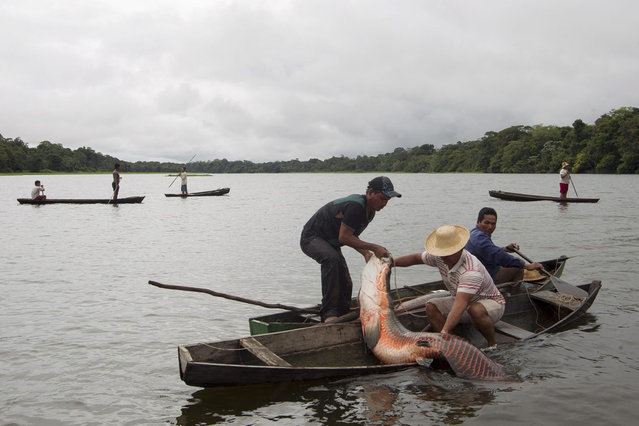
Villagers from the Porto Novo community load into their canoes arapaima or pirarucu, the largest freshwater fish species in South America and one of the largest in the world, while fishing in Poco Fundo lake along a branch of the Solimoes river, one of the main tributaries of the Amazon, in the Mamiraua nature reserve near Fonte Boa about 600 km (373 miles) west of Manaus, November 26, 2013. (Photo by Bruno Kelly/Reuters)

Villagers from the Porto Novo community load into their canoes arapaima or pirarucu, the largest freshwater fish species in South America and one of the largest in the world, while fishing in Poco Fundo lake along a branch of the Solimoes river, one of the main tributaries of the Amazon, in the Mamiraua nature reserve near Fonte Boa about 600 km (373 miles) west of Manaus, November 26, 2013. Catching the arapaima, a fish that is sought after for its meat and is considered by biologists to be a living fossil, is only allowed once a year by Brazil's environmental protection agency. The minimum size allowed for a fisherman to keep an arapaima is 1.5 meters (4.9 feet). (Photo by Bruno Kelly/Reuters)

Details
17 Dec 2013 08:03:00
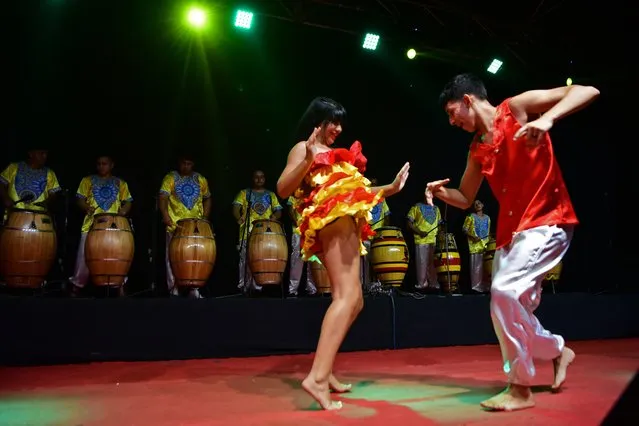
Dancers of the Saint Balthazar Kamba Kua traditional group perform in honour of Saint Balthazar, one of the Three Wise Men, during the Afro-Paraguay festival of Kamba Kua, in Fernando de la Mora, Paraguay, on January 6, 2024. The annual festival is a tradition that keeps Paraguay's Afro-descendants connected with their African roots through ancestral dance, drumming and customs. (Photo by Norberto Duarte/AFP Photo)

Dancers of the Saint Balthazar Kamba Kua traditional group perform in honour of Saint Balthazar, one of the Three Wise Men, during the Afro-Paraguay festival of Kamba Kua, in Fernando de la Mora, Paraguay, on January 6, 2024. The annual festival is a tradition that keeps Paraguay's Afro-descendants connected with their African roots through ancestral dance, drumming and customs. (Photo by Norberto Duarte/AFP Photo)
Details
28 Apr 2024 03:42:00
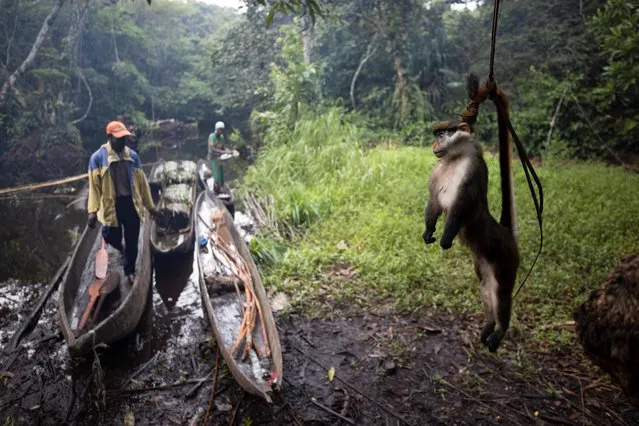
A dead red-tailed monkey hangs by its tail above the ground, in order to keep it away from ants, in the forest near the city of Mbandaka, Democratic Republic of the Congo, April 5, 2019. Bushmeat hunters are emptying Central Africa's forests at a high rate, researchers say. A growing appetite for wild meat in cities has ramped up the scale of hunting. Research shows around 6 million tonnes of bushmeat are sourced annually from the Congo Basin, whose forest spans across six countries and is second in size only to the Amazon. (Photo by Thomas Nicolon/Reuters)

A dead red-tailed monkey hangs by its tail above the ground, in order to keep it away from ants, in the forest near the city of Mbandaka, Democratic Republic of the Congo, April 5, 2019. Bushmeat hunters are emptying Central Africa's forests at a high rate, researchers say. A growing appetite for wild meat in cities has ramped up the scale of hunting. Research shows around 6 million tonnes of bushmeat are sourced annually from the Congo Basin, whose forest spans across six countries and is second in size only to the Amazon. (Photo by Thomas Nicolon/Reuters)
Details
14 Oct 2019 00:03:00
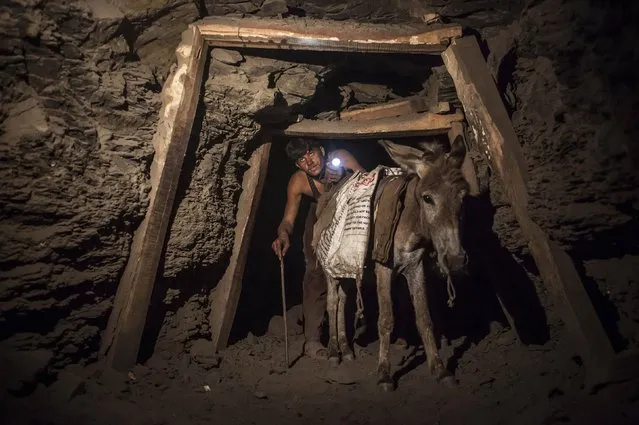
A miner with a donkey makes his way through the low and narrow tunnel leading out of a coal mine in Choa Saidan Shah in Punjab province, April 29, 2014. Workers at this mine in Choa Saidan Shah dig coal with pick axes, break it up and load it onto donkeys to be transported to the surface. (Photo by Sara Farid/Reuters)

A miner with a donkey makes his way through the low and narrow tunnel leading out of a coal mine in Choa Saidan Shah in Punjab province, April 29, 2014. Workers at this mine in Choa Saidan Shah dig coal with pick axes, break it up and load it onto donkeys to be transported to the surface. Employed by private contractors, a team of four workers can dig about a ton of coal a day, for which they earn around $10 to be split between them. The coalmine is in the heart of Punjab, Pakistan's most populous and richest province, but the labourers mostly come from the poorer neighbouring region of Khyber Pakhtunkhwa. (Photo by Sara Farid/Reuters)
Details
03 Aug 2014 07:35:00