Loading...
Done
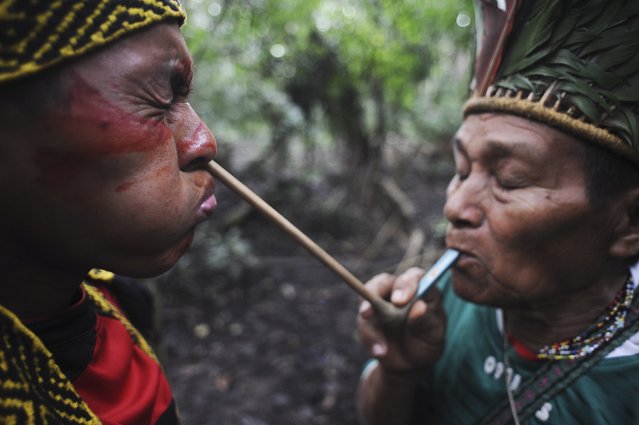
A spiritual leader (R) of the Huni Kui Indian tribe blows an herbal powder into the nose of a tribal member during a ceremony outside the village of Novo Segredo along the Envira river of Brazil's northwestern Acre state, March 9, 2014. (Photo by Lunae Parracho/Reuters)

A spiritual leader (R) of the Huni Kui Indian tribe blows an herbal powder into the nose of a tribal member during a ceremony outside the village of Novo Segredo along the Envira river of Brazil's northwestern Acre state, March 9, 2014. Many indigenous groups, including the Huni Kui, Ashaninka, and Madija, live in villages in the Brazilian rainforest near the border with Peru. (Photo by Lunae Parracho/Reuters)
Details
04 Apr 2014 08:18:00
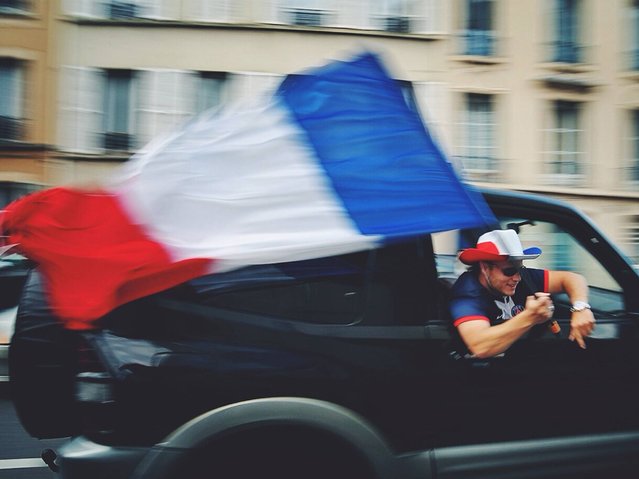
France: French fans cheering for their team. (Photo by Anthony Lepinay)

Sports have the ability to transform groups of strangers into a united community. In the celebratory spirit surrounding the 2014 FIFA World Cup, Sony and the World Photography Organisation present UNITED – a contest honouring the passion of football fans around the world. Seven inspirational photographers have been selected by Sony and WPO to capture the atmosphere and celebration of the World Cup across the globe. Photo: France – French fans cheering for their team. (Photo by Anthony Lepinay)
Details
09 Jul 2014 12:22:00
King Penguins marching during sunrise, Falkland Islands. (Photo by Wim van den Heever/Caters News)

Penguins majestically march on sand before heading out for a morning swim. Wildlife photographer Wim van den Heever, 45, visited the Falkland Islands this year to shoot pictures and scout the area for future tours. Wim’s breathtaking images show a small group of king penguins before they head out to sea at sunrise. Here: King Penguins marching during sunrise, Falkland Islands. (Photo by Wim van den Heever/Caters News)
Details
13 Oct 2017 06:32:00
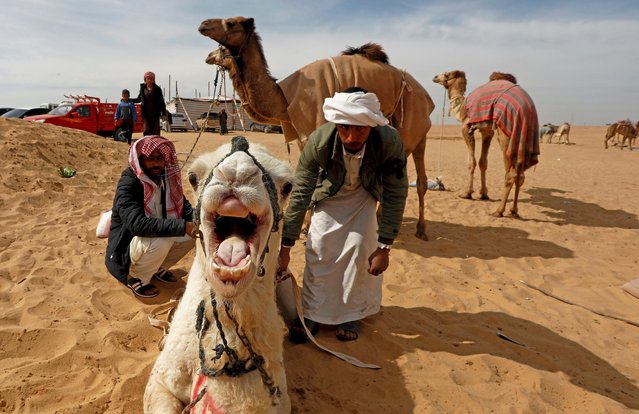
Bedouin breeders fix a robot jockey mounted on a camel before the 18th International Camel Racing festival at the Sarabium desert in Ismailia, Egypt, March 12, 2019. (Photo by Amr Abdallah Dalsh/Reuters)

Bedouin breeders fix a robot jockey mounted on a camel before the 18th International Camel Racing festival at the Sarabium desert in Ismailia, Egypt, March 12, 2019. Several Gulf countries have banned child jockeys from the traditional Bedouin sport after rights groups said the youngsters were often injured and some had been abducted or sold by their families. (Photo by Amr Abdallah Dalsh/Reuters)
Details
21 Mar 2019 00:01:00
It is said that Torajans are people who “live to die”. For this Indonesian ethnic group, funerals are such extravagant events that they sometimes attract tourists. Families can postpone burials years (and the deceased are considered sick and hosted at home until the funeral) until the family can raise enough money and gather as many relatives as possible. And then it’s a jubilant multiday social event with a parade, dances and animal sacrifices. Agung Parameswara photographed these funerary practices when he traveled to South Sulawesi province, where the Torajans live. But often, their funeral isn’t the last time the dead are seen. In August, crypts are opened, coffins are slid back out and bodies delicately unsheathed. This tender ritual is known as Ma’Nene, which is customarily performed every few years. (Photo by Agung Parameswara/The Washington Post)

It is said that Torajans are people who “live to die”. For this Indonesian ethnic group, funerals are such extravagant events that they sometimes attract tourists. Families can postpone burials years (and the deceased are considered sick and hosted at home until the funeral) until the family can raise enough money and gather as many relatives as possible. And then it’s a jubilant multiday social event with a parade, dances and animal sacrifices. Agung Parameswara photographed these funerary practices when he traveled to South Sulawesi province, where the Torajans live. (Photo by Agung Parameswara/The Washington Post)
Details
06 Oct 2016 09:15:00
In this March 31, 2019 photo, an Egyptian student borrows a Bedouin wedding dress to pose for a photograph with Bedouin men from the Hamada tribe, in Wadi Sahw, Abu Zenima, in South Sinai, Egypt. Four Bedouin women are for the first time leading tours in Egypt’s Sinai Peninsula, breaking new ground in their deeply conservative community, where women almost never work outside the home or interact with outsiders.  The tourists can only be women, and the tours can’t go overnight. Each day before the sun sets, the group returns to the Hamada’s home village in Wadi Sahu, a narrow desert valley. (Photo by Nariman El-Mofty/AP Photo)

In this March 31, 2019 photo, an Egyptian student borrows a Bedouin wedding dress to pose for a photograph with Bedouin men from the Hamada tribe, in Wadi Sahw, Abu Zenima, in South Sinai, Egypt. Four Bedouin women are for the first time leading tours in Egypt’s Sinai Peninsula, breaking new ground in their deeply conservative community, where women almost never work outside the home or interact with outsiders. The tourists can only be women, and the tours can’t go overnight. Each day before the sun sets, the group returns to the Hamada’s home village in Wadi Sahu, a narrow desert valley. (Photo by Nariman El-Mofty/AP Photo)
Details
11 Apr 2019 00:01:00
A relative of murdered prisoner, lies on a chair next to his coffin  during a wake after a prison riot in the city of Altamira, Para state, Brazil on July 30, 2019. (Photo by Bruno Kelly/Reuters)

A relative of murdered prisoner, lies on a chair next to his coffin during a wake after a prison riot in the city of Altamira, Para state, Brazil on July 30, 2019. At least 57 prisoners were killed by other inmates during clashes between organized crime groups in the Altamira prison in northern Brazil Monday with 16 of the victims being decapitated, according to prison officials. (Photo by Bruno Kelly/Reuters)
Details
02 Aug 2019 00:05:00
Peruvian surfer Carlos “Huevito” Areola rides a reed board, or “caballito” (little horse), into a wave at Sydney's Bondi Beach, February 24, 2016. (Photo by Jason Reed/Reuters)

Peruvian surfer Carlos “Huevito” Areola rides a reed board, or “caballito” (little horse), into a wave at Sydney's Bondi Beach, February 24, 2016. Areola is part of a group of Peruvian surfers touring Australia’s east coast to promote the use of the “caballito”. The “caballito” is thought to have been invented around 3,000 BC in northern Peru. (Photo by Jason Reed/Reuters)
Details
25 Feb 2016 11:46:00