Loading...
Done
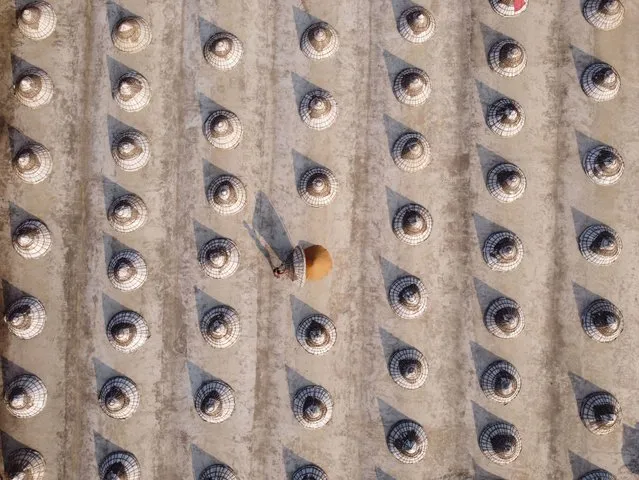
A worker covers mounds of rice with a giant hat-shaped bamboo cone in a field in Brahmanbaria, Bangladesh on September 21, 2023 after they have been dried in the scoring sun. (Photo by Joy Saha/Rex Features/Shutterstock)

A worker covers mounds of rice with a giant hat-shaped bamboo cone in a field in Brahmanbaria, Bangladesh on September 21, 2023 after they have been dried in the scoring sun. (Photo by Joy Saha/Rex Features/Shutterstock)
Details
11 Oct 2023 04:17:00
A couple poses for a joint photograph in a photo booth (photomaton) at a metro station in Paris on July 24, 2024. (Photo by Dimitar Dilkoff/AFP Photo)

A couple poses for a joint photograph in a photo booth (photomaton) at a metro station in Paris on July 24, 2024. (Photo by Dimitar Dilkoff/AFP Photo)
Details
04 Aug 2024 05:03:00
UK Eurovision girlband Remember Monday feature pals Lauren Byrne, Holly-Anne Hull and Charlotte Steele, 2025. (Photo by Rob Parfitt)

UK Eurovision girlband Remember Monday feature pals Lauren Byrne, Holly-Anne Hull and Charlotte Steele, 2025. (Photo by Rob Parfitt)
Details
16 Mar 2025 04:21:00
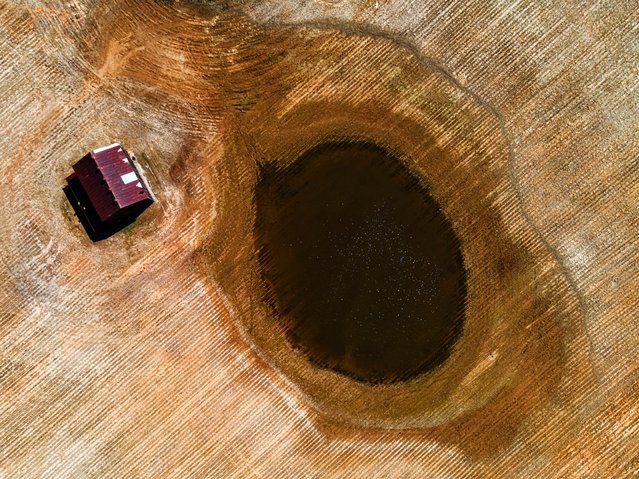
In an aerial view, a flooded section of farmland is seen next to a home in Cadiz, Kentucky, U.S. April 18, 2025. (Photo by Jon Cherry/Reuters)

In an aerial view, a flooded section of farmland is seen next to a home in Cadiz, Kentucky, U.S. April 18, 2025. (Photo by Jon Cherry/Reuters)
Details
07 May 2025 03:41:00
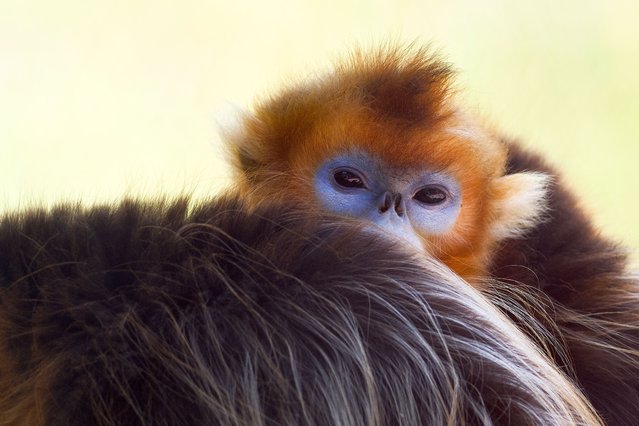
A golden snub-nosed monkeys (Rhinopitheque de Roxelane) looks through its enclosure after quarantine during its presentation at the Beauval Zoopark in Saint-Aignan Central France, on May 7, 2025. ZooParc de Beauval (Loir-et-Cher) welcomed three golden snub-nosed monkeys on April 3, 2025, an endangered species from China, as part of a conservation program, becoming the first zoo outside Asia to house these long-haired, red-furred primates with bluish faces. (Photo by Guillaume Souvant/AFP Photo)

A golden snub-nosed monkeys (Rhinopitheque de Roxelane) looks through its enclosure after quarantine during its presentation at the Beauval Zoopark in Saint-Aignan Central France, on May 7, 2025. ZooParc de Beauval (Loir-et-Cher) welcomed three golden snub-nosed monkeys on April 3, 2025, an endangered species from China, as part of a conservation program, becoming the first zoo outside Asia to house these long-haired, red-furred primates with bluish faces. (Photo by Guillaume Souvant/AFP Photo)
Details
18 May 2025 02:44:00
Children play on an uprooted tree along a beach in Mele, Vanuatu that was once lined with vegetation, now largely lost to storms, erosion and other environmental pressures on Saturday, July 19, 2025. (Photo by Annika Hammerschlag/AP Photo)

Children play on an uprooted tree along a beach in Mele, Vanuatu that was once lined with vegetation, now largely lost to storms, erosion and other environmental pressures on Saturday, July 19, 2025. (Photo by Annika Hammerschlag/AP Photo)
Details
22 Aug 2025 04:02:00
A woman poses for a souvenir photo with a cat statue on display at the Shenzhen Bay commercial district, in Shenzhen, China's Guangdong province, Monday, September 15, 2025. (Photo by Andy Wong/AP Photo)

A woman poses for a souvenir photo with a cat statue on display at the Shenzhen Bay commercial district, in Shenzhen, China's Guangdong province, Monday, September 15, 2025. (Photo by Andy Wong/AP Photo)
Details
03 Oct 2025 02:35:00
On August 31, 2012, a long filament of solar material that had been hovering in the sun's atmosphere, the corona, erupted out into space at 4:36 p.m. EDT. The coronal mass ejection, or CME, traveled at over 900 miles per second. The CME did not travel directly toward Earth, but did connect with Earth's magnetic environment, or magnetosphere, causing aurora to appear on the night of Monday, September 3. (Photo by NASA/GSFC/SDO)

On August 31, 2012, a long filament of solar material that had been hovering in the sun's atmosphere, the corona, erupted out into space at 4:36 p.m. EDT. The coronal mass ejection, or CME, traveled at over 900 miles per second. The CME did not travel directly toward Earth, but did connect with Earth's magnetic environment, or magnetosphere, causing aurora to appear on the night of Monday, September 3. (Photo by NASA/GSFC/SDO via The Atlantic)
Details
14 Sep 2012 09:01:00