Loading...
Done
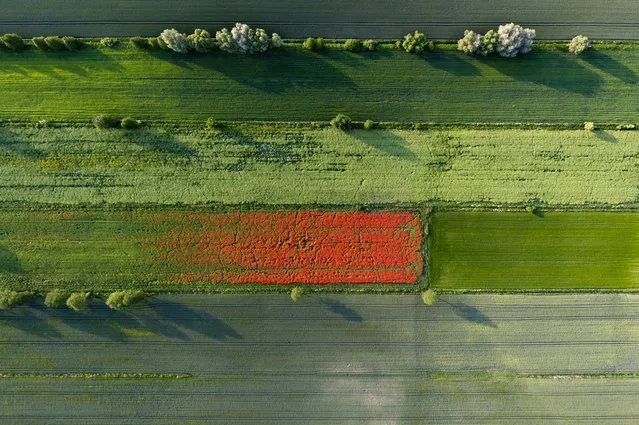
A view over fields of grain in Spring white chamomile, blue cornflower and other weeds growing amongst the grain sprouts. (Photo by Kacper Kowalski/Panos Pictures)

In his book “Side Effects”, aerial photographer Kacper Kowalski took to the skies to paint a portrait of the complex relationship between humans and nature. From the sky, he captured where nature and civilization collide into aesthetic, abstract colors and shapes. Photo: A view over fields of grain in Spring chamomile, cornflower and other weeds growing amongst the grain sprouts. (Photo by Kacper Kowalski/Panos Pictures)
Details
04 Sep 2014 08:19:00
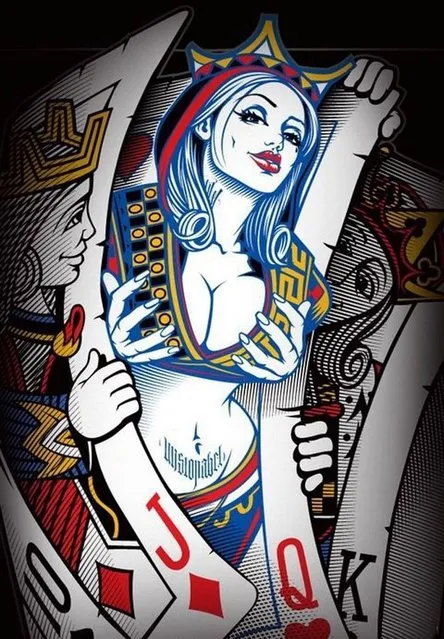
Cards Poker By Og Abel

The great vector artist OG Abel was a diamond in the rough. Growing up in violent surroundings, OG Abel found shelter in art. With an unsupportive father who always told him artist die broke, his only creative activity was strongly connected to religion. Having a church-going mother, OG Abel says he would spend hour drawing images from the Bible, his favorite pictures being those of animals, especially lions. He would also study the elaborate paintings in churches, the architecture, and/or the sculptures.
Details
15 Sep 2014 11:22:00
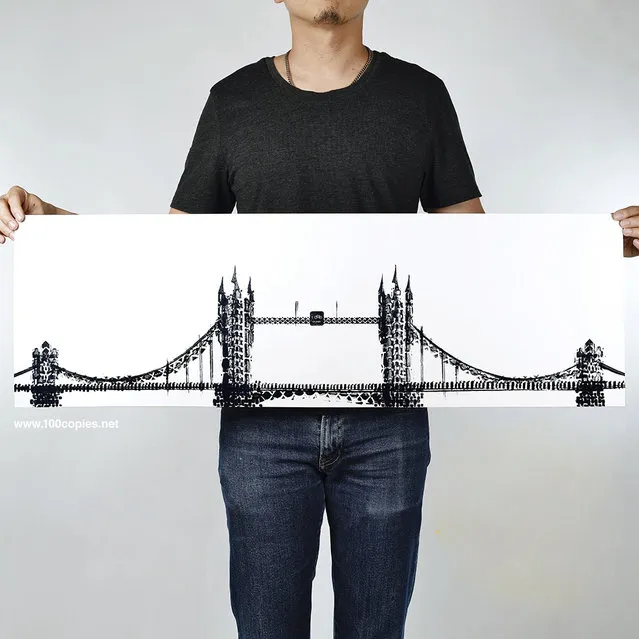
The Unforbidden Cyclist By Thomas Yang

Image patterning has existed for hundreds of years; however, before Thomas Yang no one has ever thought of putting paint on the bicycle wheels and using it as a patterning tool to create very interesting-looking pictures. Being an avid cyclist and an artist, Thomas Yang has decided to combine the two, creating the 100copies. The name of this project not only alludes to the fact that only one hundred copies of those pictures were going to be made, but also to the fact that the pictures themselves consist of hundreds of repeating shapes. And even though the project is called 100copies, no two pictures are alike due to the nature of their creation, making them truly unique. (Photo by Thomas Yang)
Details
11 Nov 2014 12:00:00
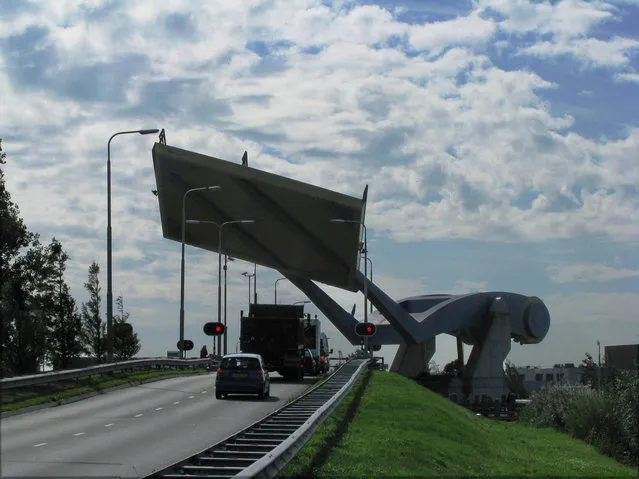
Slauerhoff Bridge, Netherlands

The Slauerhoffbrug (English: Slauerhoff Bridge) is a fully automatic bascule bridge (aka tail bridge) in the city of Leeuwarden in the Netherlands. It uses two arms to swing a section of road in and out of place within the road itself. It is also known as the “Slauerhoffbrug ‘Flying’ Drawbridge”. A tail bridge can quickly and efficiently be raised and lowered from one pylon (instead of hinges). This quickly allows water traffic to pass while only briefly stalling road traffic. The deck is 15 m by 15 m. It is painted in yellow and blue, representative of Leeuwarden's flag and seal.
Details
06 Nov 2013 10:34:00
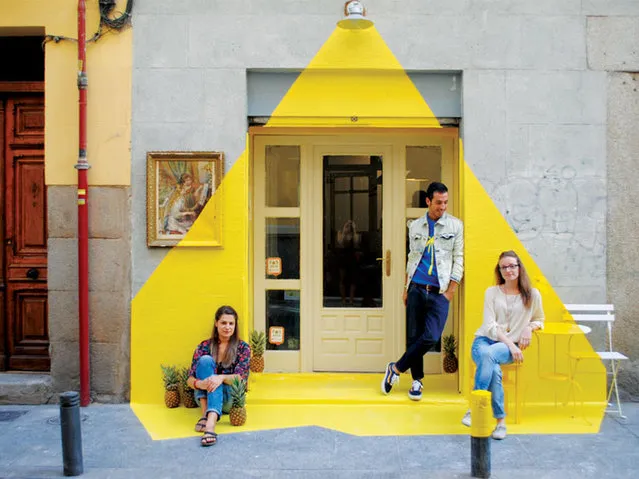
Ephemeral Lighting Installation By (Fos)

(fos) is the name of the first ephemeral installation by the multidisciplinary team (fos). It means light in Greek and melted in Catalan. In this project has been represented by a skin that covers both vertical and horizontal surfaces. The protected façade of the vegan restaurant Rayen at Lope de Vega street in Madrid has been illuminated for 4 days and nights by more than 250lm of yellow duct tape, painted décor items, pineapples and... a lamp. A visual game between perspective and colored volumes that gained the looks.
Details
10 Apr 2014 12:16:00


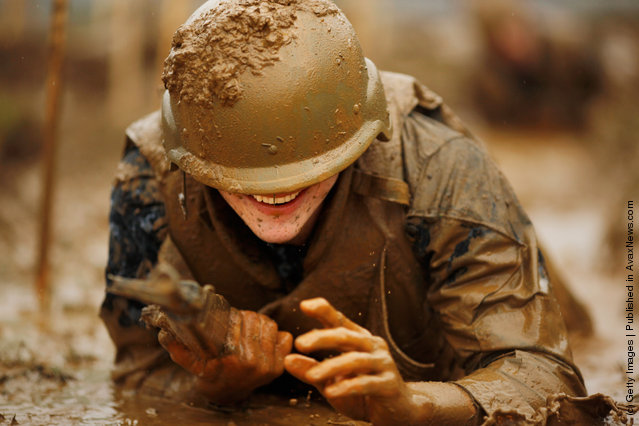
A member of the United States Naval Academy freshman class wears body armor, helmet and carries a rifle through a mud-filled ditch as part of the “Wet and Sandy” challenge during the rigorous Sea Trials May 17, 2011 in Annapolis, MD. Under strict safety supervision, about 900 freshmen, or “Plebes”, faced 14 hours of 32 rigorous physical and mental challenges during the trials, a daylong, action-oriented event modeled after the Marine Corps 54-hour Crucible and the Navy's Battle Stations. (Photo by Chip Somodevilla/Getty Images)
Details
18 May 2011 07:51:00


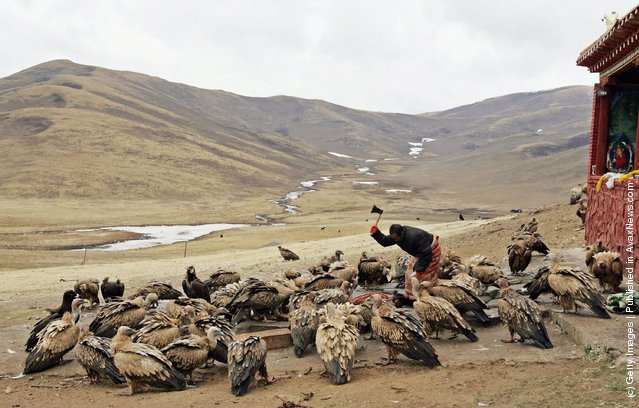
“Sky burial or ritual dissection was once a common funerary practice in Tibet wherein a human corpse is cut in specific locations and placed on a mountaintop, exposing it to the elements or the mahabhuta and animals – especially to birds of prey. The location of the sky burial preparation and place of execution are understood in the Vajrayana traditions as charnel grounds. In Tibet the practice is known as jhator, which literally means, «giving alms to the birds»”. – Wikipedia

Photo: A burial master chops bones of a body to feed vultures during a celestial burial ceremony on April 19, 2006 in Dari County of Guoluo Prefecture, Qinghai Province, northwest China. Celestial burial is a traditional funeral of Tibetan people, which began in the 7th century. (Photo by China Photos/Getty Images)
Details
18 Jun 2011 12:12:00
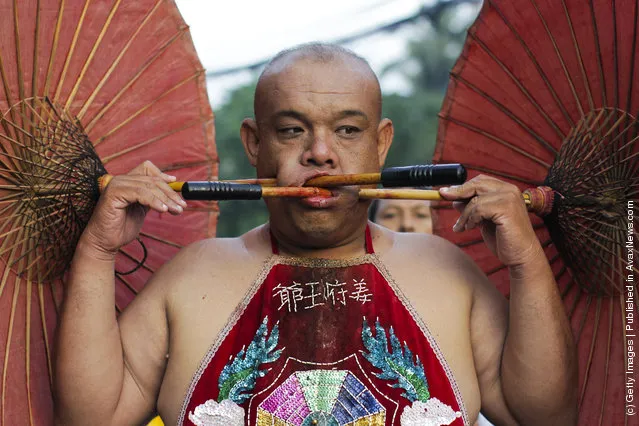
Devotees Practice Self Mutilation At Phuket Vegetarian Festival

A devotee of the Chinese shrine of Kathu Shrine, pierces his cheeks with umbrellas during a procession of Vegetarian Festival on October 4, 2011 in Phuket, Thailand. Ritual Vegetarianism in Phuket Island traces it roots back to the early 1800's. The festival begins on the first evening of the ninth lunar month and lasts for nine days. Participants in the festival perform acts of body piercing as a means of shifting evil spirits from individuals onto themselves and bring the community good luck. (Photo by Athit Perawongmetha/Getty Images)
Details
04 Oct 2011 10:49:00