Loading...
Done


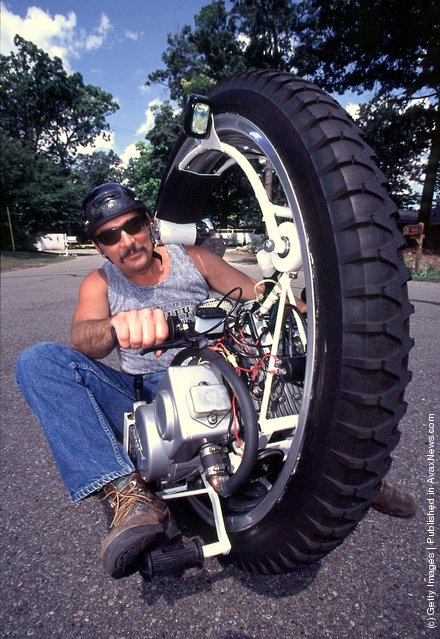
“A monowheel is a one-wheeled single-track vehicle similar to a unicycle. However, instead of sitting above the wheel, the rider sits either within it or next to it. The wheel is a ring, usually driven by smaller wheels pressing against its inner rim. Most are single-passenger vehicles, though multi-passenger models have been built.

Pedal-powered monowheels were built in the late 19th century; most built in the 20th century have been motorized. Some modern builders refer to these vehicles as monocycles, though that term is also sometimes used to describe motorized unicycles. Today, monowheels are generally built and used for fun and entertainment purposes, though from the 1860s through to the 1930s, they were proposed for use as serious transportation”. – Wikipedia

Photo: Cycle inventor Kerry McLean poses for the photographer 2000 in Walled Lake, Michigan. The “Monocycle” is equipped with a 40-horsepower engine, 4ft tire and is expected to reach speeds upwards of 100 mph. (Photo by Bill Pugliano/Liaison)
Details
02 Jul 2011 12:24:00


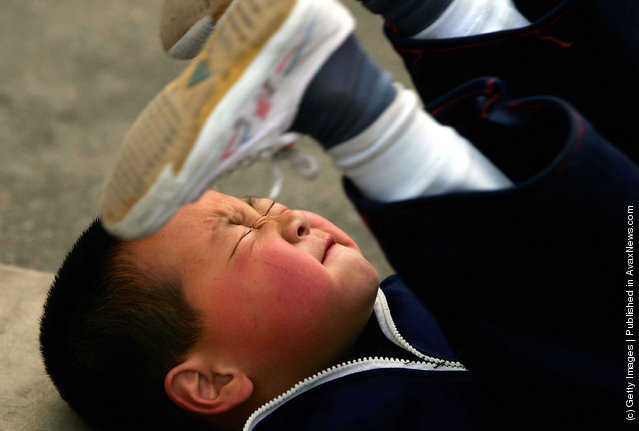
Wang Zeyu, 4, a fee-paying enthusiast of kung fu, practises during a training class at a kung fu school near the Shaolin Temple April 10, 2005 in Dengfeng, Henan Province, China. Zeyu's father sent him to the school from his home in Jiangsu Province, thousands kilometres away from Dengfeng, when he was just 3 years old. And his father must pay 9,800 yuan (US$1195) for one year's tuition at the school, a huge amount for most Chinese. There are more than 80 kung fu schools that line the road from the city of Dengfeng to the Shaolin Temple with hundreds and thousands of young kung-fu lovers from all over the country and beyond studying here. All the schools use the Shaolin name to attract students as the Shaolin Temple is the birthplace of Chinese Kung Fu. (Photo by Cancan Chu/Getty Images)
Details
06 Jul 2011 11:21:00
Priest, Valamo Monastery, Karelia, Russia (then Finland), 1930s. Father Venerius with a birchbark basket. (Photo by Einar Erici)

“Einar Erici (1885–1965) was a physician by profession, working at a tuberculosis hospital in Stockholm, even running a private medical practice. He was by then the most renowned Swedish expert of church organs and organ builders, and his archival collection is today held by the Swedish National Heritage Board. This archive includes mostly writings, such as letters and manuscripts for published articles and essays, but also more than 2 000 black and white photos – original prints, glass plates and film negatives”. – Swedish National Heritage Board

Photo: Priest, Valamo Monastery, Karelia, Russia (then Finland), 1930s. Father Venerius with a birchbark basket. (Photo by Einar Erici)
Details
09 Dec 2012 11:41:00
She wowed judges and competitors at the NPC Junior USA Bodybuilding Championships. (Photo by Incredible Features/Barcroft Media)

Meet Barbie Thomas the incredible armless female body builder who is inspiring America. The 37-year-old lost both her arms during a horrific electrical accident as a toddler – but that hasn't stopped her from pursuing her bodybuilding dream.Barbie says she can do anything an average person can do – except she uses her feet. That includes brushing her teeth, making dinner, taking milk out of the fridge, texting, shopping, putting on makeup and even driving. Photo: Barbie Thomas cooks up meals with her feet. (Photo by Incredible Features/Barcroft Media)
Details
27 May 2014 10:55:00
Tridacna Gigas, or Giant Clams

“The giant clam, Tridacna gigas (known as pā’ua in Cook Islands Māori), is the largest living bivalve mollusc. T. gigas is one of the most endangered clam species. It was mentioned as early as 1825 in scientific reports. One of a number of large clam species native to the shallow coral reefs of the South Pacific and Indian oceans, they can weigh more than 200 kilograms (440 lb) measure as much as 120 cm (47 in) across, and have an average lifespan in the wild of 100 years or more”. – Wikipedia

Photo: Tridacna Gigas, or Giant Clams spew water as a traditional fisherman passes by a small sanctuary on January 23, 2004 near Bolinao in the Northern Philippines. The clams, prime builders for coral reefs and providing shelter for spawning fish and other marine life, are exposed by low tides in the sanctuary. Overfishing and pollution throughout the country are not only threatening food security, but are also starting to choke one of the few working clam sanctuaries in the world. (Photo by David Greedy/Getty Images)
Details
01 Oct 2011 13:10:00
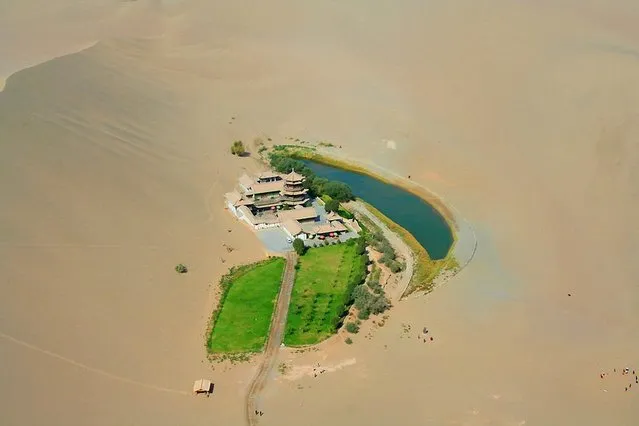
Crescent Lake In China

Yueyaquan is a crescent-shaped lake in an oasis, 6 km south of the city of Dunhuang in Gansu Province, China. It was named Yueyaquan in the Qing Dynasty. According to measurements made in 1960, the average depth of the lake was 4 to 5 meters, with a maximum depth of 7.5 metres In the following 40 years, the depth of the lake continually declined. In the early 1990s, its area had shrunk to only 5,500 m2 with an average depth of 0.9 meter (maximum 1.3 meter). In 2006, the local government with help of the central government started to fill the lake and restore its depth; its depth and size have been growing yearly since then. The lake and the surrounding deserts are very popular with tourists, who are offered camel and 4x4 rides.
Details
25 Jun 2013 10:29:00
A glass building mirrors the sky in Singapore as the sun goes down over the city. (Photo by Fong Qi Wei/Thoughtful Photography)

Intrigued by photographing time, Singapore-based photographer Fong Qi Wei created single, composite pictures from a sequence of images spanning 2-4 hours. He concentrated on capturing sunrises and sunsets as they evolved over different landscapes, seascapes, and cityscapes. He then digitally stitched the images together to get a snapshot of time passing over the scene for his series “Time is a Dimension”. “Most paintings and photographs are an instance of time”, Wei explained in his artist’s statement. “That’s not the way the world works. We experience a sequence of time, and that’s why a video is somehow more compelling than a freeze frame”. (Photo by Fong Qi Wei/Thoughtful Photography)
Details
19 Aug 2014 10:28:00
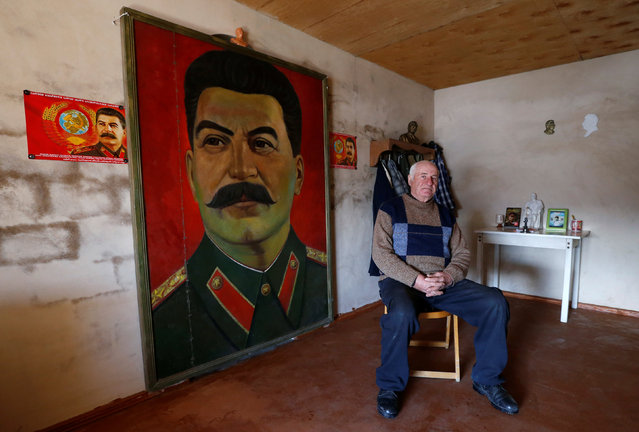
Retired builder Vasili Sidamonidze, 70, poses for a portrait at his home in Gori, Georgia, December 6, 2016. “Unfortunately, Stalin is not popular nowadays. Our people don't respect him. Only we, members of the (Communist) Party, respect him”, Sidamonidze said. “I always try to attend Stalin's birthday anniversaries in Gori. Unfortunately many people don't want to join us even if they live nearby. They look at us from their windows”. Stalin, who was born in Gori in 1878 and died in 1953, is largely reviled today in Georgia, which regained its independence during the 1991 collapse of the Soviet Union. Over the years, his memorials have been dismantled, most recently in 2010 when authorities removed a statue of the dictator from Gori's central square. But Stalin is still revered by a small group of mainly elderly supporters who stress his role in the industrialisation of the Soviet Union and in defeating Nazi Germany in World War Two. Each Dec. 21, a few dozen people mark his birthday by gathering outside a Gori museum dedicated to Stalin, where they make speeches and walk to the square where a 6-meter-high bronze statue of him once stood, calling for it to be reinstated. Opponents say it was a symbol of Moscow's still lingering shadow. In 2008, Russia fought a brief war with Georgia and recognised its breakaway regions of Abkhazia and South Ossetia as independent states. (Photo by David Mdzinarishvili/Reuters)

Retired builder Vasili Sidamonidze, 70, poses for a portrait at his home in Gori, Georgia, December 6, 2016. “Unfortunately, Stalin is not popular nowadays. Our people don't respect him. Only we, members of the (Communist) Party, respect him”, Sidamonidze said. “I always try to attend Stalin's birthday anniversaries in Gori. Unfortunately many people don't want to join us even if they live nearby. They look at us from their windows”. (Photo by David Mdzinarishvili/Reuters)
Details
17 Dec 2016 07:59:00